PR tracker for lifting: how to log and beat your records
A PR tracker records when you set a personal record in strength training: more weight, more reps at the same weight, or a higher estimated one-rep max. A notebook or an app both work, as long as every set is logged with weight and reps and compared with your previous best.
Updated:
What counts as a PR in the gym?
PR stands for personal record, your best performance in a given lift. There is more than one kind: a new heaviest weight is a PR, but so is one more rep at a weight you have lifted before.
If you only count your heaviest weight, you can go weeks without a record while still getting stronger. That is why it helps to track several record types separately.
- Weight PR: the heaviest weight you have lifted with good form in that exercise, regardless of reps.
- Rep PR: the most reps at a specific weight, for example 9 instead of 8 reps at 175 lb.
- Estimated 1RM: your calculated one-rep max from weight and reps (formulas below).
- Time PR for holds such as planks: your longest hold.
- Warm-up sets never count; mark them in your log so they don’t skew the comparison.
How to calculate your 1RM from reps
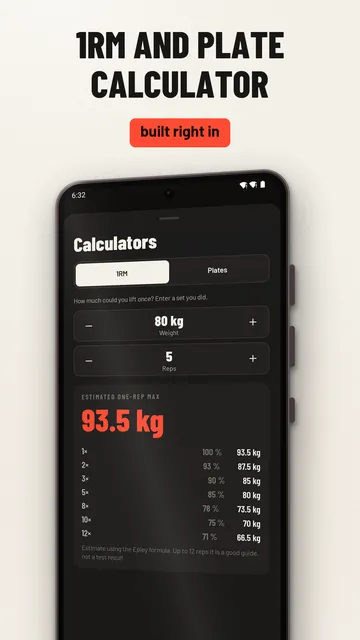
Your 1RM (one-rep max) is the weight you could lift exactly once with good form. Testing it for real is demanding and not necessary for most lifters. You can estimate it from a hard set of a few reps instead.
Two common formulas are Epley (1RM = weight × (1 + reps / 30)) and Brzycki (1RM = weight × 36 / (37 − reps)). Example: 175 lb for 9 reps gives 175 × 1.3 = 227.5 lb with Epley and 175 × 36 / 28 = 225 lb with Brzycki. The more reps in the set, the less accurate any formula gets; sets of up to about 10 reps work best.
It also works the other way round: if you want 8 reps, you will land at roughly 75 to 80 percent of your 1RM. The table shows typical guide values, which vary from person to person.
| Reps | Share of 1RM | Weight at 1RM 200 lb |
|---|---|---|
| 1 | 100% | 200 lb |
| 3 | 91% | 182 lb |
| 5 | 86% | 171 lb |
| 8 | 79% | 158 lb |
| 10 | 75% | 150 lb |
| 12 | 71% | 143 lb |
How often should you progressive overload?
Progressive overload means the training stimulus has to rise slowly over time, otherwise your body stops adapting. The American College of Sports Medicine position stand on resistance training suggests raising the load by about 2 to 10 percent once you can reliably exceed your target reps.
A simple, proven method is double progression: you work within a rep range such as 8 to 12. First add reps until every set reaches 12, then add the smallest plate step and start again at 8.
- Week 1: bench press 3 × 8 at 155 lb.
- Week 2: 3 × 9, week 3: 3 × 10 and so on until 3 × 12.
- Then go to 160 lb (2 × 2.5 lb plates) and build up from 3 × 8 again.
- If you miss the progression two sessions in a row, hold the weight and check sleep, rest times and form instead of forcing more load.
How to keep a workout log that shows your records
A record is only as reliable as the log behind it. Write down every working set right after you finish it, not after the workout, with exercise, weight and reps. A variation (dumbbell instead of barbell, incline instead of flat) gets its own line, otherwise you compare apples with oranges.
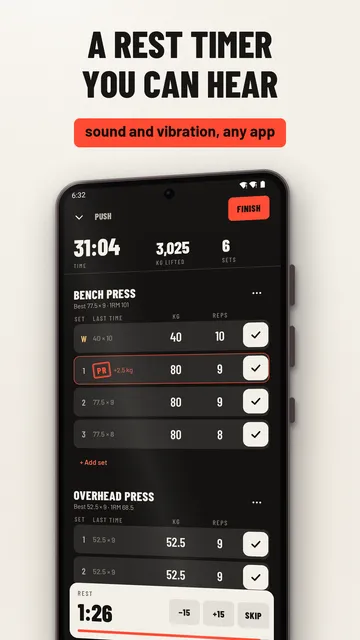
Rest between sets changes results a lot. If you rest 90 seconds one day and 4 minutes the next on heavy compound lifts, you are measuring your rest more than your strength. A fixed rest timer keeps sets comparable.
- Before each set, look at last time’s numbers and set a small target (one more rep or one plate step).
- Form before records: a set with a shortened range of motion is not a PR.
- Work out the plates per side before loading (45 lb bar + 2 × 45 lb + 2 × 10 lb = 155 lb).
- Once a week, count your sets per muscle group so no area keeps falling behind.

How Hefto works as a PR tracker
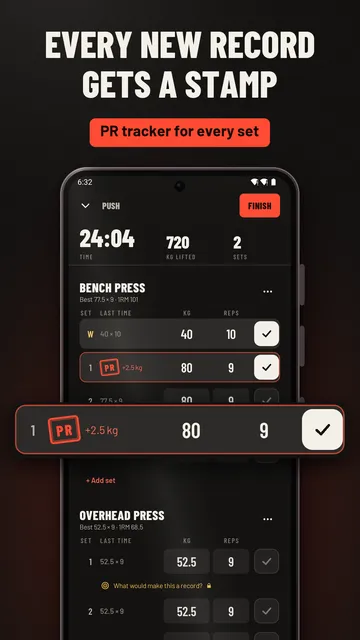
Hefto is a workout log for Android that compares every checked set with your whole history and marks new records the moment they happen. Your data stays on your phone, and no account is needed.
- Last time’s weights are already filled in; one tap on the check mark logs the set.
- A red PR stamp whenever a set beats a record (heaviest weight, best estimated one-rep max, most reps, longest hold), with the jump over your old best such as “+5 lb”.
- Warm-up sets are marked with a W and never count as records.
- A rest timer with sound and vibration, even while a music app is open; plus or minus 15 seconds, or skip.
- Push Pull Legs, Upper Lower and full body templates, your own plans and around 90 exercises, with room for your own.
- A 1RM calculator with weights for 2 to 12 reps and a plate calculator per side, in kg or lb.
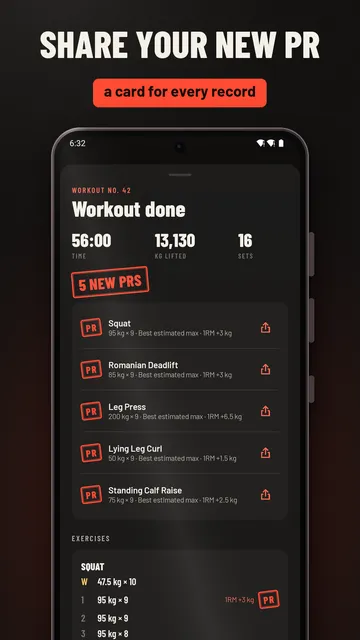
- A story-sized record card to share, and a backup file to move to a new phone.
What the app cannot do
Hefto is a training log, not a coach: it does not build a personal program, check your form or give medical advice. The 1RM is an estimate from formulas, not a test, and the app is available for Android only.
Price
Workouts, plans, PR stamps, your history, the rest timer and both calculators are free; Hefto Pro, with set targets, progress charts, the record book, weekly sets per muscle group and CSV export, costs $2.79 a month or $21.99 a year in the US. The free version shows ads; Pro is ad-free. We build this app ourselves; on Google Play it is listed under the developer name InfinityAkhi.
Screenshots
Related calculators on ToolboxDay
Frequently asked questions
What does PR mean in the gym?
PR means personal record, your best performance in an exercise, for example your heaviest weight or the most reps at a given weight.
How often should you hit a new PR?
Beginners often improve almost every week, experienced lifters much less often. Counting several record types (weight, reps, estimated 1RM) keeps progress visible. If a lift stalls for weeks, look at rest, sleep and training volume.
Do I need to test my real 1RM?
No. For planning, an estimated 1RM from a hard set of up to about 10 reps is enough. A true max attempt belongs in training only with good form and safety (spotter, safety bars).
Does Hefto work in pounds?
Yes. Hefto works in kilograms or pounds, and the plus and minus buttons jump one plate step of 5 lb or 2.5 kg.
Sources
More guides
- Winter arc challenge: set your rules and keep them until December 31
- Neck exercises for a stiff neck: a gentle 3-minute routine
- Daily protein tracker: how to count protein the easy way
- Recurring payments: find them, add them up, cancel what you don’t use
- Lean angle motorcycle guide: how it is measured and what the number means
- Constellation finder: how to find constellations in the night sky
- Our apps