Constellation finder: how to find constellations in the night sky
A constellation finder app shows which stars and constellations are in the direction your phone is pointing, using your location, the time and the phone’s motion sensors. It only works if the phone’s compass is right, and if you also learn a few signpost stars like the Big Dipper and Polaris, you can find your way around the sky without a screen.
Updated:
How do you find constellations in the night sky?
The easiest way is to start from a few bright landmark patterns and hop from there. There are 88 officially defined constellations that cover the whole sky; from mid-northern latitudes you can see many of them over a year, but only a handful stand out at first glance.
A constellation is a defined region of the sky; a recognisable star pattern inside it is called an asterism. The Big Dipper is exactly that: not a constellation itself, but the brightest part of Ursa Major, the Great Bear.
- Big Dipper (the Plough in the UK): seven bright stars shaped like a ladle, visible all year from most of the US and Europe and high in the north in spring.
- Polaris: extend the line through the two stars at the end of the bowl about five times. You reach a moderately bright, lonely star that marks north quite precisely.
- Cassiopeia: on the opposite side of Polaris, about as far away as the Dipper, look for a clear “W” or “M”.
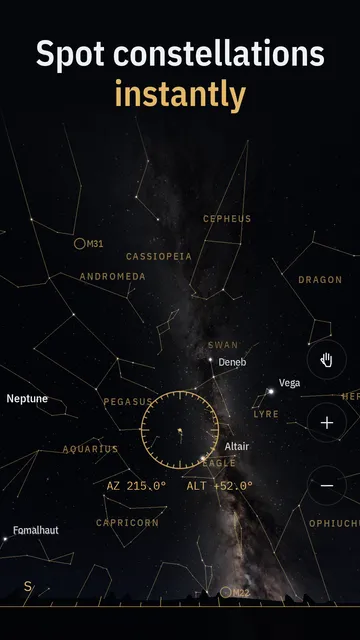
- Summer Triangle: in summer and autumn, Vega (Lyra), Deneb (Cygnus) and Altair (Aquila) form a large triangle high in the sky, with the Milky Way running through it.
- Orion: in winter, the three belt stars in a row are the key. Follow them down to the left to Sirius, the brightest star of the night sky, and up to the right to orange Aldebaran in Taurus.
Which constellations can you see each season?
As the Earth orbits the Sun, a slightly different part of the sky is overhead at the same clock time each night. Constellations near Polaris never set from mid-northern latitudes (they are circumpolar); the rest have their season.
The table gives rough guidance for about 10 pm local time at mid-northern latitudes. Two hours later the sky looks roughly as it will a month later at 10 pm.
| Season | Easy to see | How to recognise it |
|---|---|---|
| all year (north) | Ursa Major, Cassiopeia, Ursa Minor | Dipper, “W”, Polaris |
| spring | Leo, Boötes | Regulus, orange Arcturus |
| summer | Lyra, Cygnus, Aquila | Summer Triangle, Milky Way |
| autumn | Pegasus, Andromeda | Great Square of four stars |
| winter | Orion, Taurus, Gemini, Canis Major | belt stars, Sirius |
Why does my star map app point the wrong way?
Usually the phone’s magnetometer is to blame, not the star calculations. Metal nearby, magnets in phone cases or a car next to you can throw the compass off by ten degrees or more, so the Moon and stars on screen sit beside their real position.
Then there is magnetic declination: a compass points to magnetic north, while star maps work with true north. Depending on where you are, the difference ranges from almost nothing to well over ten degrees.
- Take the phone out of a magnetic case and step a few metres away from cars, railings or steel beams.
- Calibrate the compass, usually by moving the phone in a figure eight.
- Use a known object as a test: if the Moon on screen is not where the Moon is in the sky, the orientation is off, not the sky.
- Allow location access or set your place correctly; an error of a few hundred kilometres visibly shifts the sky.
How long does it take for your eyes to adjust to the dark?
Allow roughly 20 to 30 minutes before faint stars appear. A single look at a bright screen or flashlight undoes part of that adaptation.
That is why observers use dim red light: it disturbs dark adaptation less than white light. On a phone, a red light mode plus the lowest brightness setting helps.
- Measure distances in the sky by hand: a fist at arm’s length covers about 10 degrees, a finger about 1 degree, a spread hand about 20 degrees.
- In a city you may only see stars down to magnitude 3 or 4; at a dark site without the Moon you see far fainter ones, which can make familiar patterns look crowded at first.
- Nights around new moon work especially well for constellations; under a full moon, faint stars disappear.
How can you tell a planet from a star?
Planets always appear close to the ecliptic, the path the Sun and Moon take across the sky, and they usually twinkle less than stars. A very bright “star” in the evening or morning sky that is not on any star chart is often Venus or Jupiter.
Over weeks, planets move against the constellations, so their rise and set times keep changing; an up-to-date list for your location saves searching.

How Asterism helps you find constellations
Asterism is a live star map for Android: hold your phone up to the sky and the map turns with it. The app calculates the positions of the Sun, Moon and planets itself; according to the developer they were checked against NASA JPL Horizons.
- About 8,400 stars from the Yale Bright Star Catalogue, all 88 constellations with lines and names, the Sun and planets out to Neptune, and the Milky Way from NASA data.
- The Moon with its real phase and surface, based on a NASA map.
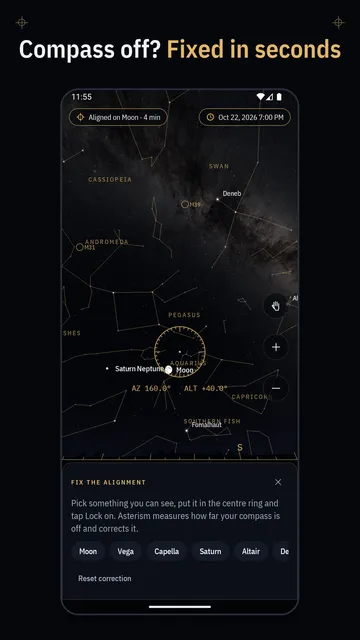
- “Fix”: put the Moon, a planet or a bright star in the crosshair and the app corrects the compass error; magnetic declination is included automatically.
- Search with an arrow that leads you to the chosen star, planet or constellation.
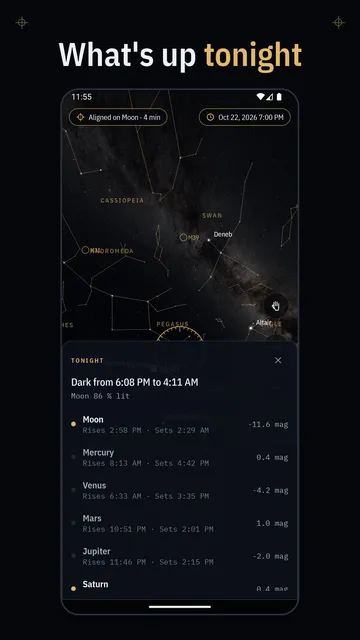
- “Tonight”: how dark it gets, the moon phase, and which planets are up with rise and set times.
- Red light mode, adjustable limiting magnitude for city skies, and finger dragging for phones without a compass.
- With Pro: time travel to any date, a camera view with stars over your camera image, and 110 Messier objects with a finder.
What the app cannot do
Asterism can only be as accurate as your phone’s sensors; without “Fix”, a disturbed compass can rotate the map. It does not identify stars from a photo, the camera view needs Pro, and the app is available for Android only.
Price
Free with ads; Pro is a monthly or yearly subscription (currently $2.79 a month or $16.99 a year in the US), cancel any time in Google Play. We build this app ourselves; on Google Play it is listed under the developer name InfinityAkhi.
Get it on Google Play: Asterism
Screenshots
Related calculators on ToolboxDay
Frequently asked questions
How many constellations are there?
The International Astronomical Union divides the sky into 88 constellations with fixed boundaries. Patterns like the Big Dipper or the Summer Triangle are asterisms, not constellations of their own.
Does a constellation finder need the camera?
No, most apps draw the sky themselves and only use the motion sensors and compass. In Asterism, the camera is only used for the optional camera view in Pro.
Why is the Moon in the app somewhere else than in the sky?
Almost always the phone’s compass is off, for example because of metal or magnets nearby. Calibrate the compass, or use “Fix” in Asterism with the Moon as reference.
How do I find the North Star?
Extend the line through the two end stars of the Big Dipper’s bowl about five times their distance. Polaris sits there, almost exactly above due north on the horizon.
Sources
More guides
- Live moon wallpaper: moon phases, moonrise and battery explained
- KP index explained: what Kp you need to see the northern lights
- True north compass: how to point at the real north, not just magnetic north
- Recurring payments: find them, add them up, cancel what you don’t use
- Lean angle motorcycle guide: how it is measured and what the number means
- Oil change reminder: how to time it and never miss it
- Our apps