Daily protein tracker: how to count protein the easy way
A protein tracker adds up the protein you eat during the day and compares it with your daily goal. The common reference for healthy adults is 0.8 g of protein per kg of body weight (about 0.36 g per lb); people who train hard often plan more. All you need to count is the portion size and the protein per 100 g from the label or a food database.
Updated:
How much protein per day do you need?
For healthy adults, the widely used reference intake is 0.8 g of protein per kilogram of body weight per day; the German Nutrition Society (DGE) recommends 1.0 g/kg from age 65. Recreational exercise of about 30 minutes four to five times a week does not raise this need, according to the DGE.
For hard strength or endurance training, the International Society of Sports Nutrition (ISSN) position stand gives 1.4 to 2.0 g per kilogram. That is a range for people who train, not a target for everyone. With kidney disease, during pregnancy and breastfeeding or on a special diet, your protein intake belongs with your doctor or a registered dietitian.
| Situation | g per kg | Grams per day |
|---|---|---|
| Adults (reference intake) | 0.8 | 56 g |
| Age 65+ (DGE) | 1.0 | 70 g |
| Strength/endurance training, lower end (ISSN) | 1.4 | 98 g |
| Strength/endurance training, upper end (ISSN) | 2.0 | 140 g |
How to calculate protein per kg of body weight
The maths is simple: body weight in kilograms times the factor equals grams of protein per day. In pounds, divide by 2.2 first, or multiply your weight in pounds by 0.36 for the 0.8 g/kg reference. At 180 lb that is about 65 g; at 1.6 g/kg it is roughly 131 g. For people with a lot of excess weight, professionals often use an adjusted body weight instead, so ask for advice there.
Many people who lift spread their protein over three or four meals instead of eating most of it at dinner. The ISSN describes roughly 20 to 40 g of high-quality protein per meal as a typical range.
- Weigh yourself in the morning.
- Choose a factor: 0.8 g/kg for everyday health, more only if you really train.
- Weight × factor = daily goal in grams, rounded to 5 g.
- Divide by your number of meals to get a target per meal.
What are high protein foods?
Counting is fastest when you know the protein in your usual portions, not just per 100 g. The figures below are rounded averages from USDA FoodData Central; your product can differ, and the nutrition label comes first.
For packaged food: protein per 100 g × grams eaten ÷ 100. A Greek yogurt with 10 g of protein per 100 g gives 17 g in a 170 g cup.
| Food | Portion | Protein |
|---|---|---|
| Chicken breast, cooked | 150 g (5.3 oz) | about 47 g |
| Egg, large | 1 | about 6 g |
| Greek yogurt, plain nonfat | 170 g (6 oz) | about 17 g |
| Lentils, cooked | 200 g (1 cup) | about 18 g |
| Tofu, firm | 150 g | about 18–25 g (varies by brand) |
| Oats, dry | 50 g (½ cup) | about 7 g |
Protein tracker app or a simple list?
What matters is that logging is quicker than forgetting. A tally of your ten most common portions works surprisingly well; an app pays off once you eat a lot of packaged food or want to see weeks of history.
- Log right after eating, not from memory at night.
- Save repeat meals (breakfast, a shake) once as a fixed portion.
- Close a gap in the evening with a protein-rich snack instead of pushing the goal to tomorrow.
- If you want to lose weight, keep an eye on calories too: more protein does not automatically mean less energy.

How Protally works as a daily protein tracker
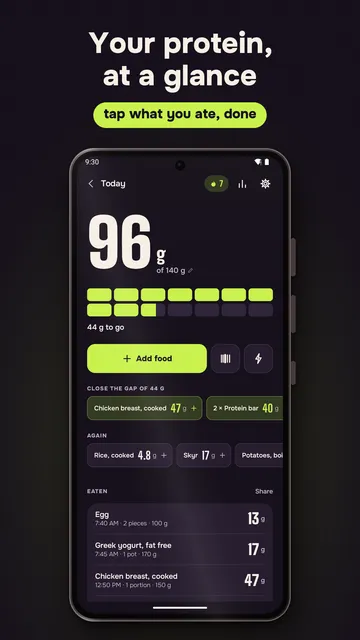
Protally is a protein tracker for Android built around one number: your protein today against your goal. Entries stay on your phone and no account is needed. Protally is a food diary, not a medical product, and it does not replace advice from a doctor or dietitian.
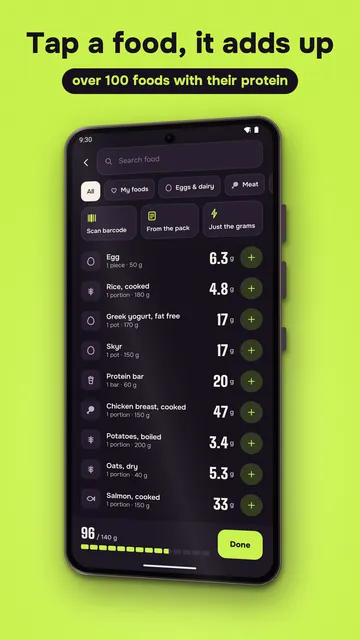
- More than 100 everyday foods with a normal portion and their protein, ready to tap; values from USDA FoodData Central.
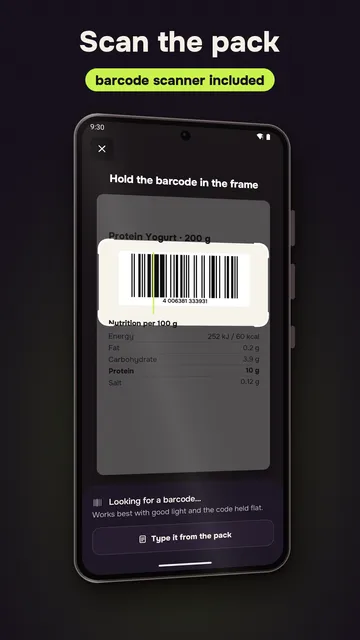
- Barcode scanner: looks up the protein per 100 g on Open Food Facts and works out your portion. Only the barcode number is sent, and the lookup can be switched off.
- Type a value from the pack once; next time it is one tap.
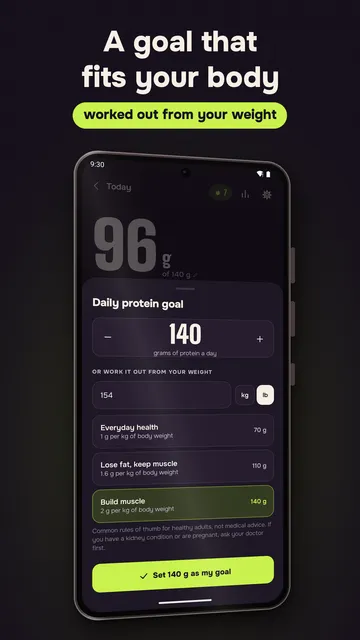
- A daily goal from your body weight in kg or lb, with three levels: everyday health, losing fat while keeping muscle, building muscle.
- Suggestions to close the gap, one evening check only if you are still short, a streak and the last 7 days as bars.
- A share card for your day and a backup file.
What the app cannot do
Protally only counts what you log; food values are averages, and Open Food Facts data can be missing or differ from your product. Calories, trends and saved meals need Pro, and the app is available for Android only.
Price
Logging, the food list, the barcode scanner, your goal and the evening check are free; Protally Pro, with trends, protein across the day, saved meals, calories, a widget and export, costs $3.79 a month or $23.99 a year in the US. The free version shows ads; Pro is ad-free. We build this app ourselves; on Google Play it is listed under the developer name InfinityAkhi.
Get it on Google Play: Protally
Screenshots
Related calculators on ToolboxDay
Frequently asked questions
How much protein do I need to build muscle?
The ISSN gives 1.4 to 2.0 g per kg of body weight per day (about 0.64 to 0.9 g per lb) for people who train, spread over several meals. Without regular strength training, extra protein alone does not build muscle.
How much protein per day to lose weight?
When losing weight, an intake toward the upper range can help you keep muscle, and protein is filling. Weight loss still depends on your energy balance; if you have a medical condition, agree on the amount with your doctor.
Can you eat too much protein?
In studies with healthy people who train, intakes up to about 2 g per kg showed no harm. If you have kidney disease, set your protein intake with your doctor.
Does Protally need an internet connection?
Logging from the food list and from the pack works without internet. Only the barcode lookup asks Open Food Facts online.
Sources
More guides
- PR tracker for lifting: how to log and beat your records
- Supplement tracker: how to take supplements consistently
- Recurring payments: find them, add them up, cancel what you don’t use
- Lean angle motorcycle guide: how it is measured and what the number means
- Constellation finder: how to find constellations in the night sky
- Oil change reminder: how to time it and never miss it
- Our apps