Neck exercises for a stiff neck: a gentle 3-minute routine
Gentle neck exercises such as chin tucks, slow head turns, ear-to-shoulder stretches and shoulder blade squeezes, done for a few minutes several times a day, can help a stiff neck. The NHS suggests neck flexibility exercises and keeping your neck moving rather than resting it. Stay within a pain-free range and get warning signs checked by a doctor.
Updated:
What are the best neck exercises for a stiff neck?
A handful of simple moves without equipment covers the basics. They move the neck in every direction, stretch the muscles at the side of the neck and bring the shoulders back from a forward slump. Move slowly, keep breathing and only go as far as feels comfortable.
The times below are a guide, not a prescription. Stop if you feel pins and needles in your arms, dizziness or sharp pain.
- Chin tuck: sit tall, look straight ahead and slide your chin straight back, as if making a double chin. Hold 3 to 5 seconds, release, 5 to 10 times.
- Head turn: slowly turn your head to one side as far as is comfortable, pause, return to the middle, then turn to the other side. 3 to 5 times each side.
- Ear to shoulder: tilt your head to the side without lifting your shoulder, let the other shoulder sink, hold 15 to 20 seconds, then switch sides.
- Shoulder rolls: roll both shoulders slowly in large circles, up, back and down. 8 to 10 times.
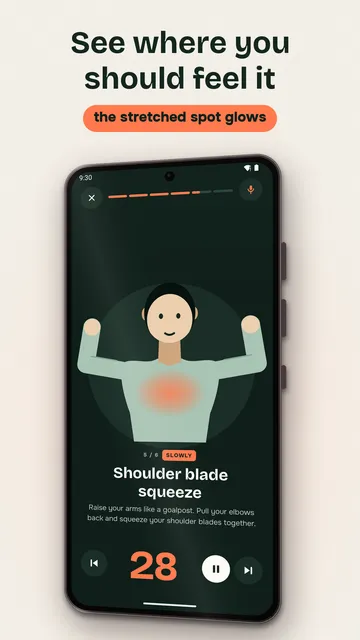
- Shoulder blade squeeze: raise your arms like a goalpost with elbows at shoulder height, then draw your elbows back and gently squeeze your shoulder blades together. Hold 3 to 5 seconds, 5 to 8 times.
Neck exercises at your desk: a 3-minute seated routine
At a desk, change is what helps most. The NHS advises not keeping your neck in the same position for a long time, for example when sitting at a desk, and sitting upright with your shoulders gently rolled back. A short routine works seated, without getting up.
| Time | Exercise | Note |
|---|---|---|
| 0:00–0:30 | Chin tuck | 5 times, 3 seconds each |
| 0:30–1:10 | Head turn | 3 times each side, slowly |
| 1:10–2:00 | Ear to shoulder | 20 seconds each side |
| 2:00–2:30 | Shoulder rolls | 8 times backwards |
| 2:30–3:00 | Shoulder blade squeeze | 5 times, 3 seconds each |
How often should you do neck exercises?
There is no fixed number. For stiffness from long sitting, short and regular sessions are usually easier to keep up than one long one: for example once in the morning, and on desk days a short break with two or three moves every hour or two. Sticking with it and moving in between matters more than the exact amount.
If you also want to strengthen your neck, add gentle holds, such as tucking your chin while pressing your head lightly into your own hand without letting it move. A physiotherapist can put together a program that fits you.
- Put your screen at eye level so your head doesn’t keep tipping forward.
- Lift your phone to read instead of dropping your head.
- Don’t clamp a phone between your ear and shoulder.
- A break reminder or a Pomodoro timer helps you remember to move.
Stiff neck: what to do, and when to see a doctor?
According to the NHS, most neck pain only lasts a few weeks. It suggests a low, firm pillow, heat or cold packs and neck flexibility exercises, and advises against wearing a neck collar unless a doctor tells you to, because it is better to keep your neck moving.
See a GP if pain or stiffness doesn’t go away after a few weeks, painkillers haven’t worked, you are worried, or you have other symptoms such as pins and needles or a cold arm. Get urgent help for the warning signs below. These exercises do not replace a doctor’s visit.
- Pain after an accident or a fall
- You can’t bend your head forward to your chest
- Headache with nausea, vomiting, dizziness or sensitivity to light
- Fever, chills or unexplained weight loss
- Numbness, weakness, tingling or a cold feeling in your arms or hands
- Pain that isn’t improving after a few weeks
How to check your neck mobility at home
The easiest way to notice progress is mobility. A simple self-check: sit upright and slowly turn your head left and right. Note where your gaze ends on each side, for example a spot on the wall. Then do the same for tilting and nodding.
Repeat the check after one or two weeks at the same time of day, as many people are stiffer in the morning than in the afternoon. A difference between left and right is common and not a concern on its own; a sudden, marked loss of movement is. The check is a rough guide, not a medical measurement.
How Nodwell guides your neck exercises
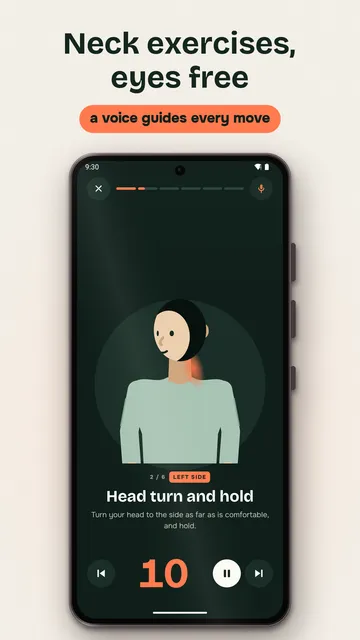
Nodwell is an Android app for short neck exercises you can do without looking at your phone: a voice tells you each move, a tone marks every switch and your phone vibrates when it is time to change sides. No account is needed, and three routines are free.
- Free routines: Quick reset (3 minutes), Desk break and Morning loosen-up.
- 20 exercises with short explanations and a figure on which the stretched spot glows; the figure moves like your mirror image, with short, normal or long holds.
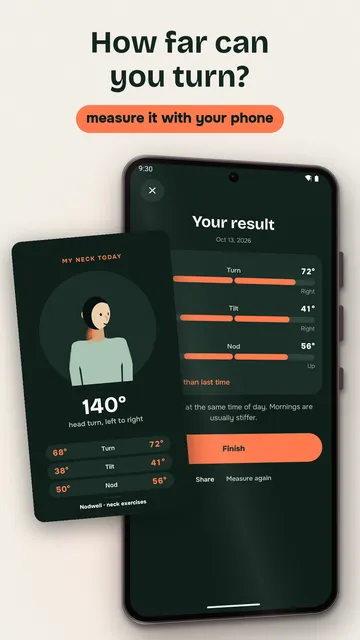
- Mobility check: hold your phone to your forehead and the motion sensors show in degrees how far you turn, tilt and nod, left and right separately.
- An optional daily reminder that stays quiet if you have just done a routine.
- Pro: five more routines, your own routines from all 20 exercises, a mobility trend over weeks and break reminders while you work.
What the app cannot do
Nodwell is a guide for general wellbeing, not a medical device; it does not replace medical advice, diagnosis or physiotherapy and does not adapt the exercises to a condition. The mobility check is a rough guide, and the app is available for Android only.
Price
Three routines and the mobility check are free; Pro costs $4.69 a month or $27.99 a year in the US (as of 7 Nov 2026, prices vary by country). We build this app ourselves; on Google Play it is listed under the developer name InfinityAkhi.
Get it on Google Play: Nodwell
Screenshots
Related calculators on ToolboxDay
Frequently asked questions
Should neck exercises hurt?
A gentle pull during a stretch is normal, pain is not. Only go as far as feels comfortable, and stop if you feel dizzy, tingling or a sharp pain.
Can neck exercises help with headaches?
Headaches should be checked by a doctor first, especially if they are new, severe or come with nausea, dizziness or sensitivity to light. Only then is it clear whether exercises make sense.
Can I do neck exercises sitting down?
Yes, all five exercises above work seated at a desk. Sit upright with your feet flat on the floor.
How does Nodwell measure neck mobility?
You hold the phone to your forehead and move your head; the phone’s motion sensors calculate the angle. The values stay on your phone and are a rough guide to your own progress.
Sources
More guides
- 4-7-8 Breathing: How the Technique Works and What It Can Do
- Winter arc challenge: set your rules and keep them until December 31
- Recurring payments: find them, add them up, cancel what you don’t use
- Lean angle motorcycle guide: how it is measured and what the number means
- Constellation finder: how to find constellations in the night sky
- Oil change reminder: how to time it and never miss it
- Our apps