Winter arc challenge: set your rules and keep them until December 31
The winter arc challenge is a social media trend: you use the last months of the year, usually until December 31, to keep a fixed set of daily rules such as steps, workouts, water, reading or an early wake-up. There are no official rules. What matters is picking a few measurable rules up front and recording honestly every day whether you kept them.
Updated:
What is the winter arc?
“Arc” comes from “character arc”, the development of a character over the course of a story. A winter arc is the stretch where you deliberately work on yourself during the colder months instead of just waiting for spring. The term spread through short videos on social media.
There is no organiser and no official rulebook. Most versions share three things: a clear time frame, a set of daily rules, and a promise to yourself to keep those rules every single day. The appeal is that the period is short enough to see the end, and it finishes by itself at the end of the year.
When does the winter arc challenge start?
There is no official start date. Many people begin between early September and early October, others on November 1; the end is almost always December 31. You can join at any time, the challenge just gets shorter.
If you start late or want a fixed frame, pick a set length instead: 30 days is a good entry point, 75 or 90 days is much tougher. Counting the days to the end of the year is simple: starting on October 15 gives 17 days in October (15th to 31st), 30 in November and 31 in December, 78 days in total.
| Start | Days until Dec 31 |
|---|---|
| September 1 | 122 |
| October 1 | 92 |
| October 15 | 78 |
| November 1 | 61 |
| December 1 | 31 |
What are the winter arc challenge rules?
You choose them yourself. Three to five rules that are doable every day, even on a busy workday, tend to work best. People who start with ten rules often quit after the first week. Start small and raise the targets later.
Write every rule so that by the evening it is clear whether you kept it. “Move more” cannot be checked, “8,000 steps” can. For movement, the World Health Organization recommendation is a useful anchor: adults should get at least 150 minutes of moderate activity a week and do muscle-strengthening activity on two or more days. The WHO does not set a step count, so a step rule is your own target, not an official number.
- Steps: a fixed daily target, for example 8,000, measured by your phone.
- Workout: a minimum duration such as 30 or 45 minutes.
- Early rise: a time you get up before, for example 6:00 am.
- Water: a number of glasses over the day.
- Reading: a page count, say 10 pages.
- Cut-outs: for example no sugar or no social media in the evening, a simple yes or no.
Winter arc plan: what does a sample day look like?
A plan works when each rule has a fixed slot in your day, so you don’t have to decide again every morning. The example below assumes five rules and deliberately leaves room for work and family.
For the early rise, a steady rhythm helps most: going to bed and getting up at roughly the same time every day is easier than shifting a lot at weekends. Set a realistic wake-up time and move it earlier in small steps.
| Time | Rule | When is it kept? |
|---|---|---|
| 5:50 am | Early rise | Up before 6:00 am |
| 7:00–7:45 am | Workout | 45 minutes done |
| through the day | Water | 8 glasses |
| lunch + evening | Steps | 8,000 steps reached |
| 9:30 pm | Reading | 10 pages read |
How do I stick to it, and what if I miss a day?
Most challenges don’t fail on day one but on a missed day in week three. Decide in advance what happens then. There are two options: in hard mode you go back to day 1 after a missed day; in normal mode the day counts as not kept and you carry on the next day.
For most people normal mode is the better choice, because a single slip doesn’t wipe out weeks of work. Honesty is what counts: a missed day is logged as missed, not explained away. In the end, the number of days you kept matters more than a perfect streak.
- Write your rules and targets down before you start.
- Check every evening at the same time what is still open.
- Only log what is really done, including your wake-up time.
- Decide beforehand what applies when you are ill or travelling. A planned pause is more honest than quietly cheating.
- Review after two weeks and adjust a rule that is too hard instead of giving up.

How Oathline helps with the winter arc challenge
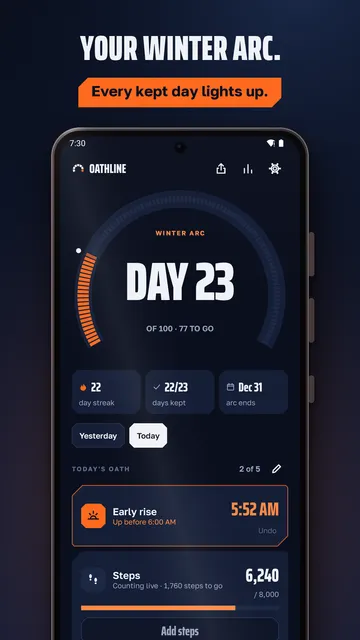
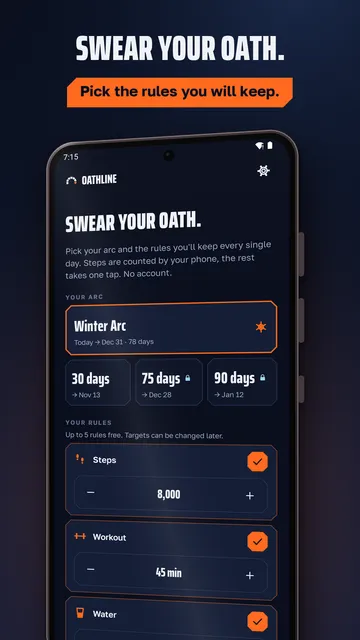
Oathline is an Android app for the winter arc challenge that measures your days instead of just ticking them off. You swear your “oath” with up to five rules, and each day becomes one segment of a big arc on the start screen. No account is needed.
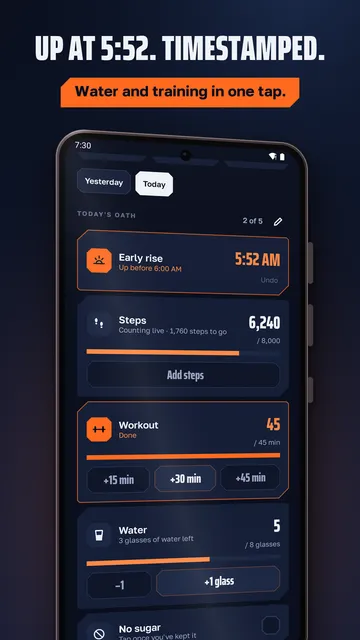
- Steps are counted by your phone’s step sensor, no extra app or watch; water, reading and workouts take one tap (+1 glass, +5 pages, +30 min).
- Early rise with a real timestamp: tap “I’m up” and the time is recorded.
- Rules you can’t measure, such as no sugar, are a simple check at the end of the day.
- Winter arc until December 31 or a 30 day challenge; streak, days kept and arc end at a glance, and you can catch up on yesterday the next morning.
- Evening check: one notification, only if something is still open, listing exactly what is missing.
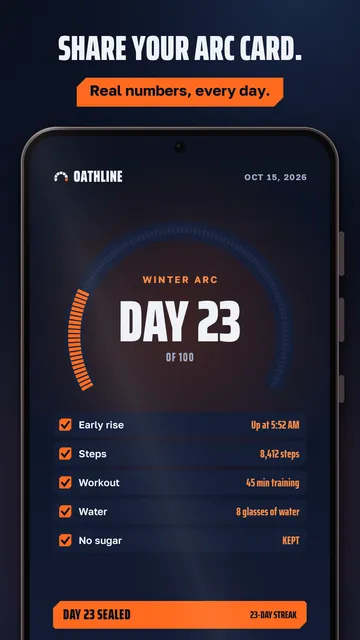
- Every sealed day becomes a shareable Arc card with your real numbers; progress photos stay on your phone, and a backup file keeps oath, history and photos together.
What the app cannot do
Oathline is a challenge and habit tracker, not a training plan and not medical advice. Step counts come from your phone’s sensor and can differ from a watch or other devices; workouts, water and reading are logged by you. The app is available for Android only.
Price
The winter arc, the 30 day challenge, up to five rules, the Arc card, evening check, photos and backup are free. Oathline Pro, with 75 and 90 day challenges, hard mode, unlimited rules, trends, photo comparison, a morning reminder and CSV export, costs $3.79 a month or $23.99 a year in the US. The free version shows ads; Pro is ad-free. We build this app ourselves; on Google Play it is listed under the developer name InfinityAkhi.
Get it on Google Play: Oathline
Screenshots
Related calculators on ToolboxDay
Frequently asked questions
Do I have to start on October 1?
No. There is no official start date. You can begin any time; the challenge then runs until December 31 or for a fixed length such as 30 days.
How many rules make sense?
Three to five rules you can manage even on a busy day. More rules feel motivating at first but often lead to quitting in the first weeks.
How many steps should I aim for?
There is no official step count; the WHO recommends at least 150 minutes of moderate activity a week for adults. Pick a target slightly above your current average and raise it later.
What happens in Oathline if I forget to log a day?
You can catch up on yesterday the next morning. Only in Oathline Pro’s hard mode does a missed day send you back to day 1.
Can I keep going after winter?
Yes. If you start in spring or summer, Oathline turns it into a 90 day Spring Arc or Summer Arc, with your history carried over.
Sources
More guides
- Glow up challenge: how to plan and document your 30 days
- Neck exercises for a stiff neck: a gentle 3-minute routine
- 4-7-8 Breathing: How the Technique Works and What It Can Do
- Recurring payments: find them, add them up, cancel what you don’t use
- Lean angle motorcycle guide: how it is measured and what the number means
- Constellation finder: how to find constellations in the night sky
- Our apps