Lean angle motorcycle guide: how it is measured and what the number means
Your lean angle (motorcycle riders mean how far the bike tilts from upright in a corner) follows from speed and corner radius: at 45 mph in a 200 ft radius turn it is roughly 34 degrees. A reliable reading needs a gyroscope, because an accelerometer alone sees the bike as upright in a steady corner.
Updated:
How is motorcycle lean angle measured?
Ball-in-tube inclinometers and phone apps that rely only on the accelerometer measure the direction of the total force acting on the bike. In a steady, well-ridden corner, gravity and cornering force add up to a force that points almost exactly down through the leaning bike. The ball stays centred, and an accelerometer-only reading says “upright” right when you are leaning the most.
Proper lean angle sensors, including those in modern motorcycles, add a gyroscope that measures roll around the bike’s long axis. A gyro drifts over time, so it is corrected with other data, for example GPS speed and turn rate, from which the cornering force can be removed.
- Ball or pendulum gauge: cheap, but shows almost nothing in a steady corner.
- Accelerometer only: same problem, plus engine vibration can cause wild spikes.
- Gyroscope with correction (GPS, accelerometer): follows the real lean, even mid-corner.
How much lean angle do you need at a given speed?
For a steady corner, the idealised formula is lean angle = arctan(v² ÷ (g × r)), with v in metres per second (or feet per second), r the corner radius and g = 9.81 m/s² (32.2 ft/s²). Lean grows with the square of speed, so taking the same corner a little faster asks for noticeably more lean.
Wide modern tyres need slightly more lean than the formula suggests because the contact patch moves out onto the sidewall. Hanging off reduces the bike’s lean at the same speed, because the combined centre of mass moves to the inside.
| Speed | Corner radius | Lean angle |
|---|---|---|
| 31 mph (50 km/h) | 164 ft (50 m) | about 21.5° |
| 45 mph (72 km/h) | 197 ft (60 m) | about 34.2° |
| 62 mph (100 km/h) | 328 ft (100 m) | about 38.2° |
| 62 mph (100 km/h) | 197 ft (60 m) | about 52.7° |
What is a normal lean angle on the street?
On public roads most riders stay well below what tyres and chassis could theoretically handle. How much grip is really available depends on surface, temperature, wet patches, gravel and tyre condition, and no gauge knows that reserve. A lean angle number is feedback about your ride, not a target and not a measure of safe riding.
Used sensibly, the value is most useful for spotting differences, for example that you take left-handers more hesitantly than right-handers. That is something to work on in a rider training course with an instructor, not on the street.
What do chicken strips say about lean angle?
Chicken strips are the unused edges of the tyre tread. Their width depends not only on lean angle but also on tyre profile, tyre width, riding style and body position, so they say little about how well someone rides. On the street some unused edge is normal and sensible: it is reserve for the unexpected, such as gravel mid-corner or a needed correction.
How do you use a lean angle tracker safely?
A phone or sensor on the bike is set up before the ride and never operated while riding. Eyes stay on the road; the numbers are for later. A solid mount matters too, because a wobbling mount distorts the measurement.
- Mount the phone firmly so it cannot shift while you ride.
- Start recording while stopped, then leave the screen alone.
- Ride as you always do: within your skill, the conditions and the traffic rules.
- Review the values after the ride and compare them with earlier rides.

How Apexwell measures lean angle
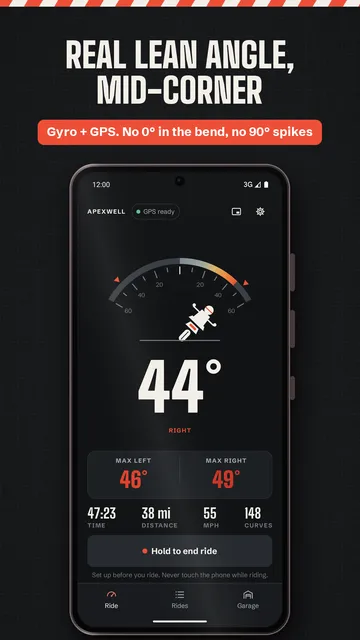
Apexwell is a lean angle tracker for Android that follows the bike’s roll with the gyroscope, removes the cornering force using GPS speed and turn rate, and ignores readings that do not fit, such as vibration and bumps. In the developer’s simulated test rides the typical deviation was about 1°, with peak values within 3°. Set everything up before you ride and never operate the phone while riding.
- Live lean angle gauge plus max left and max right for every ride.
- Automatic calibration for upright, landscape, tilted or tank-mounted phones; the zero point corrects itself on the first straight.
- Recording keeps running with the screen off; starting and ending a ride needs a long press.
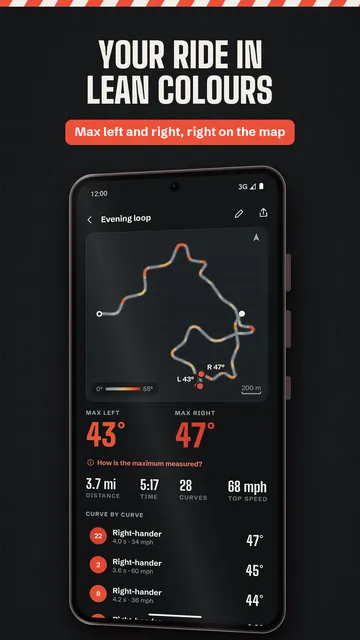
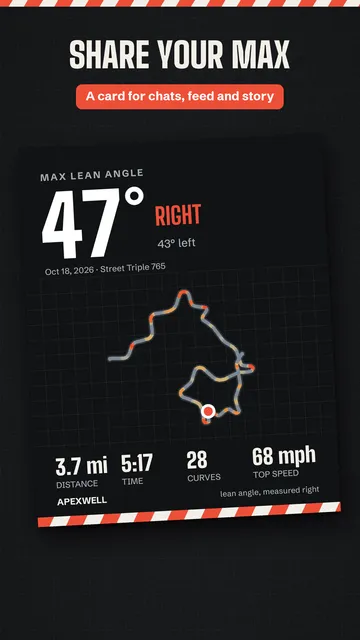
- Your last three rides with a route map in lean angle colours, and a share card with your maximum.
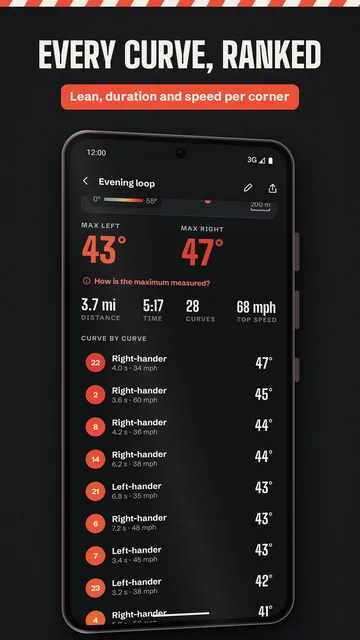
- Pro: curve by curve with lean, duration and speed, lean profile with an estimated tyre edge, unlimited history, best values per road, several bikes, GPX and CSV export.
What the app cannot do
Lean angles from phone sensors are estimates; accuracy has been checked with simulations, not against a reference system on a real motorcycle, and depends on the mount and the phone. Apexwell is a fun tool, not a training aid or a safety device, and it is available for Android only.
Price
The live gauge, max left and right, your last three rides and the share card are free; Pro costs $4.69 a month or $32.99 a year in the US through Google Play, and you can cancel anytime. The free version shows ads; Pro is ad-free. We build this app ourselves; on Google Play it is listed under the developer name InfinityAkhi.
Get it on Google Play: Apexwell
Screenshots
Related calculators on ToolboxDay
Frequently asked questions
Why does my lean angle app show almost 0° in a corner?
It reads lean from the accelerometer only. In a steady corner the sum of gravity and cornering force points through the leaning bike, so the sensor sees “upright”. A gyroscope with correction is needed.
Can I calculate my lean angle?
Yes, in the idealised case with arctan(v² ÷ (g × r)). At 45 mph (about 66 ft/s) in a 197 ft radius corner that is about 34°. Tyre width and body position shift the real value a little.
Can I look at the app while riding?
Set everything up before you ride and do not operate the phone while riding. Check your values once you have stopped.
Is a big lean angle a sign of good riding?
No. The number follows from speed and corner radius and says nothing about grip reserve, line choice or anticipation. On public roads reserve matters more than a record.
Sources
More guides
- 0 to 60 GPS timer on your phone: how to get times you can trust
- True north compass: how to point at the real north, not just magnetic north
- Recurring payments: find them, add them up, cancel what you don’t use
- Constellation finder: how to find constellations in the night sky
- Oil change reminder: how to time it and never miss it
- Garden layout planner: how to lay out a raised bed step by step
- Our apps