No spend challenge: rules, how to start and a worked example
In a no spend challenge you spend no money on non-essentials for a set period, such as a week or a month, while rent, bills and basic groceries carry on as normal. What makes it work is clear rules agreed up front, a visible tally of your no spend days and a goal for where the saved money goes.
Updated:
What are the rules of a no spend challenge?
There are no official rules; you set them yourself. A simple split works well: essentials that keep running, and wants that are off limits for the length of the challenge. Write both lists down beforehand, or you will renegotiate with yourself every day.
A day counts as a no spend day if you bought nothing outside your essentials list. Automatic payments for rent or insurance do not break the day.
- Usually allowed: rent, utilities, insurance, loan payments, groceries from a list, medicine, commuting.
- Usually off limits: takeout, coffee to go, clothes, decor, online shopping, new subscriptions, impulse buys.
- Decide the grey areas in advance: gifts, gas for leisure trips, meeting friends, replacing something broken.
- An emergency is not a failure: buy it, note it, carry on.
How do you start a no spend challenge?
Start smaller than you think you can manage: a week or a weekend without spending is a better first step than a whole month that falls apart on day three. After that, stretch it to 30 days or to a few no spend days every week.
- Pick a period: 7 days, 30 days, or for example every weekday except Saturday.
- Write your essentials and off-limits lists and keep them visible, on paper or on your phone.
- Check your pantry and plan a week of meals so you are not forced into a hungry shopping trip.
- Remove triggers: log out of shopping apps, unsubscribe from sale emails, delete saved cards in your browser.
- Tick off every no spend day and work out at the end what is left over.
How much can you save with a no spend challenge?
It depends on what you usually spend money on. Work with your own habits: note what you spend on non-essentials on a normal day and multiply it by the number of no spend days.
Move the saved money to a savings account or emergency fund straight away. Otherwise it tends to end up in impulse buys at the end of the month after all.
| Habit | usually per day | saved over 24 days |
|---|---|---|
| Coffee to go | $3.50 | $84.00 |
| Snack on the go | $2.50 | $60.00 |
| Small online orders | $4.00 | $96.00 |
| Total | $10.00 | $240.00 |
No buy, 52 week or 100 envelope challenge: which one suits you?
A no spend challenge saves by spending less. Other savings challenges work the other way round: you put money aside on a fixed plan. Many people combine both, for example a no spend month alongside the 52 week challenge.
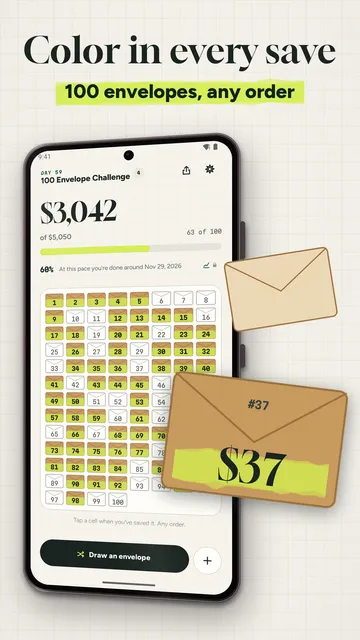
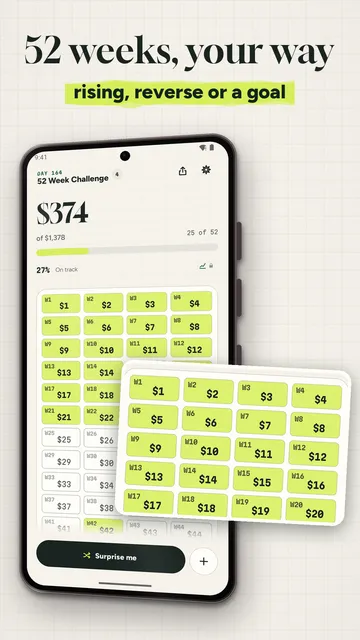
In the 52 week challenge you save $1 in week 1, $2 in week 2 and so on; after 52 weeks that is $1,378. In the 100 envelope challenge, 100 envelopes carry the amounts 1 to 100, adding up to $5,050, and you choose the order.
| Challenge | How it works | Typical total |
|---|---|---|
| No spend challenge | days without non-essential spending | depends on your habits |
| No buy challenge | skip one category (e.g. clothes) for months | depends on the category |
| 52 week challenge | week n = save n dollars | $1,378 |
| 100 envelope challenge | envelopes 1 to 100 in any order | $5,050 |
What if you break your no spend challenge?
One slip does not end the challenge. Write down what you bought and in what situation, and carry on the next day. Those notes later reveal your triggers, such as boredom in the evening or the route past the bakery.
A simple budget next to the challenge helps: it shows whether the money you saved really stays in your monthly budget or was just pushed into another month.

How Pennyfold helps with your no spend challenge
Pennyfold turns the no spend challenge, the 100 envelope challenge and the 52 week challenge into trackers you color in, like the popular printables. You tap a cell when you save and watch the total grow; everything is saved after every tap.
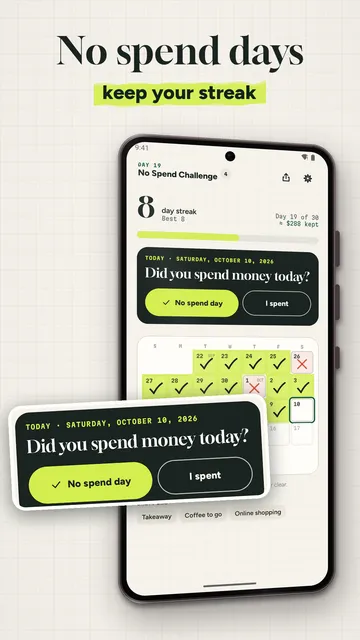
- No spend challenge from 7 to 365 days on a calendar: log a no spend day with one tap, keep your streak and see roughly how much you kept.
- Four challenges for free: 100 envelopes (or 50, 150, 200) with a random envelope draw, 52 weeks (rising, reverse, a fixed amount or worked out from a goal) and a custom savings goal.
- Any order, any currency, plus extra amounts such as spare change or a bonus.
- Daily or weekly reminders with a “No spend day?” check-in and buttons right in the notification.
- Share progress as a story picture or a 9:16 coloring video, milestone stamps at 25, 50, 75 and 100 percent, and a backup file to move to a new phone.
What the app cannot do
Pennyfold never moves money and does not connect to a bank account: it only records what you enter, and the savings shown for a no spend challenge are an estimate. The free version runs one challenge at a time; several at once need Pro, and the app is available for Android only.
Price
All four challenges, reminders and sharing are free; Pennyfold Pro (several challenges at once, shapes, insights, HD video) costs $1.89 a month or $10.99 a year in the US (EUR 1.99 / 11.99 in Germany) and can be cancelled any time in Google Play. The free version shows ads; Pro is ad-free. We build this app ourselves; on Google Play it is listed under the developer name InfinityAkhi.
Get it on Google Play: Pennyfold
Screenshots
Related calculators on ToolboxDay
Frequently asked questions
How long should a no spend challenge last?
Start with a week, then try 30 days. Some people keep fixed no spend days for good, for example three a week, instead of a whole month.
Do groceries count as spending?
For most people, groceries from a list are on the essentials list and do not break the day. Treats or extras outside the list do.
What is the difference between a no spend and a no buy challenge?
No spend means whole days without non-essential spending. No buy usually targets one category, such as no clothes or no beauty products for several months.
Can I run several challenges at once in Pennyfold?
The free version runs one active challenge. Several in parallel, such as envelopes plus a no spend month, are part of Pennyfold Pro.
Sources
More guides
- Envelope budget: give every dollar a job before you spend it
- Recurring payments: find them, add them up, cancel what you don’t use
- Winter arc challenge: set your rules and keep them until December 31
- Lean angle motorcycle guide: how it is measured and what the number means
- Constellation finder: how to find constellations in the night sky
- Oil change reminder: how to time it and never miss it
- Our apps