Dew point calculator for your home: humidity, cold walls and airing
A dew point calculator turns air temperature and relative humidity into the temperature at which moisture condenses. At home that tells you whether a cold wall or window will get damp and whether outdoor air is drier than yours, so opening the window actually helps. The EPA recommends keeping indoor humidity below 60%, ideally between 30 and 50%.
Updated:
What is dew point and how is it different from humidity?
The National Weather Service defines dew point as the temperature air must be cooled to, at constant pressure, to reach 100% relative humidity. Relative humidity depends on temperature and can mislead; dew point tracks the actual amount of moisture in the air.
The NWS example: 30 °F with a dew point of 30 °F is 100% humidity, while 80 °F with a dew point of 60 °F is only 50%, yet the warm day feels far more humid because the air holds more water. For outdoor comfort in summer the NWS gives these guide values: 55 °F or less feels dry and comfortable, 55 to 65 °F becomes sticky, and 65 °F or more means lots of moisture in the air, becoming oppressive.
How do you calculate dew point from temperature and humidity?
Calculators use an approximation such as the Magnus formula. You do not need to do it by hand, but a table helps you see how quickly dew point rises with humidity. Values below are for a room at 68 °F (20 °C), rounded.
| Relative humidity | Dew point | Absolute humidity |
|---|---|---|
| 40% | 42.8 °F (6.0 °C) | 6.9 g/m³ |
| 50% | 48.7 °F (9.3 °C) | 8.6 g/m³ |
| 60% | 53.6 °F (12.0 °C) | 10.3 g/m³ |
| 70% | 57.8 °F (14.4 °C) | 12.1 g/m³ |
What indoor humidity prevents mold?
The EPA advises keeping indoor humidity below 60 percent, ideally between 30 and 50 percent, and measuring it with an inexpensive humidity meter. Mold does not need visible water: the surface of a cold corner can be far more humid than the middle of the room.
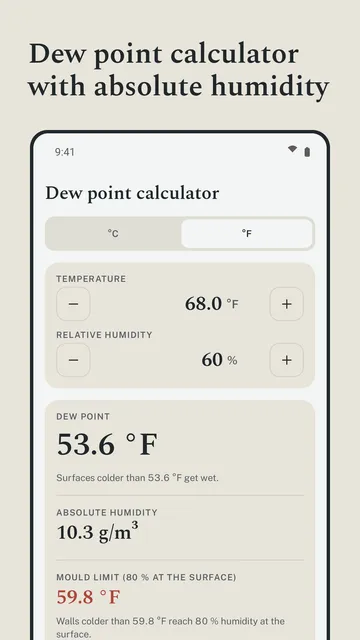
Example: room air at 68 °F and 60% has a dew point of about 53.6 °F. A wall surface colder than about 59.8 °F (15.4 °C) already reaches 80% humidity at its surface, the level many guides treat as the mold threshold. That is why outside corners, window reveals and walls behind wardrobes get mold first.
- Move furniture a few inches away from exterior walls so warm air can circulate.
- Do not let unused rooms get very cold.
- Fix leaks and condensation sources quickly; ventilation cannot dry out water damage.
When does opening a window lower indoor humidity?
Only when the outdoor air holds less water than the indoor air, which you see by comparing dew points or absolute humidity, not relative humidity. Cold winter air at 32 °F and 90% holds about 4.4 g of water per cubic metre; warmed to 68 °F indoors it is only around 25% relative humidity, so airing dries the room even in drizzle.
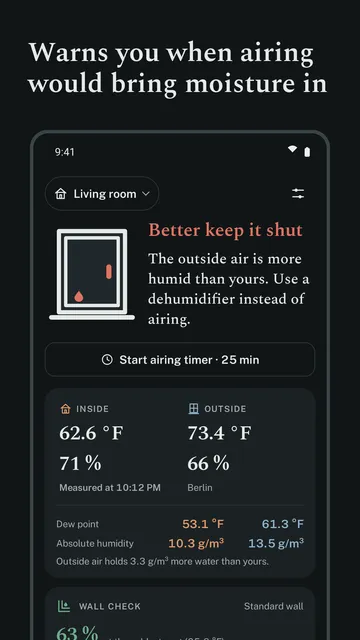
Summer works the other way round. Air at 77 °F (25 °C) and 70% holds about 16 g/m³ and has a dew point near 66 °F (19 °C). Let it into a basement at 59 °F (15 °C) and water condenses on the walls. Air basements in the late evening or early morning, and use a dehumidifier when the outside dew point is higher than the indoor one.

How Fensto works as a dew point calculator
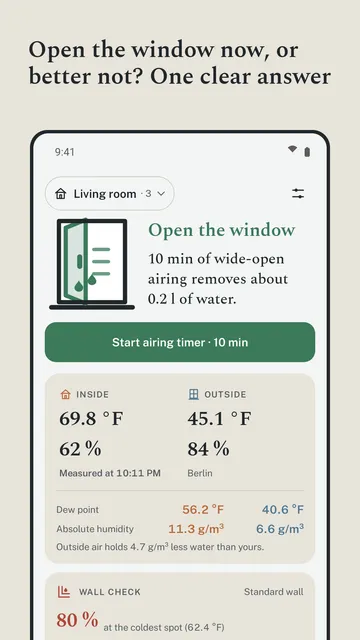
Fensto is an Android dew point calculator with a clear answer. You enter the temperature and humidity from your hygrometer, Fensto compares them with the weather for your place and tells you in one sentence whether to open the window now, and for how long.
- Traffic-light window: open now, only briefly or better not, with weather for your place and the estimated water removed by airing.
- Dew point calculator for inside, outside and the wall, in °F or °C, with absolute humidity and the mold limit at 80% surface humidity.
- Wall check showing how humid the coldest spot gets in the current weather, and a warning when outside air would bring moisture into the basement.
- Airing timer with a “close the window” notification, a widget with the current answer and a log of the last 24 hours.
- With Pro: a 24-hour airing plan with the best hours and the night-time wall risk, airing-window notifications (at most 3 a day), unlimited rooms, a weekly summary and PDF export.
What the app cannot do
Fensto does not measure humidity itself; it works with the numbers you read from your hygrometer, and it needs an internet connection for the weather. Airing durations are guide values and the wall check is an estimate, not a substitute for a professional inspection if you already have mold; the app is available for Android only.
Price
The dew point calculator, the airing answer for one room, the timer, wall check and widget are free; Fensto Pro is a monthly or yearly subscription (in the US US$2.99 a month or US$19.99 a year) that you can cancel any time in Google Play. The free version shows ads; Pro is ad-free. We build this app ourselves; on Google Play it is listed under the developer name InfinityAkhi.
Screenshots
Related calculators on ToolboxDay
Frequently asked questions
What is a good dew point indoors?
There is no single number, because it depends on room temperature. At 68 °F, the EPA’s ideal range of 30 to 50% humidity corresponds to a dew point of roughly 35 to 49 °F.
Can I measure humidity with my phone?
Most phones have no humidity sensor. Use a small hygrometer and enter its readings; Fensto adds the outdoor weather for your place.
Should I open the window when it rains?
In winter usually yes, because cold air holds little water even when it rains and becomes dry once warmed. What matters is the dew point or absolute humidity inside versus outside.
Does Fensto show °F?
Yes. The dew point calculator switches between °C and °F, and the US screens show temperatures in °F.
Sources
More guides
- EMF reader on your phone: how to measure magnetic fields and read the numbers
- Garden layout planner: how to lay out a raised bed step by step
- Recurring payments: find them, add them up, cancel what you don’t use
- Lean angle motorcycle guide: how it is measured and what the number means
- Constellation finder: how to find constellations in the night sky
- Oil change reminder: how to time it and never miss it
- Our apps