Garden layout planner: how to lay out a raised bed step by step
A garden layout planner, whether graph paper, a spreadsheet or an app, answers four questions: how many plants fit, which ones can grow side by side, when to sow and plant out, and what goes in the same spot next year. The simplest way is a grid of 1 ft squares and planting dates counted from your average last frost.
Updated:
Square foot garden layout: how many plants per square foot?
Divide the bed into 1 ft squares (30 × 30 cm). A 4 × 8 ft raised bed gives you 32 squares, a 3 × 7 ft bed 21. Each square holds a single crop.
How many plants fit in a square follows from the in-row spacing: up to 3 in (7.5 cm) apart fits 16, up to 4 in (10 cm) fits 9, up to about 6.5 in (17 cm) fits 4, and anything up to about 22 in (55 cm) gets one square to itself. Large sprawling plants such as zucchini or pumpkin need several squares. The spacings below follow the Colorado State University planting guide and the Bavarian Garden Academy fact sheets.
- Work out the squares first (length ÷ 1 ft × width ÷ 1 ft, rounded down) and draw the grid on graph paper.
- Write one crop per square plus the plant count from the table, so you know straight away how many seedlings or seeds you need.
- Keep the plan: next year it is the basis for your crop rotation.
| Plant | In-row spacing | Plants per square |
|---|---|---|
| Carrot | 1–1.5 in (3 cm) | 16 |
| Radish, spinach | 2 in (5 cm) | 16 |
| Beetroot | 3 in (8 cm) | 9 |
| Onion | 4 in (10 cm) | 9 |
| Leek | 6 in (15 cm) | 4 |
| Leaf lettuce, kohlrabi, basil | 10–12 in (25–30 cm) | 1 |
| Tomato, sweet pepper | 18–20 in (45–50 cm) | 1 |
| Zucchini | 3 ft (100 cm) | 1 plant across 4 squares |
Companion planting garden layout: which plants grow well together?
Companion planting means mixing crops with different habits and needs instead of one big block of a single crop. Common pairings appear in extension charts such as the University of California Master Gardener companion chart, as well as in German garden institute tables.
Treat these charts as experience, not proof. Washington State University Extension separates the effects that are well documented, such as habitat for beneficial insects, trap crops and ground cover, from popular neighbour lists with little evidence behind them, and the Bavarian Garden Academy notes that observations often contradict each other. It explicitly does not recommend the classic onion next to carrot, because their nutrient and water needs differ.
| Pair | Rating |
|---|---|
| Tomato + basil | good neighbours |
| Cucumber + dill | good neighbours |
| Carrot + leek | good neighbours |
| Kohlrabi + lettuce | good neighbours |
| Beetroot + onion | good neighbours |
| Tomato + potato | avoid |
| Bush bean + onion | avoid |
| Pea + leek | avoid |
When to plant vegetables: dates from your last frost
Your average last spring frost sets the pace. In the US you can estimate it from your USDA hardiness zone or, better, from local station data; it comes later in frost pockets and at altitude.
Colorado State University Extension groups crops by frost tolerance: hardy crops such as peas, radish, spinach and lettuce go out 2–4 weeks before the average last frost, semi-hardy crops such as beets, carrots and potatoes 0–2 weeks before, and very tender crops such as tomato, pepper and pumpkin typically 2 or more weeks after it.
- Hardy crops can go out as soon as the soil has dried enough to work.
- Frost dates are averages: in any given year frost can come two to three weeks earlier or later, so keep fleece handy.
| Group | Rule | Works out to about |
|---|---|---|
| Hardy (peas, radish, spinach) | 2–4 weeks before last frost | April 7 – April 21 |
| Semi-hardy (beets, carrots) | 0–2 weeks before last frost | April 21 – May 5 |
| Very tender (tomato, pepper) | 2+ weeks after last frost | from May 19 |
Crop rotation in raised beds: what goes where next year?
Crop rotation means not growing the same plant family in the same spot year after year. The Royal Horticultural Society recommends a four-year rotation; it reduces the build-up of crop-specific pests and diseases and groups crops by their needs.
A simple scheme moves heavy feeders (tomato, zucchini, pumpkin) to medium feeders (carrot, chard, fennel), then light feeders (radish, beans, onions) and then a green manure before starting again. The family matters most: brassicas such as cabbage and radish should not follow each other, nor should tomatoes and potatoes. Keep a note or a photo of each year’s layout so you can check.
- Year 1: green manure (for example clover).
- Year 2: heavy feeders (tomato, zucchini, pumpkin).
- Year 3: medium feeders (carrot, chard, fennel).
- Year 4: light feeders (radish, beans, onions), then start again.
How Beetwell helps you plan
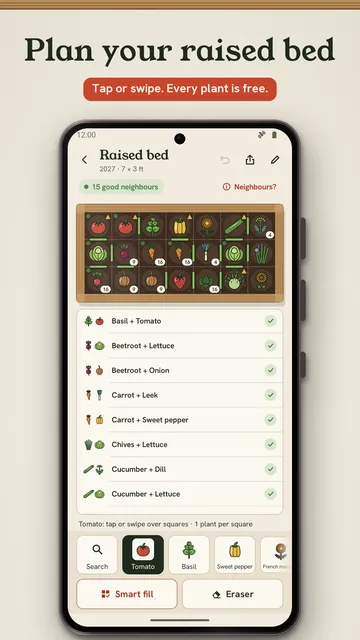
Beetwell is a garden layout planner for Android that brings the steps above together on your phone: the grid, the neighbour check and the planting calendar work hand in hand. No account is needed and your plans stay on the device; according to its store listing the app uses the internet only for Google Play purchases and anonymous usage counters.
- Raised bed, vegetable plot or window box in 1 ft squares: pick a plant, tap or swipe over squares, with eraser and undo; the app shows how many plants fit per square.
- Companion check: a green seam between two squares marks good neighbours and a red one bad neighbours, each with a “Why?” and its source; pairs where sources disagree are left out.
- “Smart fill” fills the bed with good neighbours in one tap.
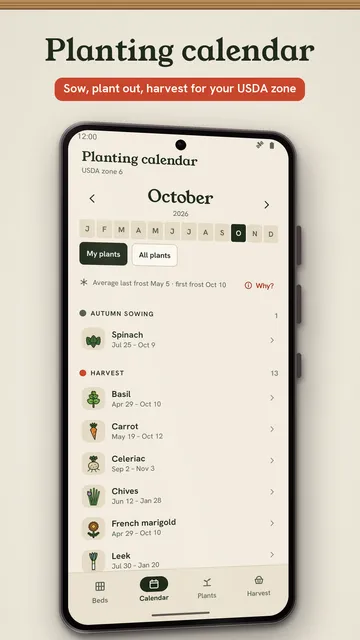
- Planting calendar from your average last frost: USDA zones 3 to 9, Central European regions or your own frost dates, month by month for starting indoors, sowing, planting out and harvest.
- Almost 80 vegetables, herbs, salads and companion flowers with plant profiles, none behind a paywall; the home screen shows what is due in the next two weeks.
- With Pro: unlimited beds, reminders, crop rotation per square over the years, harvest diary and the garden plan as a PDF.
What the app cannot do
Beetwell works with average frost dates and knows nothing about your local weather, soil or variety; the neighbour check reflects traditional advice from garden sources, not a yield guarantee. The app is Android only, and the free version includes one bed.
Price
All plants, one bed, the companion check, the planting calendar and backup are free; Beetwell Pro costs $3.79 a month or $27.99 a year in the US, with local prices elsewhere. The free version shows ads; Pro is ad-free. We build this app ourselves; on Google Play it is listed under the developer name InfinityAkhi.
Get it on Google Play: Beetwell
Screenshots
Related calculators on ToolboxDay
Frequently asked questions
What size should each square be?
One foot (30 cm) works well: small enough to mix crops, big enough for a tomato or a kohlrabi. Small plants such as carrots or radishes go several to a square.
Can I plant onions next to carrots?
You can, but the Bavarian Garden Academy does not recommend it: the two need different amounts of nutrients and water, and the idea that each repels the other’s fly rarely works in practice.
When can tomatoes go into a raised bed?
Only after your last frost; Colorado State University Extension suggests about two weeks after the average date. A raised bed does not protect it from a night frost.
Does Beetwell work for window boxes and in-ground beds?
Yes. You create a raised bed, vegetable plot or window box with your own dimensions and the grid adapts. More than one bed at a time needs Pro.
Sources
- Colorado State University Extension: Vegetable Planting Guide (CMG GardenNotes #720)
- Royal Horticultural Society: Crop rotation
- Washington State University Extension: Gardening with Companion Plants
- University of California ANR: Companion Planting Chart
- USDA Agricultural Research Service: Plant Hardiness Zone Map
More guides
- Hive inspection checklist: what to record and when to test for mites
- Egg laying tracker: count eggs and understand your hens
- Fishing journal: what to log after every catch
- Recurring payments: find them, add them up, cancel what you don’t use
- Lean angle motorcycle guide: how it is measured and what the number means
- Constellation finder: how to find constellations in the night sky
- Our apps