Vertical jump measure: how to test your jump height at home
A reliable vertical jump measure needs the same jump, the same warm-up and the same method every time. The simplest at-home options are a wall mark (jump and reach) or flight time, because jump height follows directly from how long you are in the air: h = g · t² / 8. Measure before and after a training block and you see what your training really did.
Updated:
How to measure vertical jump at home without equipment?
The classic method is jump and reach. Stand side-on to a wall, reach up as high as you can with flat feet and mark the spot. Then jump and touch the wall at your highest point. The difference between the two marks is your vertical jump. It needs nothing but chalk or tape, but the result depends on how well you reach at the top and how precisely you read the mark.
Flight time is the other method, and it is what jump mats and force plates use; it has been described in sports science for decades (Bosco and colleagues, 1983). The key rule: land with straight legs, the same way you took off. Tucking your knees on landing stretches the flight time and inflates the number.
- Warm up for 5–10 minutes: easy jogging, bodyweight squats, a few easy hops.
- Pick one jump type, usually the countermovement jump: dip quickly from standing and explode straight up.
- Do three valid attempts with 30–60 seconds rest and keep the best one.
- Keep conditions identical: same shoes, same surface, same time of day, arm swing either always or never.
How do you calculate vertical jump height from flight time?
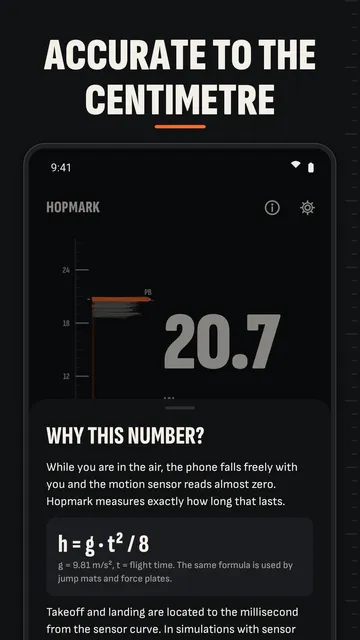
In the air only gravity acts on you. Going up and coming down take the same time, so half the flight time is the fall from the highest point. That gives h = g · t² / 8, with g = 9.81 m/s² and t in seconds. Small timing differences matter: 50 milliseconds more air time means roughly 7 cm (almost 3 in) at typical heights.
To estimate power you can use the Sayers equation (1999): peak power in watts = 60.7 × jump height in cm + 45.3 × body mass in kg − 2055. Example: a 52.5 cm jump at 75 kg gives 60.7 × 52.5 + 45.3 × 75 − 2055 ≈ 4,529 W. It is an estimate derived from many athletes, not an exact number for you.
| Flight time | Jump height (cm) | Jump height (in) |
|---|---|---|
| 0.40 s | 19.6 cm | 7.7 in |
| 0.50 s | 30.7 cm | 12.1 in |
| 0.55 s | 37.1 cm | 14.6 in |
| 0.60 s | 44.1 cm | 17.4 in |
| 0.70 s | 60.1 cm | 23.7 in |
| 0.80 s | 78.5 cm | 30.9 in |
How much vertical do you need to dunk?
A regulation rim is 10 ft (3.05 m) high. To dunk, your hand with the ball has to clear the rim clearly, roughly 6 in (15 cm) as a rule of thumb. How much vertical that takes depends mainly on your standing reach, the height you touch with your arm fully extended and feet flat.
Example: standing reach 7 ft 10.5 in (2.40 m). To touch the rim you need about 25.5 in (65 cm), to dunk about 31.5 in (80 cm). If you jump 20.7 in (52.5 cm), you are still around 5 in short of the rim. Measure your standing reach at a wall rather than estimating it from your height, because arm length varies a lot.
How often should you do vertical jump training?
For most recreational athletes two to three sessions a week with at least one rest day in between is enough. Jumps are short, maximal efforts, so quality beats quantity: a few crisp reps with full rest instead of long sets to exhaustion.
Combine basic strength (squats, lunges, calf raises), jumps (squat jumps, box jumps, broad jumps) and reactive drills with short ground contact such as skipping and jump rope. Progress technique first, then height or volume. If your knees, Achilles tendons or back hurt, stop and get it checked.
- Put jumps at the start of a session while your legs are fresh.
- Beginners: about 30–60 foot contacts per session, more later.
- Land softly and under control, knees tracking over your toes.
- Retest every 2–4 weeks under the same conditions.

How Hopmark measures your vertical jump with your phone
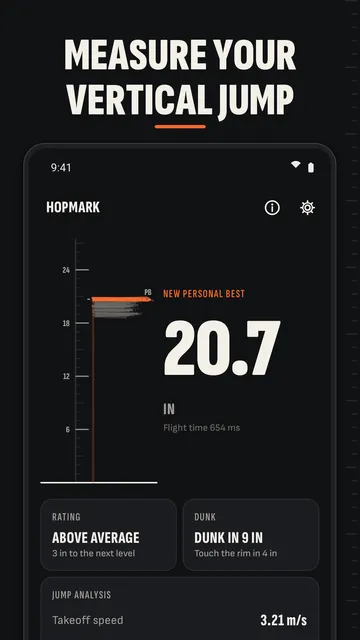
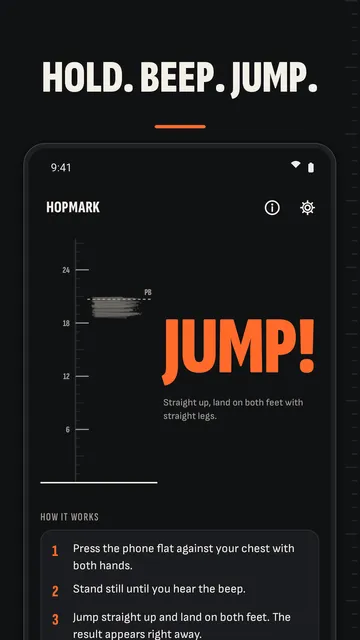
Hopmark uses the flight time method with your phone’s motion sensor. Hold the phone against your chest with both hands, wait for the beep and jump. The app detects takeoff and landing and shows your jump height in centimetres or inches the moment you land.
- Unlimited vertical jump tests with height, flight time and a rating based on published reference values for adults.
- Dunk calculator: how far you are from touching the rim and from dunking.
- Jump duel for two: pass the phone, best of three wins, plus a share card with your result.
- “Why?” explains every number; jumps where the phone wobbles instead of flying freely are discarded.
- With Pro: analysis of every jump (takeoff speed, Sayers power, push-off and landing force), full history with before and after, hop series with reactive strength index, duels for up to 8 players.
What the app cannot do
Hopmark only measures correctly when the phone stays pressed to your chest and you land with straight legs; tucked knees distort any flight time measurement. It does not replace a lab force plate, is not a medical device and is available for Android only.
Price
Measuring, the dunk calculator and two-player duels are free; Pro costs $5.99 a month or $39.99 a year in the US. The free version shows ads; Pro is ad-free. Pro is also available as a one-time lifetime purchase ($69.99 in the US as of 9 Nov 2026). We build this app ourselves; on Google Play it is listed under the developer name InfinityAkhi.
Get it on Google Play: Hopmark
Screenshots

Frequently asked questions
What is a good vertical jump?
It depends on age, sex and sport. Many untrained adults jump roughly 12–18 in (30–45 cm) in a countermovement jump, athletes from jumping sports a lot more. Your own trend under identical test conditions matters more than comparing with others.
Should I swing my arms when I test?
You can, but then always do it. Arm swing adds several centimetres. Pick one version and stick with it, otherwise before and after are not comparable.
Why does a flight time measure sometimes read too high?
Usually because of the landing. Tucking your knees or landing on your heels keeps you in the air longer without jumping higher. Straight legs at takeoff and landing keep the number honest.
How fast does vertical jump training work?
First gains often show within a few weeks, largely from better technique. How much is possible varies a lot between people; regular retests tell you whether your plan is working.
Sources
More guides
- PR tracker for lifting: how to log and beat your records
- Hybrid training plan: how to prepare for a fitness race
- 0 to 60 GPS timer on your phone: how to get times you can trust
- Recurring payments: find them, add them up, cancel what you don’t use
- Lean angle motorcycle guide: how it is measured and what the number means
- Constellation finder: how to find constellations in the night sky
- Our apps