Hybrid training plan: how to prepare for a fitness race
A hybrid training plan combines endurance and strength in the same week: runs for your base and pace, strength and station sessions for working under fatigue. For a fitness race with 8 × 1 km of running and 8 stations, plan backwards from race day, build volume gradually and practise the transitions between running and stations.
Updated:
What does a hybrid training plan look like each week?
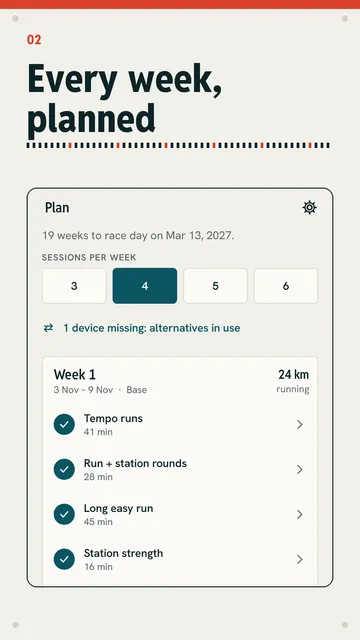
A typical beginner week has three to five sessions, and each one has a single job: base, pace, strength or race specific. Cramming everything into every session means doing everything halfway. Avoid hard sessions on back-to-back days and keep at least one full rest day.
For running volume the usual caution applies: build in small steps and make every third or fourth week deliberately lighter. Sports medicine research links sharp spikes in load to injury risk, while load built up gradually tends to protect (Gabbett, 2016).
| Day | Session | Purpose |
|---|---|---|
| Monday | Rest or mobility | Recovery |
| Tuesday | Intervals, e.g. 5 × 1 km at target pace | Race pace |
| Wednesday | Station strength: sled, lunges, wall balls | Strength endurance |
| Friday | Alternating run and station rounds | Transitions under fatigue |
| Sunday | Long easy run | Aerobic base |
What are the stations in the 8 × 1 km fitness race?
The common format has eight 1 km runs, each followed by a station. The order is fixed; the loads depend on your division and can change between seasons, so always check the organiser’s current rulebook.
For training this means every station has its own weak spot. Sleds and lunges hit the legs, the ski erg and rower test your engine, the farmers carry tests your grip, and the wall balls at the end test everything at once. If your gym lacks a machine, use a similar movement, such as heavy pushes or hill sprints instead of the sled push.
| No. | Station | Distance or reps |
|---|---|---|
| 1 | Ski erg | 1000 m |
| 2 | Sled push | 50 m |
| 3 | Sled pull | 50 m |
| 4 | Burpee broad jumps | 80 m |
| 5 | Rowing | 1000 m |
| 6 | Farmers carry | 200 m |
| 7 | Sandbag lunges | 100 m |
| 8 | Wall balls | 100 reps |
How do you split a target finish time?
A finish time only becomes useful once it is broken into sections: eight runs, eight stations and the transitions in between. The transition zone is often underestimated, so budget a realistic few minutes for it. Then you can see which running pace and which station times fit your goal.
Example for 1:30:00: eight runs at 5:30 per km add up to 44:00. Budget 8:00 for transitions. That leaves 38:00 for the eight stations, for example ski erg 5:00, sled push 4:00, sled pull 5:00, burpee broad jumps 5:00, row 5:00, farmers carry 2:15, lunges 5:00 and wall balls 6:45. These numbers are a worked example, not a standard; your own split depends on your strengths.
- Don’t go out too fast: the stations slow down the later kilometres.
- The station where you lose the most time compared with your other sections offers the biggest gain in training.
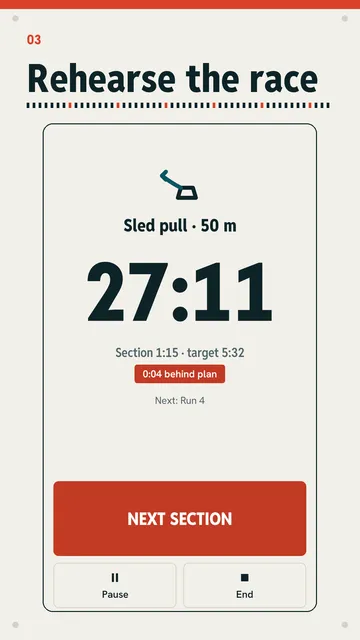
- A full dress rehearsal with every section shows whether your planned splits hold.
How many weeks do you need to train for the race?
For a first race, 12 to 16 weeks is a good frame if you already run or lift regularly. Split the weeks into base, build, race-specific phase and taper. In the last 7 to 10 days, volume drops clearly while intensity stays short and sharp, so you start fresh.
Don’t double up on missed sessions. Carry on with the plan and, if in doubt, drop a hard session rather than an easy one. If you have health concerns, talk to a doctor before you start training.

How Sledra builds your hybrid training plan
Sledra plans the 8 × 1 km + 8 station fitness race backwards from race day. It starts with a finish time calculator: pick your division and race day, add a few benchmarks or let the app estimate them, and you get a forecast with a likely range and a split plan.
- Finish time calculator with forecast, range, a split plan for all 16 sections and your biggest lever: the station where you lose the most time.
- Weekly plan to race day with base, build, race-specific and taper phases; every fourth week is lighter.
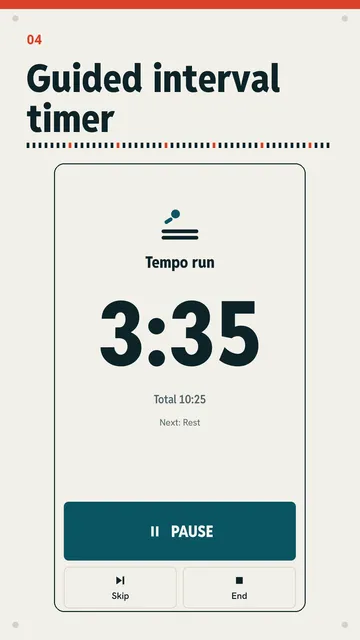
- Guided sessions with a timer: big numbers, a tone and vibration at every change, even with the screen off.
- Race simulation with target vs. actual per section and forecast history.
- Every station with an animated movement glyph, technique cues, the most common mistake and a substitute exercise; CSV export of your log.
What the app cannot do
Sledra estimates finish times from what you enter; that is a forecast, not a guarantee, and it does not replace personal coaching or medical advice. The app is independent and not affiliated with any race organiser; it does not record heart rate and is available for Android only.
Price
The finish time calculator, week 1, one guided session per calendar week, one race simulation and CSV export are free; Pro costs $9.99 a month or $59.99 a year in the US. The free version shows ads; Pro is ad-free. We build this app ourselves; on Google Play it is listed under the developer name InfinityAkhi.
Screenshots
Related calculators on ToolboxDay
Frequently asked questions
Can I follow a hybrid training plan without a sled?
Yes. Missing equipment has substitutes, such as hill sprints or heavy pushes instead of the sled and burpee broad jumps on the spot. You should still try the actual race movement a few times before race day.
How many running kilometres do I need per week?
Beginners often do fine with 15 to 30 km a week over two or three runs. More important than the number is that you can handle 8 km alternating with stations, and run and station rounds work especially well for that.
How long does the race take for beginners?
Many first-timers finish somewhere between about 1:15 and 2:00 hours. The range is wide because running fitness, strength and division vary a lot.
Is Sledra an official app of a race organiser?
No. Sledra is an independent training app and is not affiliated with any race organiser.
Sources
More guides
- PR tracker for lifting: how to log and beat your records
- Vertical jump measure: how to test your jump height at home
- Cold plunge for beginners: how long, how cold, how safe
- Recurring payments: find them, add them up, cancel what you don’t use
- Lean angle motorcycle guide: how it is measured and what the number means
- Constellation finder: how to find constellations in the night sky
- Our apps