Spirograph drawing: how to plan points, laps and loops
In spirograph drawing a toothed wheel rolls inside a toothed ring, and a pen in one of the wheel’s holes traces a looping curve. The pattern depends on three numbers: the teeth of the ring, the teeth of the wheel and how far the pen hole sits from the wheel’s centre. With the greatest common divisor of the two tooth counts you can work out in advance how many points the pattern gets and after how many laps it closes.
Updated:
How does a spirograph work?
The drawing toy consists of toothed rings and wheels. The ring is held in place, a wheel rolls along its inside, and the pen sits in one of the wheel’s holes. Because the wheel spins around itself while it also travels around the ring’s centre, the pen draws a curve made of many loops. Mathematicians call it a hypotrochoid; a wheel rolling around the outside of a disc draws an epitrochoid.
The toy was developed by British engineer Denys Fisher in the 1960s. The curves themselves are much older and were known to mathematicians long before the toy.
- Fix the ring to thick paper with tape or pins.
- Place a wheel inside the ring so the teeth mesh.
- Put the pen in a hole and press it sideways against the ring, not down into the paper.
- Move in an even circle until the pen returns to where it started.
How many points does a spirograph pattern have?
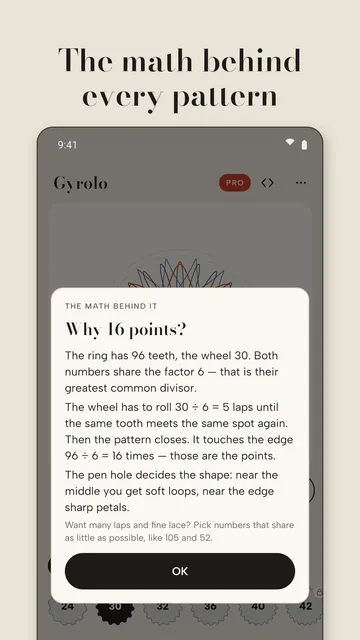
Divide the ring’s teeth by the greatest common divisor (GCD) of ring and wheel. The result is the number of points or petals. The wheel’s teeth divided by the same GCD give the number of laps the wheel has to travel around the ring before the pattern closes.
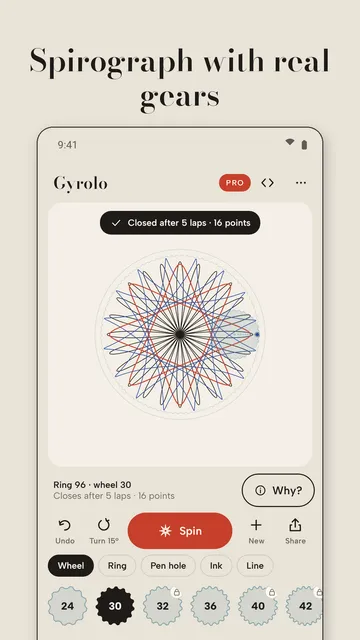
Example: ring 96, wheel 30. Both are divisible by 6, so the GCD is 6. You get 96 ÷ 6 = 16 points, and the wheel needs 30 ÷ 6 = 5 laps. If ring and wheel share no divisor other than 1, for example ring 105 and wheel 52, the pattern gets very dense: 105 points after 52 laps.
| Wheel (teeth) | GCD | Points | Laps to close |
|---|---|---|---|
| 24 | 24 | 4 | 1 |
| 30 | 6 | 16 | 5 |
| 32 | 32 | 3 | 1 |
| 36 | 12 | 8 | 3 |
| 40 | 8 | 12 | 5 |
| 42 | 6 | 16 | 7 |
Which hole gives which shape?
The pen hole decides how sharp or soft the pattern gets. A hole near the wheel’s centre only swings a little, so you get soft, wavy curves. The further out the hole, the wider the pen swings, and you get sharp petals or loops that cross each other.
If you want to plan the shape exactly, you can calculate the curve. With ring radius R, wheel radius r and hole distance d, for the angle t: x = (R − r) · cos t + d · cos((R − r) / r · t) and y = (R − r) · sin t − d · sin((R − r) / r · t). The radii are in the same ratio as the tooth counts, so the teeth are all you need.
- Hole near the centre: soft waves, a calm ornament.
- Hole halfway between centre and rim: rounded petals.
- Hole near the rim: sharp points and small loops.
How do you make a spirograph mandala?
A mandala is several layers of the same basic pattern. Draw the first layer, then turn the ring or the starting point by a small angle and draw the same pattern again. With even steps, for example 15 degrees, the picture stays symmetrical.
For depth, combine layers with different holes or colours: a dense pattern with a rim hole on the inside, a soft one with a centre hole on the outside. On black paper, light gel pens stand out especially well.
- Start with dark colours and finish with light ones.
- For a calm look, keep the same wheel and change only the hole and colour.
- A wheel that shares many divisors with the ring (e.g. 96/24) gives a few large shapes; a wheel with no shared divisor gives a fine web.
Why does my spirograph keep slipping?
Usually the pen pushes down instead of sideways against the ring. The teeth then jump and the line gets an offset. A fixed ring, a soft base of several sheets, a smooth-running pen and slow, even movements without stopping mid-lap all help.
How Gyrolo helps with spirograph drawing
Gyrolo is an Android app that works like the gear toy, just without slipping: you circle your finger anywhere on the sheet and the wheel rolls as far as your finger moves. Gyrolo is an independent app and is not affiliated with the Spirograph brand.
- Choose ring, wheel, pen hole and ink; tap Spin and the wheel finishes the pattern for you.
- “Why?” shows the maths with your numbers: the shared divisor, the laps until the pattern closes and the number of points.
- Stack layers and turn the next one by 15°; undo any layer, and your drawing survives closing the app.
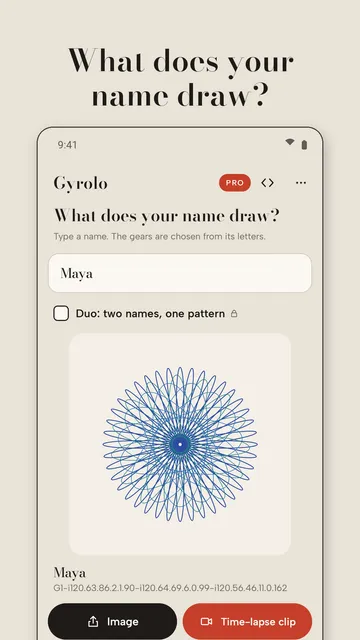
- Name patterns: the app picks the gears from the letters of a name, and the same name draws the same pattern on every phone.
- Share a 9:16 time-lapse clip or an image; every drawing has a gear code that lets anyone draw exactly the same pattern.
What the app cannot do
The free version has 2 rings, 6 wheels, 6 inks, up to 3 layers, 3 saved drawings and one time-lapse clip a day with a small Gyrolo mark. Gyrolo only draws curves from rolling gears, not freehand pictures, and it runs on Android only.
Price
Free to use; Gyrolo Atelier with all 19 wheels, 5 rings, 4 discs, 24 inks, Duo patterns and clips without the mark costs $6.99 a month or $39.99 a year in the US. The free version shows ads; Pro is ad-free. Pro is also available as a one-time lifetime purchase ($6.99 in the US as of 9 Nov 2026). We build this app ourselves; on Google Play it is listed under the developer name InfinityAkhi.
Screenshots
Related calculators on ToolboxDay
Frequently asked questions
How do I work out when a spirograph pattern closes?
Divide the wheel’s teeth by the greatest common divisor of ring and wheel; that is the number of laps. With ring 96 and wheel 36 the GCD is 12, so the pattern closes after 3 laps and has 8 points.
What is the difference between a hypotrochoid and an epitrochoid?
For a hypotrochoid the wheel rolls inside a ring; for an epitrochoid it rolls around the outside of a disc. Outside patterns tend to have loops pointing outwards.
Why do some patterns look almost the same?
What counts is the tooth ratio after reducing. Ring 96 with wheel 30 and ring 96 with wheel 42 both have 16 points but need a different number of laps, so their density differs.
Can I share my Gyrolo pattern?
Yes, as an image, as a time-lapse clip or as a gear code. Anyone who enters the code draws exactly the same pattern.
Sources
More guides
- Draw music: how lines become melodies and beats
- Photo grid splitter: how to cut a picture into a perfect grid
- Recurring payments: find them, add them up, cancel what you don’t use
- Lean angle motorcycle guide: how it is measured and what the number means
- Constellation finder: how to find constellations in the night sky
- Oil change reminder: how to time it and never miss it
- Our apps