Draw music: how lines become melodies and beats
To draw music, you translate sound into a picture: the height of a line stands for pitch, left to right stands for time, and colours or shapes stand for instruments and rhythm. To keep it sounding good, snap the line to a scale such as the pentatonic and play it over a simple chord progression at a steady tempo.
Updated:
How do you draw music?
The idea is old and is called graphic notation: instead of note heads on a five-line staff you draw shapes that describe how the music should sound. 20th-century composers wrote whole pieces this way, for example Cornelius Cardew’s graphic score “Treatise”. Iannis Xenakis went further with his UPIC system, which turned drawings directly into sound.
For your own experiments a simple grid is enough. The horizontal axis is time, the vertical axis is pitch. A flat line holds a note, a rising line runs upwards, a dot is a short hit. Use several colours and give each one an instrument, say blue for piano and red for bass.
- Turn the paper sideways and draw vertical guide lines for the beats (4 lines = one bar of 4/4).
- Mark five to eight pitch levels from bottom (low) to top (high).
- Draw the melody as a line, add hits as dots and decide on colours.
- To play it, move a finger from left to right in time and sing the notes or find them on an instrument.
Why does the pentatonic scale never sound wrong?
A pentatonic scale has five notes and no semitone steps. Because the small, clashing intervals are missing, almost any combination of its notes sounds pleasant, in any order. That is why music teachers use it for improvising, and why it is ideal when you draw lines freely and still want to hear music.
On a piano the major pentatonic is easy to find: the five black keys already form one. On the white keys, start on C and play C, D, E, G and A, leaving out F and B. The minor pentatonic uses the same notes but starts on A, which makes it sound darker.
| Scale | Notes | Feel |
|---|---|---|
| C major pentatonic | C D E G A | bright, happy |
| A minor pentatonic | A C D E G | calm, melancholic |
| C major (for comparison) | C D E F G A B | more colour, but F and B clash more easily |
How long is a bar at 120 BPM?
BPM means beats per minute. At 120 BPM one beat lasts 60 ÷ 120 = 0.5 seconds, so a bar of 4/4 with four beats lasts 2 seconds. That tells you how much time one drawn bar covers and how long a piece will be: 8 bars at 120 BPM take 16 seconds.
Slow tempos around 60 to 80 BPM feel calm, 100 to 130 BPM is typical for pop, above 160 BPM it gets hectic. Swing delays every second eighth note slightly, so the same rhythm feels looser and less mechanical.
| Tempo | one beat | one bar (4 beats) | 8 bars |
|---|---|---|---|
| 60 BPM | 1.0 s | 4.0 s | 32 s |
| 90 BPM | 0.67 s | 2.67 s | 21.3 s |
| 120 BPM | 0.5 s | 2.0 s | 16 s |
| 160 BPM | 0.375 s | 1.5 s | 12 s |
| 200 BPM | 0.3 s | 1.2 s | 9.6 s |
What chord progression fits my own melody?
One of the most common progressions in pop uses the degrees I, V, vi and IV, in C major that is C, G, A minor and F, one bar each. A melody fits best when it lands on a note of the current chord on the strong beats. In between it can wander freely.
In practice: on beat 1 of a C bar the melody sits well on C, E or G, in the F bar on F, A or C. When you turn drawn lines into sound, you can pull them to the nearest chord note at those points. That way any curve becomes a melody that fits the accompaniment.
- Pop, bright: C – G – Am – F
- Dreamy: Am – F – C – G
- Calm, jazzy: Dm7 – G7 – Cmaj7
Draw music with kids: which ideas work?
With children, drawing music works best the other way round: listen first, then draw. Play a short piece and let kids draw what they hear, such as waves for a flowing melody, spikes for drums and dots for single notes. Then someone else reads the picture as a score and performs it with voices or percussion.
- Sound score: each colour is a sound (clap, stamp, rustle), time runs from left to right.
- Name melody: each letter gets a note of the pentatonic scale and the name is sung.
- Loud and soft: thick lines are loud, thin lines are quiet.
- Shape songs: sing a heart, a wave or a rainbow as a melody and compare how each shape sounds.

How Doodlestra helps you draw music
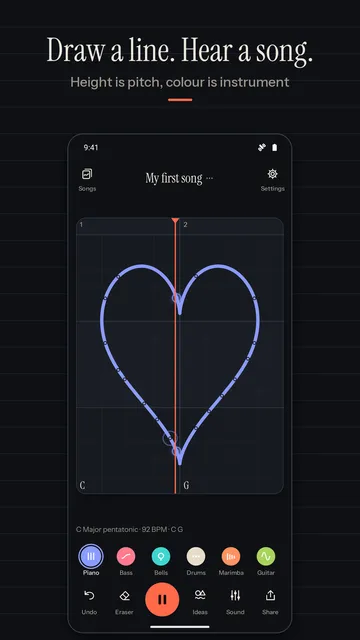
Doodlestra is an Android app that puts the grid above on your screen: whatever you draw with your finger plays right away. Height is pitch, colour is the instrument, and a playhead runs from left to right and loops your song. All sounds are synthesised live on the device; drawing and playing need no internet and no account.
- Every line snaps to the chosen scale, and the shape sets the rhythm: a flat line holds a note, a steep line becomes a run, a dot is a short hit, a circle plays two notes at once.
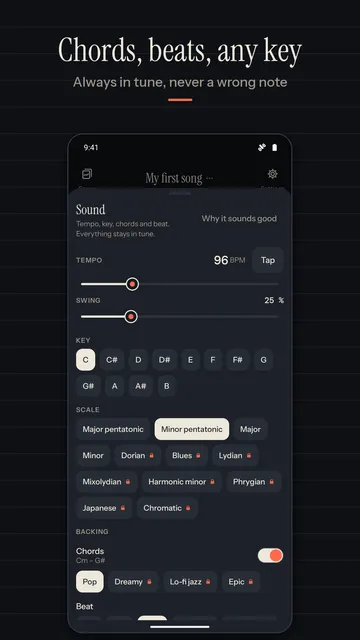
- Chords (pop, dreamy, lo-fi jazz, epic) play under your drawing; on every beat the melody moves to the nearest chord note.
- Beat and bass line with one tap, tempo from 60 to 200 BPM, swing, all 12 keys and tap tempo.
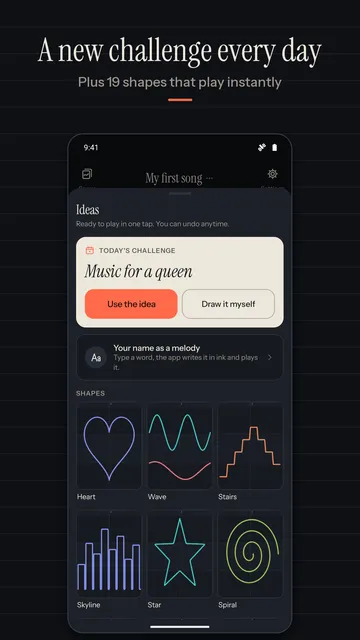
- 19 shapes to play instantly, names as melodies and a new challenge every day; note names can be shown on request.
- Export a 9:16 video in which your drawing plays along with the sound.
What the app cannot do
Doodlestra is a toy and learning tool, not a full music production app: free songs are limited to 2 bars and 3 saved songs, and free videos carry a small Doodlestra note. It uses its own synthesised sounds rather than recordings of real instruments, and it is available for Android only.
Price
Free with 6 instruments, 4 scales and video export; Doodlestra Pro (13 instruments, 12 scales, 16 bars, export as M4A, WAV and MIDI) costs $5.49 a month or $37.99 a year in the US. We build this app ourselves; on Google Play it is listed under the developer name InfinityAkhi.
Get it on Google Play: Doodlestra
Screenshots
Related calculators on ToolboxDay
Frequently asked questions
Do I need to read music to draw music?
No. Graphic notation works with height and time, not note names. If you fix a scale such as the pentatonic, you can draw freely and still hear no wrong notes.
What is the difference between major and minor pentatonic?
Both have five notes and no semitone steps. The major pentatonic (C D E G A) sounds bright; the minor pentatonic (A C D E G) uses the same notes but starts on A and sounds darker.
Can I keep editing a drawn song in a music app?
Doodlestra Pro exports songs as a MIDI file with one track per instrument, which common music apps can open. The free version exports video.
What tempo is good to start with?
Around 90 to 100 BPM. One beat then lasts a little over half a second, and it is easy to hear which part of the drawing is playing.
Sources
More guides
- Vocal range finder: how to find your range and voice type
- Spirograph drawing: how to plan points, laps and loops
- Recurring payments: find them, add them up, cancel what you don’t use
- Lean angle motorcycle guide: how it is measured and what the number means
- Constellation finder: how to find constellations in the night sky
- Oil change reminder: how to time it and never miss it
- Our apps