Skincare routine tracker: build an order you actually keep
A skincare routine tracker helps you apply products in the right order and on the right days: cleanse first, then go from thin to thick, with sunscreen last in the morning. Strong actives such as retinol and exfoliating acids usually go on separate nights. Whether you use paper, a spreadsheet or an app, the basics are cleanser, moisturizer and sunscreen.
Updated:
What order should a skincare routine go in, morning and night?
The order follows what needs to reach your skin first and what protects on top. Cleanse first, so actives don’t sit on dirt and oil. Then come thin products such as toners and serums, followed by eye cream and moisturizer to seal everything in. In the morning sunscreen always goes last; at night you skip it.
The American Academy of Dermatology (AAD) recommends a gentle, non-abrasive, alcohol-free cleanser, lukewarm water, fingertips rather than a washcloth, and washing no more than twice a day plus after heavy sweating.
| Step | Morning | Evening |
|---|---|---|
| 1 | Cleanser | Oil cleanser or cleanser (double cleanse if wearing makeup) |
| 2 | Toner (optional) | Toner (optional) |
| 3 | Serum, e.g. vitamin C | Tonight’s active, e.g. retinol or exfoliant |
| 4 | Eye cream (optional) | Eye cream (optional) |
| 5 | Moisturizer | Moisturizer |
| 6 | Sunscreen | – |
What is a skin cycling schedule?
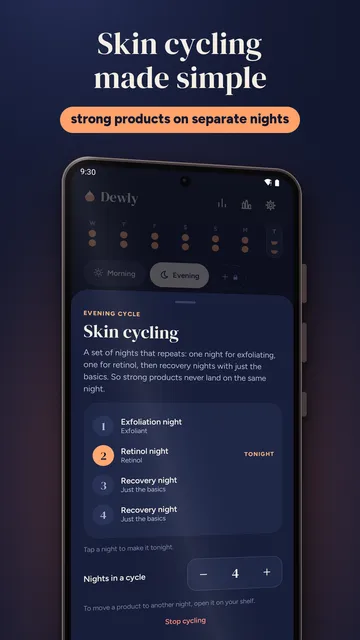
Skin cycling is a popular routine idea rather than a fixed medical rule: strong actives alternate with recovery nights in a cycle, most often four nights long. Your skin gets the actives but also breaks. The morning routine stays the same, including sunscreen.
If your skin is sensitive or you are new to retinol, you can stretch the cycle to five or six nights with more recovery nights. Always follow the directions on your products.
| Night | What | Example |
|---|---|---|
| 1 | Exfoliation night | chemical exfoliant (AHA/BHA), then moisturizer |
| 2 | Retinol night | retinol, then moisturizer |
| 3 | Recovery night | cleanser and moisturizer only |
| 4 | Recovery night | cleanser and moisturizer only |
Can you use retinol and an exfoliating acid on the same night?
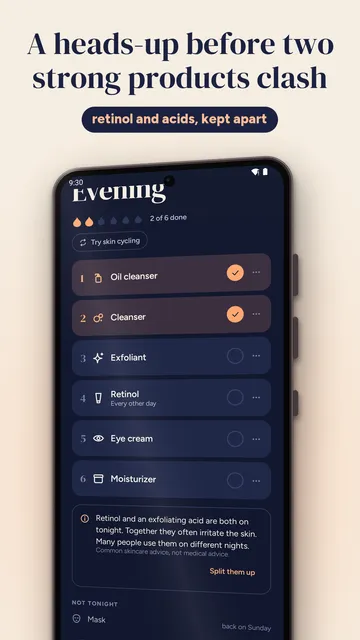
Better not. The AAD notes that products containing retinol or benzoyl peroxide can make your skin more sensitive, and exfoliating on top may worsen dry skin or cause breakouts. Spread strong products across different nights.
For exfoliating itself, the AAD advises applying gently with small circular motions for about 30 seconds, rinsing with lukewarm water and moisturizing afterwards. How often depends on your skin type and the method; the more aggressive the exfoliation, the less often. Redness and stinging mean it was too much.
- Don’t exfoliate open cuts, wounds or sunburned skin.
- Introduce new products one at a time, so you know what your skin doesn’t tolerate.
- For lasting irritation, a rash or a skin condition, see a doctor or dermatologist.
How do you track a skincare routine?
Most routines fail not on the products but on the schedule: the exfoliant is for twice a week, retinol not on the same night, the mask on Sunday. A tracker, whether a printed weekly grid, a spreadsheet or an app, should answer one question each evening: which steps are on tonight?
Track three things: which products you use on which days, whether you actually did the routine, and how your skin felt. After a few weeks you can see patterns, for example that irritation follows nights when two strong products overlapped. Change one thing at a time so the pattern stays readable.
- Per product: type, morning or evening, and days (daily, certain weekdays, every other day, or part of a cycle).
- Per day: done or skipped, plus a quick note such as dry, oily, red, breakout or tight.
- Per opened product: the date you opened it and its shelf life after opening.
How long does skincare last after opening?
Many packs carry a small open-jar symbol with a number like 12M, meaning usable for 12 months after opening. Under the EU Cosmetics Regulation (EC) No 1223/2009 this period-after-opening mark is required on products that keep for more than 30 months; products with a shorter life show a best-before date instead.
Worked example: a sunscreen marked 12M, opened on 15 March 2026, is good until about 15 March 2027. Write the opening date on the pack. If a product smells or looks different, throw it out sooner. The AAD also recommends at least SPF 30 broad-spectrum sunscreen, about a teaspoon for the face, reapplied every two hours outdoors.

How Dewly works as a skincare routine tracker
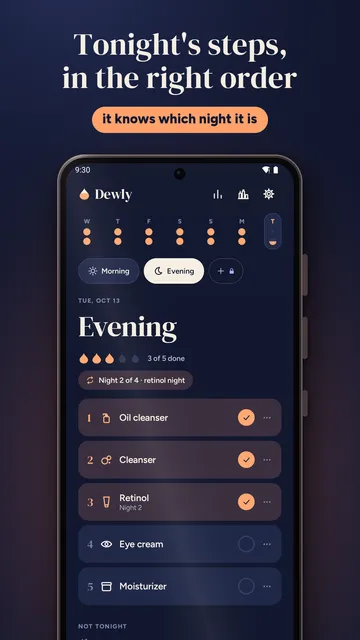
Dewly is a skincare routine tracker for Android. You tap the products on your shelf, and it builds your morning and evening routine in the right order. Each product gets its own days, so you only see the steps that are on today. No account, no quiz, no face scan.
- A schedule per product: every day, certain weekdays, every other or every third day, or as part of a night cycle for skin cycling.
- Automatic order from cleanser to sunscreen, and a heads-up when two strong products such as retinol and an exfoliating acid land on the same night.
- Tap “Why?” on any step for a plain-words explanation of the ingredient, with sources from dermatology.
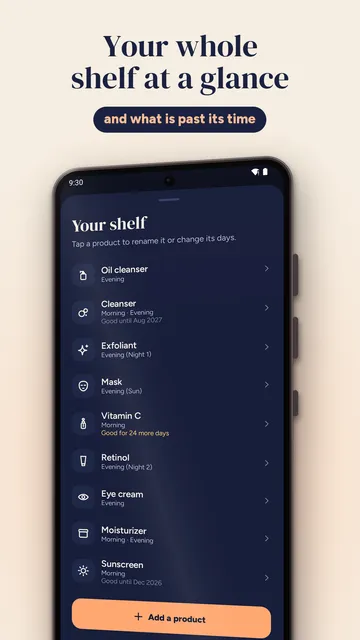
- A shelf with every product and its shelf life after opening (opening date plus a number like 12M).
- Morning and evening reminders, a two-tap skin journal and a backup file.
What the app cannot do
Dewly is not a medical product, does not treat skin conditions and does not replace advice from a doctor; its hints are general skincare knowledge. It does not recognize your products automatically or read ingredient lists, and it is available for Android only.
Price
Routines, skin cycling, hints, reminders, the shelf and the skin journal are free; Pro with progress history, stats and extra routines costs $3.79 a month or $23.99 a year in the US (as of 7 Nov 2026, prices vary by country). The free version shows ads; Pro is ad-free. We build this app ourselves; on Google Play it is listed under the developer name InfinityAkhi.
Screenshots
Frequently asked questions
Does serum go before or after moisturizer?
Before. Rule of thumb: thin to thick. The serum absorbs, the moisturizer seals, and in the morning sunscreen goes on last.
How often should I exfoliate?
It depends on your skin type and the product. The stronger the exfoliant, the less often. Many routines plan it for one or two nights a week, separate from the retinol night.
Can I use a spreadsheet as a skincare routine tracker?
Yes. A weekly grid with products in rows and days in columns works. It gets harder with every-other-day products and cycles, which is where an app that knows which night it is saves time.
Do I have to type in ingredients in Dewly?
No. You only choose what kind of product it is, such as cleanser, retinol or exfoliating acid; the order and hints follow from that.
Sources
More guides
- Glow up challenge: how to plan and document your 30 days
- What season am I? How to find your color season at home
- Recurring payments: find them, add them up, cancel what you don’t use
- Lean angle motorcycle guide: how it is measured and what the number means
- Constellation finder: how to find constellations in the night sky
- Oil change reminder: how to time it and never miss it
- Our apps