What season am I? How to find your color season at home
To answer “what season am I?”, compare colors in pairs right under your face in daylight and without make-up, the way a color analyst uses fabric drapes. You test three things in turn: undertone (warm or cool), depth (light or deep) and clarity (bright or soft), and the combination points to one of the four seasons or one of the twelve more detailed sub-seasons.
Updated:
How do I find out my color season at home?
Color analysts hold fabric drapes under the face because color works most strongly right next to the skin. A flattering color makes skin look more even, eyes clearer and shadows softer; an unflattering one brings out redness and dark circles or makes the face look washed out. You can recreate this with fabric, scarves or tops from your own wardrobe.
The key is comparing in pairs. Judging a single color on its own is hard, but switching quickly between two usually shows the difference straight away. If you can, ask a friend to watch too, because you get used to your own reflection quickly.
- Light: stand facing a window during the day, out of direct sun. Yellow lamp light warms every color and skews the test.
- Preparation: no make-up, hair pulled back (cover dyed hair with a white or grey towel), and a plain white or grey top.
- Round 1, undertone: gold versus silver, peach versus pink, tomato red versus raspberry red. If the yellow-based options win, you are probably warm; otherwise cool.
- Round 2, depth: a light pastel against a deep color in the same direction, such as light blue against navy.
- Round 3, clarity: a bright, pure color against a muted, greyed version, such as cherry red against dusty rose.
- Write down the winner after each round, then compare the two or three seasons that fit your answers against each other.
What are the 4 seasons and the 12 color seasons?
Classic seasonal color analysis sorts people into four groups named after the seasons: spring and autumn are warm, summer and winter are cool. Spring is warm and bright, autumn warm and muted, summer cool and soft, winter cool and high-contrast. Because many people do not fit neatly into one of the four, consultants expanded the system as early as the 1980s.
The widely used 12-season system splits each season into three. Every sub-season has a dominant trait and a secondary one, and neighboring seasons share a trait. Soft Autumn sits close to Soft Summer because both wear muted colors; the only difference is the undertone.
| Season | Dominant trait | Secondary trait |
|---|---|---|
| Light Spring | light | warm |
| True Spring | warm | bright |
| Bright Spring | bright | warm |
| Light Summer | light | cool |
| True Summer | cool | soft |
| Soft Summer | soft | cool |
| Soft Autumn | soft | warm |
| True Autumn | warm | soft |
| Deep Autumn | deep | warm |
| Deep Winter | deep | cool |
| True Winter | cool | bright |
| Bright Winter | bright | cool |
How do I know if my skin undertone is warm or cool?
Undertone is the hue beneath your visible skin color, and it is independent of how light or deep your skin is. Seasonal analysis separates warm, yellow-based skin from cool, blue- or pink-based skin. Very fair and very deep skin can both be warm or cool, and olive skin often reads as neutral, which makes it easy to misjudge.
The most reliable signal is a side-by-side comparison on your face rather than any single trait. The popular quick tests give hints, not certainty.
- Gold or silver: if gold jewelry makes your skin look fresher, that points to warm; silver points to cool.
- Pure white or cream: cool types look crisper in pure white, warm types in cream or ivory.
- Wrist veins: greenish is said to mean warm, bluish cool. The test is popular but unreliable, because skin thickness and lighting change what you see.
- Sun: people who tan golden easily are more often warm, people who burn pink more often cool. That too is only a hint.
Can you find your color season from a photo or with AI?
A single photo is a weak basis for color analysis. The camera adjusts white balance automatically, lamps tint skin yellow or blue, and filters shift colors further. The same face can look warm in one shot and cool in the next, which is why photo-based tests often return different seasons on different tries.
A comparison in the same light and the same frame is more dependable: when two colors sit under your face at the same time, any color cast affects both equally and the difference between them stays visible. Even so, every color season result is a guide. Research shows that people do choose clothing colors to suit their skin tone, but there is no scientific proof yet for the fixed seasonal categories, and different consulting systems do not classify colors consistently.
What do I do with my season? Palette, neutrals and jewelry
The practical payoff is in shopping. Colors from your palette matter most close to your face: tops, scarves, collars and make-up. Trousers, skirts and shoes sit further away, so you can choose more freely there. Knowing your palette also makes pieces easier to combine, because they share undertone and clarity.
Alongside accent colors, each season has neutrals for coats, trousers and shoes: warm seasons tend toward camel, chocolate brown or olive instead of black, cool seasons toward navy, charcoal or grey. Jewelry follows the undertone test, with gold or copper for warm and silver or platinum for cool. Colors outside your palette do not have to leave your closet; wear them with a flattering scarf or collar between the fabric and your face.

How Drapewell helps you find your season
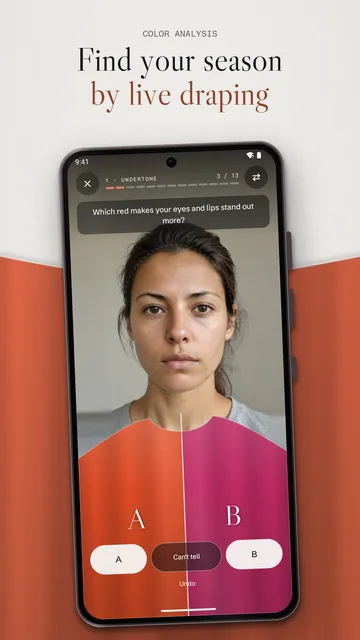
Drapewell is an Android app that brings the drape test above to your phone: the front camera acts as a mirror, digital drapes appear under your chin, and you decide with your own eyes which one looks better. You do not need an account.
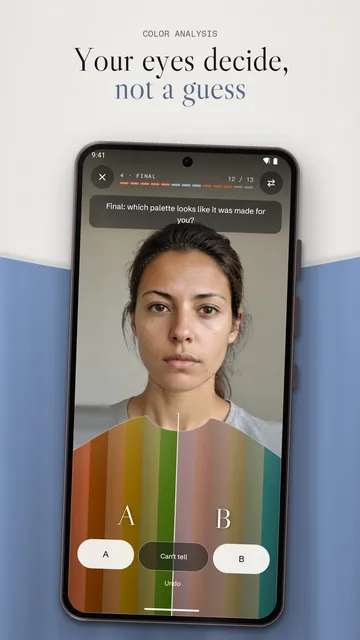
- 13 side-by-side comparisons in four rounds: undertone, depth, clarity and a final between the seasons closest to your answers; you pick A, B or “Can’t tell” and can undo an answer.
- Light check: warns you about yellow lamp light and rooms that are too dark; the screen runs at full brightness while you drape.
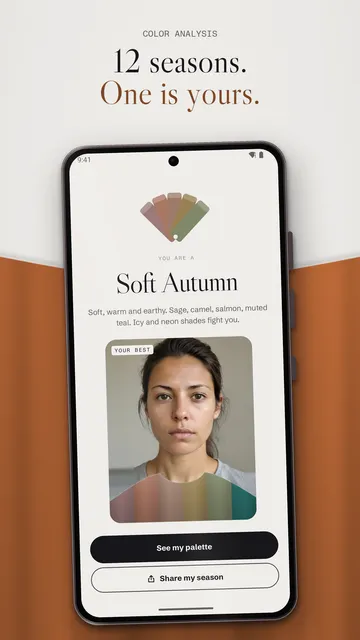
- Result: one of 12 seasons, from Light Spring to Deep Winter, with a short description and your best drape on your own photo.
- Palette with a name and hex code for each color: three colors are free; Pro unlocks the full palette of 20 colors plus neutrals, jewelry metals and colors to keep away from your face.
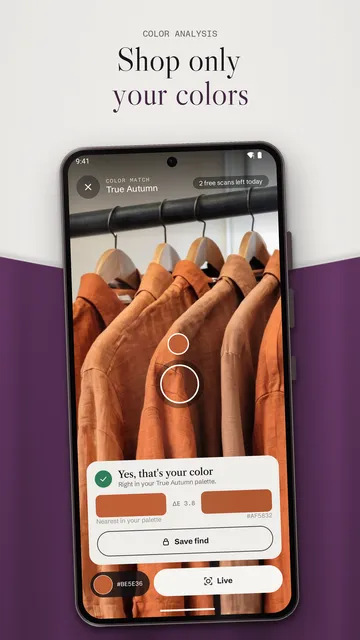
- Color scanner with the rear camera: point it at a garment and see whether it matches, is close or is better avoided, measured as the ΔE2000 color distance to your palette; three scans a day are free.
- Sharing: a card with your worst and best drape, and a 9:16 reveal video in which the drapes change until your season appears.
What the app cannot do
Drapewell does not replace an in-person analysis with real fabric drapes: screen colors are not fabric, and the result depends on your light, the camera’s white balance and your own perception, so treat it as a guide. The color scanner also measures color as the camera sees it in the current light, and the app is available for Android only.
Price
The full drape test, your result, three palette colors, sharing and three color scans a day are free; Drapewell Pro costs $3.79 a month or $23.99 a year in the US (as of November 2026) and can be canceled anytime in Google Play. We build this app ourselves; on Google Play it is listed under the developer name InfinityAkhi.
Get it on Google Play: Drapewell
Screenshots
Related calculators on ToolboxDay
Frequently asked questions
Can my color season change over time?
Seasonal analysis treats undertone as stable. Hair color, a tan and aging do change depth and contrast, though, so a neighboring season may fit better later on. After a big change in hair color it is worth retesting.
I seem to sit between two seasons. What now?
That is common, because neighboring seasons share a trait. Favor the colors that appear in both palettes, and test the two candidates directly against each other again in daylight.
Should I wear make-up for a color analysis?
No. Make-up, especially foundation, blush and lipstick, shifts your skin tone and blurs the comparison. Test with a bare face and your hair pulled back.
How accurate is a “what season am I” app?
A test in which you compare colors directly on your own face tells you more than a quiz or the analysis of a single photo. It still depends on the light, so if in doubt, repeat it by a window in daylight.
Is Drapewell free?
The test, your result, three palette colors, sharing and three color scans a day are free. The full palette, unlimited scans, saved finds, the make-up and hair color guide, all 12 palettes in the mirror and video export in 1080p without watermark are part of Pro.
Sources
More guides
- Glow up challenge: how to plan and document your 30 days
- Skincare routine tracker: build an order you actually keep
- The Y2K Camera Look: Where It Comes From and How to Shoot It
- Recurring payments: find them, add them up, cancel what you don’t use
- Lean angle motorcycle guide: how it is measured and what the number means
- Constellation finder: how to find constellations in the night sky
- Our apps