Row counter for knitting: how to keep track of every row
A row counter keeps track of how many rows or rounds you have worked, whether it is a clicker on your needle, a tally on paper or an app. What really prevents mistakes is the habit around it: count at the end of every row, track repeats and shaping separately, and check the number against your knitting now and then.
Updated:
How to count rows and rounds on the fabric
Any counter is only as good as your occasional check against the knitting itself. Flat knitting is worked in rows, circular knitting in rounds; for counting purposes one round equals one row.
Whether the cast-on row counts as row 1 depends on the pattern. If it doesn’t say, decide for yourself and write it down. What matters is that you do it the same way throughout a project.
- Stockinette (stocking stitch in the UK): on the right side every row forms a line of V-shaped stitches. Count the Vs in one vertical column from bottom to top.
- Garter stitch: each visible ridge is two rows. Count the ridges and multiply by two.
- The row on your needle counts once you have finished it, so click at the end of the row, never halfway through.
- On long stretches, hang a removable stitch marker or a scrap of contrast yarn at the edge every 10 rows. When you recount, you only count from the last marker.
Tracking “decrease every X rows” without guesswork
Patterns usually write shaping as a rule, for example: “Starting on row 24, decrease 1 st at each end, then every 8th row 5 more times (6 decreases in total).” This is where most miscounts happen, because you have to keep the total row and the interval in your head at once. Write the shaping rows out before you start.
The last shaping row is: start row + (number of decreases − 1) × interval. In the example: 24 + 5 × 8 = 64. With 86 stitches and two decreases per shaping row you end with 86 − 6 × 2 = 74 stitches, a handy check number to count on the needle after the last decrease.
If instead you need to increase or decrease evenly across a single row, divide the stitch count by the number of increases: 64 stitches and 8 increases means one increase after every 8 stitches. When the numbers don’t divide cleanly, an increase calculator spreads them for you.
| Decrease | Row | Stitches after |
|---|---|---|
| 1 | 24 | 84 |
| 2 | 32 | 82 |
| 3 | 40 | 80 |
| 4 | 48 | 78 |
| 5 | 56 | 76 |
| 6 | 64 | 74 |
Following pattern repeats alongside the total
A repeat runs over a fixed number of rows, say a cable over 6 rows. The simplest method is a second counter that goes from 1 to 6 and starts again at 1, while the main counter keeps the total.
If you only know the total, you can work out the repeat row as long as the pattern started on row 1: subtract 1 from the total, divide by the repeat height, and the remainder plus 1 is your current repeat row. Example, row 112 with a 6-row repeat: 111 divided by 6 is 18 remainder 3. You have finished 18 full repeats and are on row 4 of the 19th.
- If the pattern starts later than row 1, subtract the rows before it first.
- Two motifs with different heights (for example a 6-row cable and an 8-row lace panel) each need their own counter.
Turning inches or cm into rows with your row gauge
Many patterns give lengths rather than rows (“work even until sleeve measures 15 in / 38 cm”). Your row gauge turns that into a target row. Knit a swatch larger than 4 in / 10 cm, wash and dry it the way you will treat the finished piece, then count the rows over 4 in / 10 cm in the middle.
The maths: rows per 4 in divided by 4, times the target length in inches (or rows per 10 cm divided by 10, times cm). At 24 rows per 10 cm and a 38 cm sleeve that is 2.4 × 38 = 91.2, so about 91 rows. Treat it as a guide: knitting stretches under its own weight, so measure flat as well before you bind off (cast off in the UK).
Common counting mistakes and a quick checklist
Many errors happen at interruptions, not while knitting: the phone rings, you put the needles down, and later nobody knows whether that row was counted. A lifeline is the safety net: thread a smooth contrast yarn with a tapestry needle through every stitch of a finished, correctly counted row, for instance at the end of a repeat. If you have to rip back, the stitches are caught there and you know exactly which row it is.
- Always count at the end of the row, before you turn the work or put it down.
- Before you start, note whether the cast-on counts, where the repeat begins and on which rows the shaping falls.
- A marker at the edge every 10 rows, a lifeline at the end of repeats.
- After each shaping section, compare the stitches on your needle with the check number.
- For the second sleeve or sock, copy the row counts from the first instead of measuring again, so both match.
How Rowkeep helps you count rows
Rowkeep is a row counter for Android, for knitting and crochet, that handles the steps above for you: total rows, repeats and shaping rules run side by side, and every tap is saved immediately. It works without an account and offline.
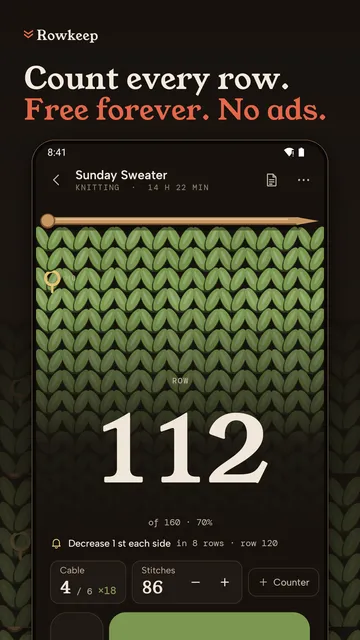
- A large plus area with minus set apart; the volume buttons count a row up or down, and the screen stays on while you count.
- Linked repeat counter: it moves with every row, jumps back to 1 after N rows and counts how many repeats you have finished.
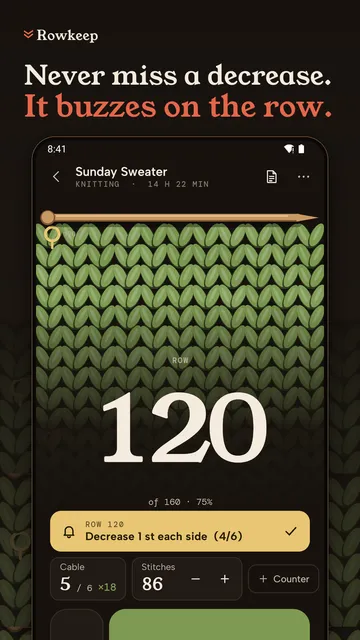
- Row reminders such as “from row X, every N rows, M times”: on the due row your phone vibrates and a band shows the task, with a preview like “in 2 rows” beforehand.
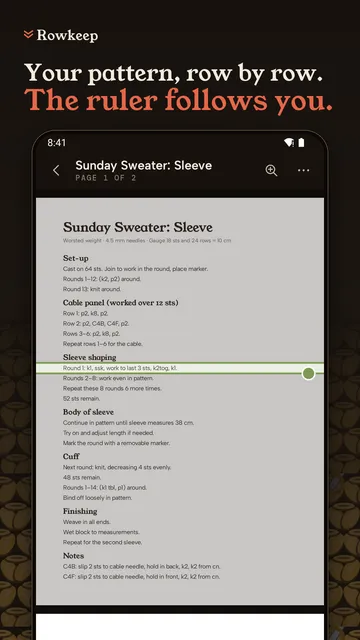
- Attach your pattern as a PDF or photo: a highlighter line marks the current line and moves down with every counted row, even across pages.
- Extra free counters, for example for stitches, plus target rows with a progress bar and notes for each project.
- Free tools: increase or decrease evenly across a row, and a gauge calculator for 4 in or 10 cm.
- Back up all projects to a ZIP file and restore them again, free of charge.
What the app cannot do
Rowkeep does not count by itself: you tap each row or press a volume button, and it does not read or interpret your pattern. The highlighter moves one line per row, so it only lines up when the pattern has one line per row; the app is available for Android only.
Price
Counting, backup and both tools are free for good; Pro, with a pattern for every project and unlimited projects, counters and reminders, is a monthly or yearly subscription. The free version shows ads; Pro is ad-free. We build this app ourselves; on Google Play it is listed under the developer name InfinityAkhi.
Get it on Google Play: Rowkeep
Screenshots
Related calculators on ToolboxDay
Frequently asked questions
Does the cast-on row count as row 1?
That depends on the pattern. If it doesn’t say, decide for yourself and note it. Staying consistent within a project matters more, so that both sleeves or socks come out the same.
How do I count rows in garter stitch?
In garter stitch two rows make one visible ridge. Count the ridges on one side and double the number.
I lost count. How do I find the right row again?
Recount on the fabric from your last marker or lifeline and set your counter to that number. If you are shaping, the stitch count on your needle tells you how many shaping rows you have already worked.
Does Rowkeep work for crochet too?
Yes. You choose knitting or crochet for each project, and the counter, repeats, reminders and pattern view work the same way for both.
Sources
More guides
- Recurring payments: find them, add them up, cancel what you don’t use
- Lean angle motorcycle guide: how it is measured and what the number means
- Constellation finder: how to find constellations in the night sky
- Oil change reminder: how to time it and never miss it
- Garden layout planner: how to lay out a raised bed step by step
- Trade journal: what to include and how to review it
- Our apps