Reverse singing game: how to talk and sing backwards
In the reverse singing game you record a word, phrase or line of a song, play it backwards, and then try to copy that reversed sound as closely as you can. When your attempt is flipped back around, everyone hears whether the original words come out, and usually they come out hilariously wrong, which is the whole point.
Updated:
How does the reverse singing game work?
The game is built on two flips. First the original is played backwards, then your imitation is played backwards a second time. Because reversing twice brings you back to forwards, a good attempt ends up sounding like the original. A poor one sounds like a foreign word or just a noise.
All you need is something that can record audio and play it in reverse: an audio editor on a computer, a video editing app, or a dedicated reverse audio app on your phone. Speed matters, because most players listen to the reversed clip five to ten times before they try it themselves.
- Record the original: say a short word or phrase clearly, for example your name.
- Play the original backwards and listen to it several times.
- Copy the reversed sound by speaking or singing it, and record that attempt.
- Play your attempt backwards: now everyone hears what you “really” said.
- Compare and score it, either by a vote in the group or with an app that gives a score.
How to talk backwards
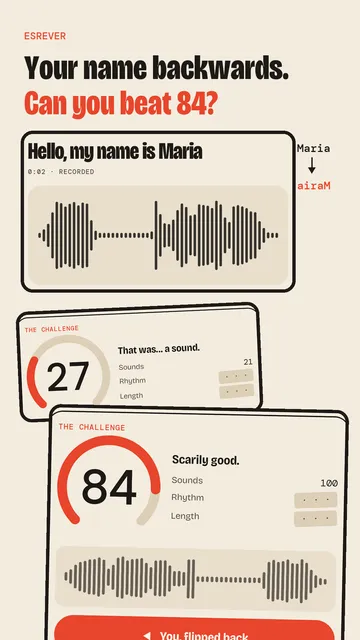
Talking backwards is not the same as reading the letters in reverse. “Maria” spelled backwards is “airaM”, but played backwards it sounds different, because every single sound is reversed too. A “k”, for example, starts with a closure and ends in a short puff of air; reversed, you hear the puff first and the click last. A diphthong like the “i” in “like” (roughly ah-ee) turns into ee-ah.
So instead of rewriting the spelling, write down what you actually hear in the reversed clip in your own made-up spelling. Then practise it syllable by syllable and only join the syllables together at the end.
- Start short: one- and two-syllable words, then names, then short phrases.
- Split the reversed clip into chunks and copy each chunk on its own.
- Keep the melody of your voice: if the pitch rises at the end of a question, it falls at the start of the reversed version.
- Speaking a little slower than normal stops you from swallowing sounds.
- Put breathy sounds (h, or p, t, k at the end of a word) in front of the vowel, just as you hear them in the clip.
What are the best words to say backwards?
How hard a word is in reverse depends less on its length than on its sounds. Vowels and long hissing sounds like “s” or “sh” sound almost the same backwards, while hard stop consonants and clusters of consonants sound completely alien. For a fair round, mix easy and hard words, or have every player try the same list.
A fun side effect: words that are spelled the same both ways (palindromes such as “level” or “racecar”) do not necessarily sound the same when the audio is reversed, again because the sounds themselves flip. That is a good one to test in a group.
| Level | Examples | Why |
|---|---|---|
| Easy | mama, banana, sunny | lots of vowels, soft sounds, few stop consonants |
| Medium | Maria, hello, pizza | two or three syllables, few hard consonants |
| Hard | cheeseburger, strawberry milkshake | stops and consonant clusters sound strange in reverse |
| Expert | tongue twisters, song lines | long and fast; rhythm and melody have to be reversed too |
How to reverse audio
Any tool that can reverse a recording works for the game. On a computer the free audio editor Audacity is a common choice: select the recording and pick Reverse from the Effect menu. If you are comfortable with the command line, ffmpeg has an areverse filter, for example “ffmpeg -i original.mp3 -af areverse reversed.mp3”. The filter keeps the whole clip in memory, which is no problem for short recordings.
On a phone, many video editing apps can play a clip in reverse, and there are dedicated reverse voice apps that put recording, reversing and replaying on one button. For the game, speed is what counts: the fewer taps between recording and hearing it backwards, the smoother a round goes.
Reverse singing challenge rules for parties and game night
A few fixed rules turn messing around into a proper game for a group. Agree beforehand how often the reversed clip may be played and how it is scored, so nobody argues afterwards.
- Everyone gets the same word or song line, so results can be compared.
- Listening limit: for example, five plays at most, then you record.
- Scoring without an app: after the flip back, the group gives 1 to 5 points for how recognisable the original is.
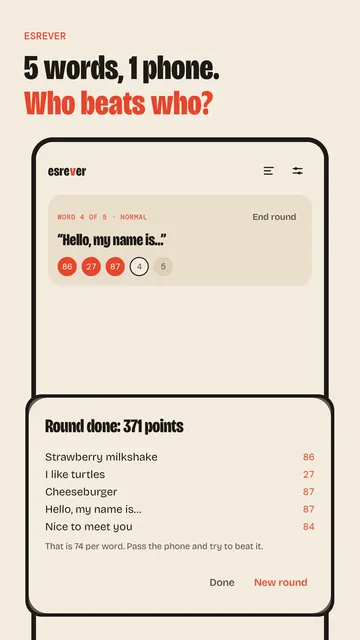
- Five words per round, add up the points, then pass the phone on.
- For song lines, let people speak them in the first round and sing them in the next; melody makes it much harder.

How Esrever helps with the reverse singing game
Esrever is an Android app that cuts this routine down to a few taps: record, hear it backwards instantly, copy it, and the app flips your attempt back and compares it with the original. You do not need an account; the microphone is only used while you record, and your recordings stay on your device unless you share them yourself.
- Recordings up to 20 seconds, as many as you like, each playable backwards and forwards.
- Challenge with a score from 0 to 100: the comparison runs on your phone and shows sounds, rhythm and length.
- 5-word rounds on Easy, Normal or Hard, with a total score for passing the phone around.
- Share the result as a video with an animated waveform and score card (with a small watermark) or as audio.
- A library for saved recordings, plus importing your own audio files to play music backwards (up to 20 seconds).
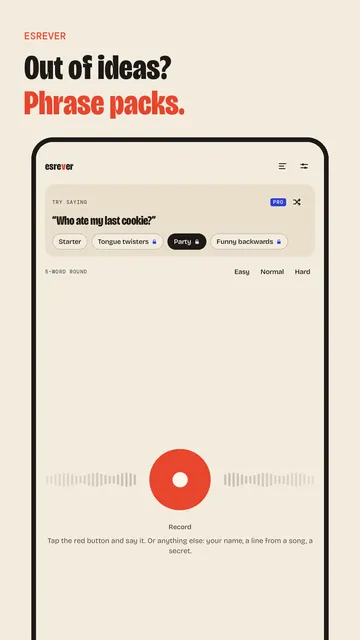
- A free Starter phrase pack; Pro adds Tongue Twisters, Party and Funny Backwards Words.
- Pro: voice effects (Chipmunk, Deep, Echo, Robot), videos without watermark with extra looks, recordings up to 5 minutes and longer imports.
What the app cannot do
The score is a playful comparison of two recordings, not a singing or pronunciation lesson, and Esrever does not write out what a word sounds like backwards; you have to hear that yourself. In the free version recordings and imports are limited to 20 seconds, and the app is available for Android only.
Price
Recording, reverse playback, the scored challenge, saving and sharing are free; Esrever Pro is a weekly ($4.69) or yearly ($27.99) subscription in the US (November 2026), and you can cancel anytime in Google Play. We build this app ourselves; on Google Play it is listed under the developer name InfinityAkhi.
Get it on Google Play: Esrever
Screenshots
Related calculators on ToolboxDay
Frequently asked questions
Why does a word sound different backwards than it looks spelled backwards?
Reversing audio flips not just the order of the sounds but every sound itself. A “k” goes from click-then-puff to puff-then-click, and a diphthong like ah-ee becomes ee-ah.
How many times can you listen to the reversed clip?
That is up to the group. A fixed number, such as five plays, keeps the game fair for everyone.
Does the reverse singing game work with songs?
Yes, but keep it to one short line. Melody and rhythm have to be reversed as well, which is much harder than speaking.
Does Esrever need an internet connection?
Recording, reverse playback and the challenge work offline. Purchases through Google Play need a connection.
Sources
More guides
- Vocal range finder: how to find your range and voice type
- The VHS Camcorder Look: What Creates It and How to Film It
- The Y2K Camera Look: Where It Comes From and How to Shoot It
- Recurring payments: find them, add them up, cancel what you don’t use
- Lean angle motorcycle guide: how it is measured and what the number means
- Constellation finder: how to find constellations in the night sky
- Our apps