Vocal range finder: how to find your range and voice type
A vocal range finder works in two steps: find the lowest and the highest note you can sing cleanly and hold, then compare that span with the typical ranges of bass, baritone, tenor, alto, mezzo-soprano and soprano. Your lowest note matters most, because the top of a voice stretches with practice far more than the bottom.
Updated:
How do I find my vocal range?
All you need is a reference: a piano or keyboard, a piano app, or a tuner that shows the note you sing. Warm up for a few minutes first with humming or lip trills, because a cold voice does not reach as far.
Only count notes you can hold steadily for about a second without pushing, creaking or shouting. A note that only flashes for a moment is not part of your usable range.
- Hum a comfortable note at speaking pitch and find the matching key on the piano.
- Sing down step by step (or slide) on “oh” or “oo” until your voice turns into a creak. The last clear, held note is your lowest note.
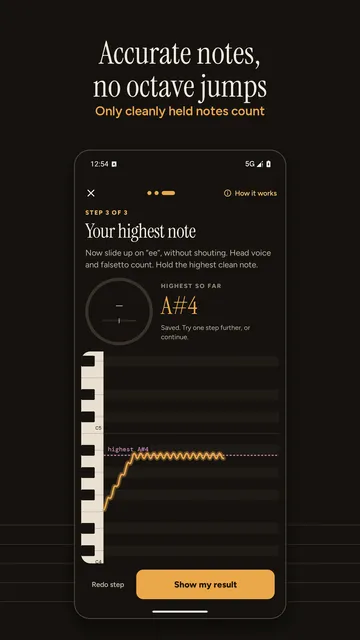
- Rest briefly, then slide up on “ee”. Head voice and falsetto count, shouting does not. The last clean, held note is your highest note.
- Write down both notes with their octave number, for example A2 and F4, and compare them with the chart below.
- Repeat the test on another day. Your low notes often differ between morning and evening, and several tests give a more reliable picture.
What are the vocal ranges for men and women?
Classical singing uses six main voice types: bass, baritone and tenor for men, alto (contralto), mezzo-soprano and soprano for women. Choirs usually only split into soprano, alto, tenor and bass. The ranges below are common guide values; some references place the limits a note or two differently.
Notes use scientific pitch notation, where C4 is middle C on the piano. Frequencies assume the standard reference pitch A4 = 440 Hz.
| Voice type | Typical range | Frequency |
|---|---|---|
| Bass | E2 – E4 | 82 – 330 Hz |
| Baritone | A2 – A4 | 110 – 440 Hz |
| Tenor | C3 – C5 | 131 – 523 Hz |
| Alto (contralto) | F3 – F5 | 175 – 698 Hz |
| Mezzo-soprano | A3 – A5 | 220 – 880 Hz |
| Soprano | C4 – C6 | 262 – 1047 Hz |
How many octaves is my vocal range?
Your range is the distance between your lowest and highest note. Count the semitones, meaning every white and black key in between, and divide by 12, since an octave has twelve semitones.
Example: lowest note A2, highest note F4. From A2 to A3 is 12 semitones, from A3 to F4 another 8, so 20 semitones in total. 20 divided by 12 is about 1.7 octaves. With A2 at the bottom, this voice is most likely a baritone; the fact that the top does not reach A4 yet matters less, because the high end usually grows more with practice.
There is no single “good” number. Trained classical singers often cover well over two octaves, while a smaller range is perfectly normal for most people. For singing, what counts is the part of your range where your voice sounds easy.
- Frequency and semitones: each semitone up multiplies the frequency by about 1.0595, and an octave doubles it (A3 = 220 Hz, A4 = 440 Hz).
- If your range sits right between two voice types, go by where your voice feels comfortable, not by your most extreme note.
How to find your vocal range without a piano
You do not need a real piano. An online piano, a keyboard app or a tuner that names the note you sing does the same job. Play a note, match it with your voice, and move up or down one key at a time.
The usual trap is the octave: a man singing A2 and a piano key A3 sound “the same note”, but they are twelve semitones apart. Check that the key you match is in the same register as your voice; a tuner or pitch app that shows the octave number avoids that mistake.
Vocal range vs. voice type: what is the difference?
Your range is simply the span of notes you can sing. Your voice type also takes into account the tessitura, the part of the range where you can sing for a long time without strain, as well as timbre, vocal weight and agility. Classical subtypes such as lyric tenor or coloratura soprano are judged by voice teachers, not measured by a device.
- Do not shout: a yelled top note does not count as your highest note.
- Vocal fry (creaky voice) at the bottom is noise, not a sung note.
- Do not test when you have a cold or after hours of talking; the result will come out too small.
- The NIDCD advises avoiding the extremes of your range such as screaming or whispering, and seeing a doctor if your voice stays hoarse for more than three weeks.

How Larkwell works as a vocal range finder
Larkwell is an Android app that runs the test above with your phone’s microphone: you slide to your lowest and highest note in three steps, and only notes held cleanly for half a second count. Pitch detection runs on the device and uses a research method (YIN with smoothing over time, as in pYIN), so a shout, a creak or a single wrong reading does not become your result.
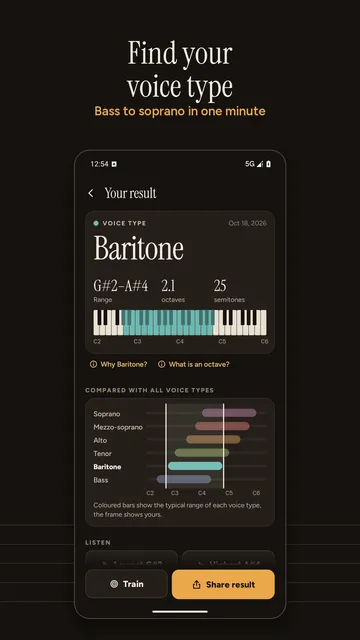
- A result with your voice type, your range from lowest to highest note, octaves and semitones, and a keyboard with your span highlighted.
- A comparison bar with all six voice types, an honest note when you sit between two types, and “Why?” explanations with sources.
- Listen back to your lowest and highest note, plus a result card to share.
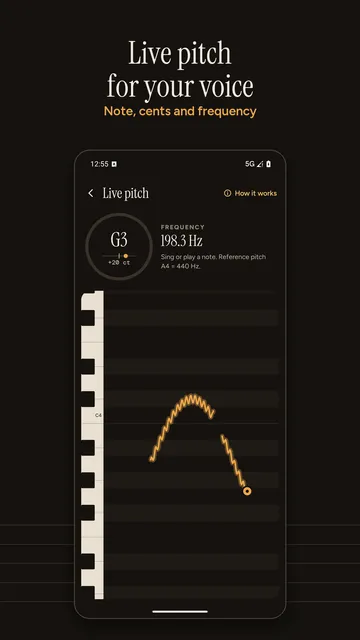
- Live pitch with note name, cents and frequency, reference pitch A4 adjustable from 430 to 450 Hz, note names with B or H.
- Pitch trainer “Lark Flight”: your voice steers a lark through notes from your own training zone, and a soft guide tone can play each note first.
- A daily practice reminder, a backup file for your data, light and dark design; no account needed.
What the app cannot do
Larkwell classifies your voice by measured range only and does not judge timbre or voice subtype, so the result is a rough guide, not a diagnosis or a replacement for singing lessons. Background noise or a weak microphone can disturb the measurement, and the app is available for Android only.
Price
The vocal range test as often as you like, your voice type, the result card, live pitch, the reminder and three trainer rounds per day are free; Larkwell Pro with unlimited rounds, the Medium and Hard levels and progress over weeks costs $6.49 a month or $41.99 a year in the US. The free version shows ads; Pro is ad-free. We build this app ourselves; on Google Play it is listed under the developer name InfinityAkhi.
Get it on Google Play: Larkwell
Screenshots
Related calculators on ToolboxDay
Frequently asked questions
Which note decides my voice type, the lowest or the highest?
Mostly the lowest, because the bottom of a voice barely moves with training while the top does. Larkwell therefore weighs your low note more heavily than your high note.
Does falsetto count towards my vocal range?
For a range test, yes: head voice and falsetto are part of what you can sing. Shouted notes and vocal fry do not count.
Can my vocal range change?
Yes. Time of day, warming up and practice all affect it, and the range often grows with training; voices also change during puberty and with age. Retesting after a few weeks shows how your range develops.
I am a woman with a low voice. Can I be a tenor?
Some low female voices sit in the tenor range, and choirs sometimes place them there. The voice type labels describe ranges, so go by where your voice is comfortable rather than by the label.
Sources
More guides
- 4-7-8 Breathing: How the Technique Works and What It Can Do
- Snore recorder: how to record and understand your nights
- Recurring payments: find them, add them up, cancel what you don’t use
- Lean angle motorcycle guide: how it is measured and what the number means
- Constellation finder: how to find constellations in the night sky
- Oil change reminder: how to time it and never miss it
- Our apps