KP index explained: what Kp you need to see the northern lights
The KP index rates how disturbed Earth’s magnetic field is over a three-hour window on a scale from 0 to 9. In Alaska a Kp of 2 to 3 can be enough, Scotland usually needs about Kp 4 to 5, the northern US states and London need Kp 5 to 6, and Chicago or New York need Kp 6 to 7 or more. A high Kp only helps if it is dark and the sky is clear.
Updated:
What the Kp number measures
Kp is a planetary index of geomagnetic activity, introduced by Julius Bartels in 1949 and now provided by the GFZ Helmholtz Centre for Geosciences in Potsdam, Germany. It is based on 13 magnetic observatories at mid-latitudes around the globe. Each value covers three hours, so there are eight Kp values per day.
NOAA’s Space Weather Prediction Center also publishes an estimated Kp in near real time, updated every minute. Values of 0 to 4 are quiet to unsettled; 5 or more means a geomagnetic storm, which NOAA rates on its G1 to G5 scale. The scale also notes how far south the aurora has been seen at each level.
| Kp | NOAA level | Aurora has been seen as low as |
|---|---|---|
| 5 | G1 minor | commonly visible at high latitudes such as northern Michigan and Maine |
| 6 | G2 moderate | New York and Idaho (typically 55° geomagnetic latitude) |
| 7 | G3 strong | Illinois and Oregon (typically 50°) |
| 8 to 9- | G4 severe | Alabama and northern California (typically 45°) |
| 9 | G5 extreme | Florida and southern Texas (typically 40°) |
Which Kp your location needs
For the aurora, ordinary latitude matters less than geomagnetic latitude, your distance from the magnetic pole. Because the magnetic pole sits toward Canada, North America is better placed than Europe at the same map latitude. NOAA’s examples describe the farthest south the aurora has been seen, so treat them as the optimistic edge.
The table below is a rule of thumb we calculated from each city’s geomagnetic latitude (dipole model) and the NOAA latitude bands. It describes a chance of seeing a glow low on the northern horizon, not a display overhead.
| Place | Geomagnetic latitude | Kp needed |
|---|---|---|
| Anchorage | about 62° | Kp 2 to 3 |
| Edinburgh | about 58° | Kp 4 to 5 |
| Seattle, Minneapolis, London | about 53° | Kp 5 to 6 |
| Chicago, New York | about 50 to 51° | Kp 6 to 7 |
| Denver | about 47° | Kp 7 to 8 |
| Dallas | about 41° | Kp 9 |
Why Kp alone is not enough
Kp describes the last three hours. Whether the sky lights up in the next hour depends on the solar wind, which spacecraft measure about a million miles upstream and which reaches Earth roughly 30 to 90 minutes later. The key value is Bz, the north-south direction of the magnetic field in the solar wind. When Bz turns strongly south (negative), the solar wind couples into Earth’s field much more efficiently.
Then come local conditions. It has to be properly dark, ideally with the sun at least 12 degrees below the horizon. Clouds block everything, and a bright moon or city lights wash out a faint display. At mid-latitudes a weak aurora often looks like a pale gray band to the eye, while a phone camera in night mode picks up far more color.
How to plan an aurora night
This order helps you catch more chances and waste fewer cold hours:
- Check the three-day Kp forecast. If Kp 5 or higher is predicted, keep the evening free.
- In the evening, check cloud cover and the moon for your spot and pick a place with a clear view north, away from city lights.
- Watch the solar wind: if speed rises and Bz turns strongly south, activity can pick up within the hour.
- Once twilight has ended, face north and take test shots with your phone camera in night mode.
- Be patient: the aurora often comes in bursts lasting a few minutes, with quieter spells in between.
Common mistakes
These misunderstandings cost the most sightings:
- Looking only at the Kp number and ignoring clouds or the moon.
- Treating the real-time estimated Kp as a forecast for the whole night.
- Looking straight up instead of low to the north, where the glow usually appears at mid-latitudes.
- Giving up too early: a strong burst can still come after midnight.
- Searching from a lit-up town instead of a dark spot with an open northern horizon.
How Glowcast turns the KP index into an answer
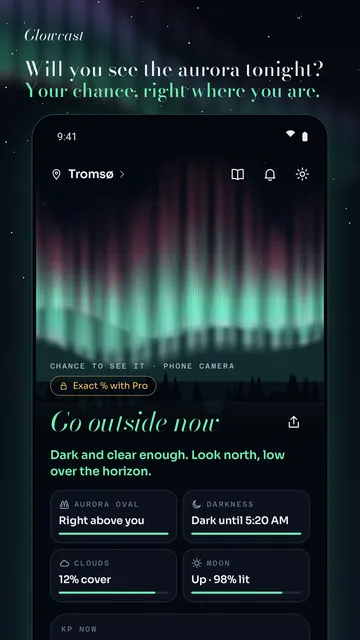
Glowcast combines NOAA’s Kp and live aurora oval with darkness, cloud cover from MET Norway and moonlight at your location. Instead of a bare number you get a rating with a reason, for example oval close, but cloudy.
- Live map of the aurora oval and the current Kp, explained in plain words.
- Visibility for your spot from four factors: distance to the oval, darkness, cloud cover and the moon.
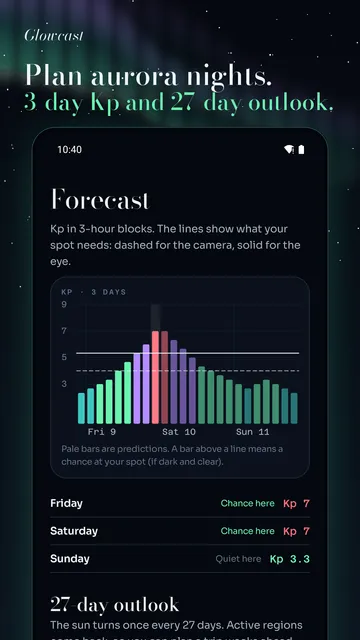
- Three-day Kp forecast that marks the Kp your spot needs for the eye and for the camera.
- Solar wind with its estimated arrival time at Earth.
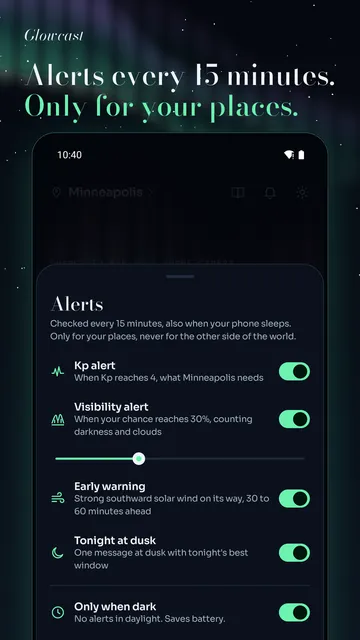
- Alerts for your place, checked every 15 minutes even while the phone sleeps.
- With Pro: early warnings while the solar wind is still on its way, several locations, a 27-day outlook and the last 24 hours of solar wind as a chart.
What the app cannot do
Glowcast shows probabilities, not promises: the aurora is a natural phenomenon and even the best forecast can be wrong. The app needs an internet connection for NOAA and MET Norway data and is not affiliated with either.
Price
Glowcast is free to use; Pro costs $3.79 a month or $23.99 a year in the US, without a free trial. The free version shows ads; Pro is ad-free. We build this app ourselves; on Google Play it is listed under the developer name InfinityAkhi.
Get it on Google Play: Glowcast
Screenshots
Related calculators on ToolboxDay
Frequently asked questions
What KP index do I need to see the northern lights?
It depends on your geomagnetic latitude. Alaska can see aurora at Kp 2 to 3, Scotland at about Kp 4 to 5, the northern US states usually need Kp 5 to 6, and places like Chicago or New York need Kp 6 to 7 or more.
How far ahead can the aurora be forecast?
Kp forecasts look about three days ahead and are rough. The most reliable warning comes from solar wind data, which gives roughly 30 to 90 minutes of lead time.
Why can’t I see anything when Kp is high?
Clouds, city lights or a bright moon are the usual culprits, or the active phase has already passed. A northward Bz can also weaken a storm for a while.
Is Kp from NOAA the same as Kp from GFZ?
GFZ provides the official Kp from 13 observatories. NOAA adds an estimated Kp in near real time, updated every minute, which can shift slightly once final values are in.
Sources
More guides
- Recurring payments: find them, add them up, cancel what you don’t use
- Lean angle motorcycle guide: how it is measured and what the number means
- Constellation finder: how to find constellations in the night sky
- Oil change reminder: how to time it and never miss it
- Garden layout planner: how to lay out a raised bed step by step
- Trade journal: what to include and how to review it
- Our apps