Egg laying tracker: count eggs and understand your hens
An egg laying tracker replaces the paper log in the coop: you record every egg, for the whole flock or per hen, and get laying rate, breaks and cost per egg from it. What matters most is consistency: log daily, write down feed, and check a laying break against season, age and molt before you start to worry.
Updated:
How many eggs does a chicken lay a day?
At most about one: forming an egg takes roughly a day, so even a hen in top form lays in runs with occasional rest days. High-production laying hybrids can manage well over 250 eggs in their first laying year, many heritage breeds fewer.
Pullets usually start laying at 18 to 22 weeks, depending on breed. Production drops with each following year, while eggs tend to get larger.
| Item | Value | Calculation |
|---|---|---|
| hens | 6 | |
| days | 30 | |
| possible eggs | 180 | 6 × 30 |
| eggs laid | 126 | egg log |
| laying rate | 70% | 126 ÷ 180 |
| eggs per day | 4.2 | 126 ÷ 30 |
Why are my chickens not laying eggs?
Usually it is something natural: too little daylight, molt, age or broodiness. Only when none of these fit, or a hen looks ill, is it time for the vet; a tracker cannot find a cause, it can only show how long a hen has been on a break.
University extension services cite roughly 14 to 16 hours of light a day for steady laying. In autumn and winter days get shorter and many hens lay little. During the autumn molt hens replace their feathers, and the break often lasts several weeks.
- Daylight: shorter days in autumn and winter slow laying, which is normal.
- Molt: feathers drop and energy goes into new plumage instead of eggs.
- Age: pullets have not started yet, older hens lay less.
- Broodiness: the hen stays on the nest and wants to sit on eggs.
- Stress, heat, parasites such as mites, a new coop or predators nearby.
- Feed: layers need a layer ration with enough protein and calcium; too many treats crowd it out.
- Hidden nests: sometimes hens keep laying, just not where you look.
How much does a backyard egg cost?
Divide the feed cost for a period by the number of eggs laid; subtract any income from egg sales first. That shows whether your flock gets more expensive in winter, when they eat as much but lay less.
Example: a 50 lb bag of layer feed for $22 lasts six hens a little over a month at about a quarter pound per hen per day. If they lay 126 eggs in that time, each egg costs about $0.17 in feed. In December with only 40 eggs the same feed works out at $0.55 an egg. Coop, bedding, vet care and the birds themselves come on top in a full cost count.
How much light do chickens need to lay eggs?
Extension guidance puts it at about 14 to 16 hours a day for consistent production. Laying drops as days shorten below that, which is why most backyard flocks slow down from autumn.
Some keepers add light in winter, others let their hens rest. If you add light, extend the morning rather than the evening so hens can find their roost at dusk, and increase it gradually.
How long does it take for a chicken egg to hatch?
Chicken eggs take about 21 days. In an incubator, eggs are commonly candled around day 7 and day 14 to spot infertile ones, and turning stops around day 18 for lockdown.
Other species differ: quail eggs take about 17 to 18 days, duck eggs around 28 days. An incubation calendar works out the hatch date from the day you set the eggs.

How Henwell helps you track eggs
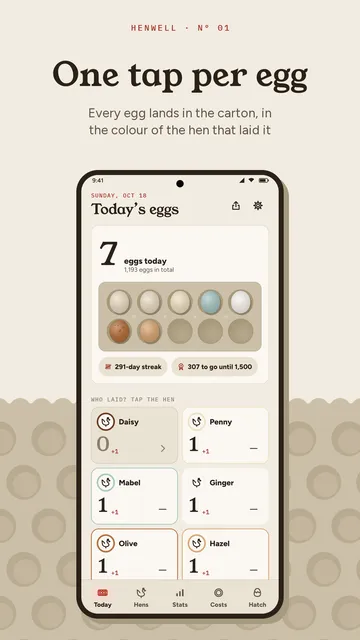
Henwell is an egg laying tracker for Android that replaces the paper log: one tap per egg, for the flock or per hen, with no account. Your records are stored on your phone.
- One tap adds an egg; a home screen widget adds +1 for the flock and up to 4 hens without opening the app.
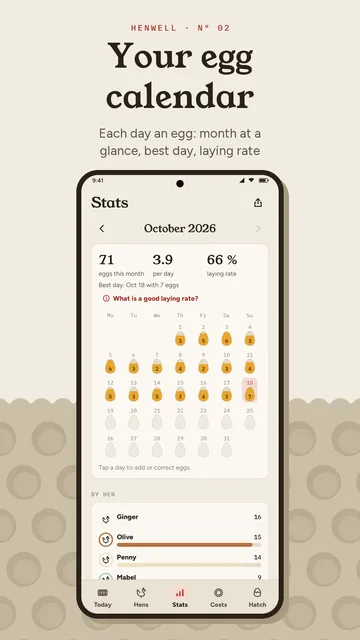
- Monthly egg calendar with average per day and laying rate, plus streaks and milestones.
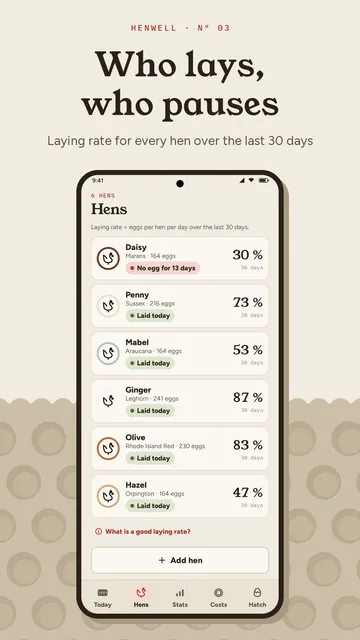
- Every hen with name, breed, shell colour and hatch date, laying performance per hen and “Paused for X days”, with no limit on flock size.
- Notes on molt, winter break, point of lay and broodiness, each number with a “Why?” and its source.
- Log feed purchases and egg sales in kg or lb, an evening reminder, and a free backup file.
- With Pro: yearly statistics per hen, cost per egg, a hatch planner for seven poultry species with candling days and reminders, PDF yearly report and CSV.
What the app cannot do
Henwell only counts what you enter and does not detect illness; it is a record book, not veterinary advice. It does not handle any registration your local rules require, and it is available for Android only.
Price
Counting, hens, calendar and backup are free; Henwell Pro is a subscription at $3.79 a month or $23.99 a year in the US, cancel any time in Google Play. The free version shows ads; Pro is ad-free. We build this app ourselves; on Google Play it is listed under the developer name InfinityAkhi.
Get it on Google Play: Henwell
Screenshots
Related calculators on ToolboxDay
Frequently asked questions
How many eggs does a chicken lay a year?
It depends heavily on breed and age. Modern laying hybrids can manage well over 250 eggs in their first year, many heritage breeds fewer, and production falls from the second year on.
Do chickens stop laying in winter?
Many lay much less or stop in winter because of the short days. That is normal and not a sign of illness on its own.
When do pullets start laying?
Usually at 18 to 22 weeks, depending on breed and season. The first eggs are often small and irregular.
Can I track each hen separately in Henwell?
Yes. You can log eggs for the whole flock or for a specific hen and then see the laying performance per hen.
Sources
More guides
- Garden layout planner: how to lay out a raised bed step by step
- Pet vaccine tracker: keep your dog’s and cat’s shots on schedule
- Reptile tracker: what to record for your snake or lizard
- Recurring payments: find them, add them up, cancel what you don’t use
- Lean angle motorcycle guide: how it is measured and what the number means
- Constellation finder: how to find constellations in the night sky
- Our apps