Fishing journal: what to log after every catch
A fishing journal records each catch with date, water, species, length, weight and bait, plus time and weather if you want to spot patterns. Write it at the water, log blank days too, and check your state’s rules on licenses, size limits and seasons, because they differ from state to state and sometimes from lake to lake.
Updated:
What should a fishing journal include? (template)
A useful fishing log book is short enough to fill in on the bank or in the boat and complete enough to learn from later. The core fields are the same everywhere: when, where, what, how big, and on what. Everything else is optional, but time of day and conditions are what turn a list of fish into patterns.
Log the catch right away, not in the evening from memory. Lengths and times drift quickly, and the time of the bite is exactly what you will want to compare across a season.
- Essentials: date and time, water body, species, length and/or weight, bait or lure, kept or released.
- Conditions: sky, wind, air pressure, water temperature, water clarity.
- Technique notes: depth, retrieve speed, rig, structure (weed edge, drop-off, dock).
- A photo on a ruler or measuring board as proof of length and to help with ID later.
- Blank days (fished, caught nothing). Without them every method looks better than it is.
| Date / time | Water | Species | Length / weight | Bait | Kept? |
|---|---|---|---|---|---|
| Oct 17, 6:42 PM | Mill Pond | Largemouth bass | 19.1 in / 3.27 lb | Swimbait 5 in | released |
| Oct 14, 7:10 AM | North Quarry | Walleye | 24.4 in / 5.07 lb | Swimbait 5 in | kept |
| Oct 15 | Mill Pond | – | – | Crankbait | blank day |
How to measure a fish length
Most anglers record total length: from the tip of the snout to the tip of the tail. Lay the fish flat on a wet measuring board or next to a tape, mouth against the stop, and read the length at the end of the tail. Exactly how the tail is positioned for legal length is defined in each state’s regulations, so check the measuring rule in your state’s fishing digest before keeping a fish that is close to the limit.
Length matters legally: Virginia, for example, makes it unlawful to alter a game fish with a size limit in a way that makes its total original length impossible to measure while you are on the water. For trophies, the same agency accepts a good photo with a length and girth measurement.
- Wet your hands and the board, keep the fish out of the water as briefly as possible.
- Snout against the stop, body straight, read at the end of the tail.
- Measure girth around the thickest part of the body if you want a weight estimate.
- Take a photo with the scale visible, then log the numbers before you release the fish.
| Length | Girth | Length × girth² ÷ 800 |
|---|---|---|
| 16 in | 10 in | about 2.0 lb |
| 20 in | 12 in | about 3.6 lb |
| 24 in | 14 in | about 5.9 lb |
What are solunar fishing times?
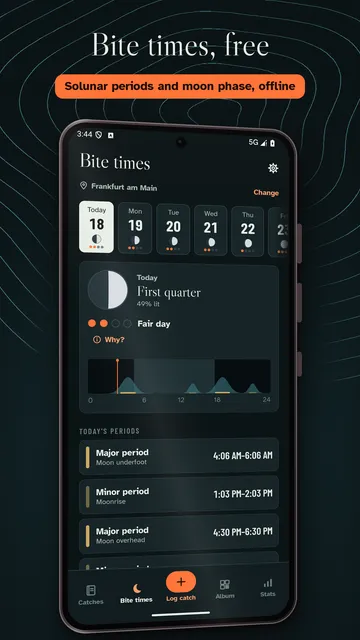
Solunar tables predict bite times from the moon. Major periods sit around the moment the moon is directly overhead or directly underfoot and are usually shown as windows of about two hours; minor periods sit around moonrise and moonset and last about one hour.
Whether fish actually follow them is disputed. Water temperature, light, pressure changes and fishing pressure matter at least as much. Your own fishing journal is the honest test: log the time of every catch and after a season compare the share of catches that fell inside the windows with the share you would expect by chance, since the windows cover a fixed part of the day anyway.
Do I need a fishing license, and who sets size limits?
In the United States, freshwater and inshore rules are set by each state’s fish and wildlife agency, so license requirements, size and creel limits and seasons vary by state and often by water body. In Virginia, for example, all fishing on inland waters requires a freshwater fishing license unless you are license exempt, and it is unlawful to have more than the daily creel limit of any fish in possession.
In federal waters, NOAA Fisheries explains that fishery management plans are generally developed by one of eight regional fishery management councils. Before every trip, check the current digest of the state you fish in and any special rules for that specific lake or river. A journal that records what you kept also helps you stay inside daily limits.

How Castwell works as a fishing journal
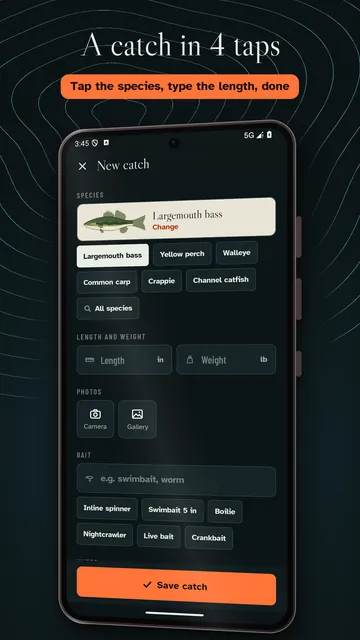
Castwell is a fishing journal for Android that works without an account. Logging a catch takes a few taps: pick the species, type the length, save; everything else is optional. Your catches and photos stay on your phone.
- Log a catch with buttons for the species you caught last, search across 50 species (English, German, Latin) or add your own; length and weight as numbers, up to four photos, bait and water suggested from your earlier entries, released or kept.
- Solunar bite times for 30 days ahead, plus moon phase, moonrise, moonset, sunrise and sunset for your place, calculated on the phone, even without signal at the water.
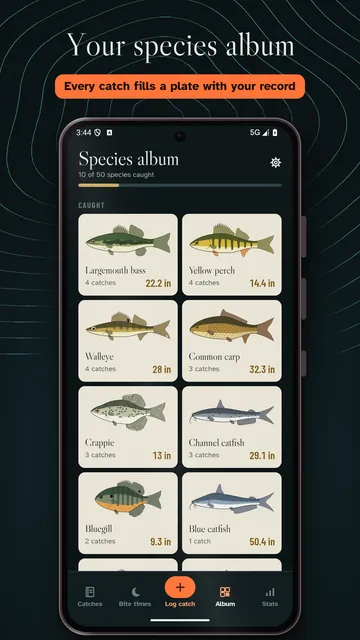
- Species album: every species you catch becomes a colour plate with your personal best, plus season stats with days fished and your longest and heaviest fish.
- Catch card to share with photo, measuring board, length, date and moon phase; the water only shows if you want it to.
- Free backup file with all catches and photos for moving to a new phone.
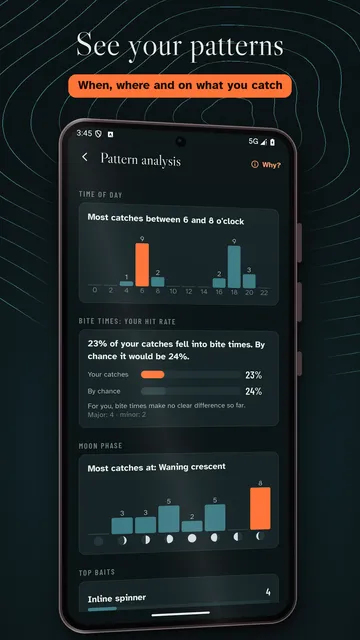
- With Pro: pattern analysis (time of day, moon phase, your bite-time hit rate compared with chance, best bait per species), barometer history on phones with a pressure sensor, and a catch list as PDF plus CSV export.
What the app cannot do
Castwell does not identify species automatically; you choose the species yourself. Bite times are a calculation based on the disputed solunar theory, not a promise of fish. The app does not include US state regulations, so licenses, size limits and seasons still have to be checked with your state agency; it is available for Android only.
Price
Logging catches, bite times, the species album, personal bests, catch cards and backup are free; Castwell Pro costs $3.79 per month or $27.99 per year in the US. The free version shows ads; Pro is ad-free. We build this app ourselves; on Google Play it is listed under the developer name InfinityAkhi.
Get it on Google Play: Castwell
Screenshots
Related calculators on ToolboxDay
Frequently asked questions
Should I log fish I release?
Yes, if you want to learn from your journal. A released fish tells you just as much about time, bait and conditions as one you keep, and it keeps your hit rate honest.
Is total length measured with the tail pinched?
That depends on your state. Each agency defines how a fish is measured for size limits in its regulations, so check your state’s digest when a fish is close to the limit.
Does Castwell work without signal?
Logging catches and calculating bite times, moon phase and sun times happen on the phone, so they work without reception at the water. No account is needed.
Can Castwell show my state’s size limits?
No. Castwell’s closed-season overview covers only a few German states. For US waters, use your state fish and wildlife agency’s current regulations.
Sources
More guides
- Hunting journal: what to log and how it makes you a better hunter
- Live moon wallpaper: moon phases, moonrise and battery explained
- Recurring payments: find them, add them up, cancel what you don’t use
- Lean angle motorcycle guide: how it is measured and what the number means
- Constellation finder: how to find constellations in the night sky
- Oil change reminder: how to time it and never miss it
- Our apps