Hive inspection checklist: what to record and when to test for mites
At every hive inspection, record the date, whether you saw the queen or eggs, frames of brood and stores, queen cells, temper and any varroa count. The Honey Bee Health Coalition suggests treating promptly at 1% mites in the dormant and population increase phases and at 2% at peak and decline.
Updated:
What to record at each hive inspection
A hive record is only useful if you can compare one visit with the next. Writing down the same few items in the same order every time shows you trends you would otherwise miss: brood shrinking, eggs missing for two visits in a row, or a mite count creeping up after the main flow.
- Date, colony and apiary
- Queen seen or not, eggs present, plus her year and marking colour
- Frames covered by bees, frames of brood, honey and pollen, drone comb and foundation
- Queen cells: none, cups, or cells with eggs or larvae
- Temper and signs of swarming
- Supers added or removed, feeding and amount
- Mite count with method and result, every treatment with product and withdrawal period
- Harvest per colony and a short free note
Hive inspection step by step
Decide what the visit is for before you open the hive. That keeps it short and calm, and it keeps your notes consistent.
- Set the goal: swarm check, adding space, checking stores or sampling for mites.
- Open the hive and look down between the frames to see how many seams of bees there are.
- Pull frames one by one and note brood, stores, drone comb and empty comb.
- Look for eggs or the queen. Fresh eggs mean a laying queen was present a few days ago.
- In swarm season, check every frame the queen can reach for queen cells.
- Note temper and anything unusual, close up, and finish the record before you leave the apiary.
How often to inspect and to sample for mites
Swarm season sets the pace. A colony can swarm once queen cells are capped. The German bee institute LWG Veitshöchheim gives queen development as 3 days egg, 5 days larva and 8 days pupa, with the cell capped on day 9, so it advises checking all frames every 7 to at most 9 days during swarming. A 7-day rhythm is recommended for beginners.
For varroa, the Honey Bee Health Coalition recommends sampling monthly from the population increase phase, or at least 4 times from peak population to decline, and always again after a treatment. The UK National Bee Unit asks for monitoring at least four times each season: early spring, after the spring flow, at honey harvest and in late autumn.
Alcohol wash or sugar roll: how to read your result
Take bees from a brood frame, making sure the queen is not on it, because brood frames carry more nurse bees. Measure about 300 bees, roughly half a cup. Wash them in alcohol, or shake them for three minutes in powdered sugar for the non-lethal sugar roll, then count the mites. Mites divided by bees, times 100, gives mites per 100 bees. Example from the coalition guide: 12 mites in 300 bees is 4%.
After a treatment, an alcohol wash should generally show under 2%. A sticky board is only a quick check after treatment; if it shows more than a few mites, follow up with a wash. The coalition notes that thresholds vary by region and advises asking your state apiarist or extension service.
| Colony phase | No immediate control needed | Control promptly |
|---|---|---|
| Dormant (sample just before clustering) | under 1% | 1% or more |
| Population increase | under 1% | 1% or more |
| Peak population | under 2% | 2% or more |
| Population decrease | under 2% | 2% or more |
Natural mite drop on a monitoring board (UK method)
The National Bee Unit uses natural mite drop as a quick indicator. Leave an oiled or sticky tray under an open mesh floor for at least 7 days in summer, longer in winter, and divide the mites by the number of days. Multiply the daily drop by 400 from November to February, by 30 from May to August, and by 100 in March, April, September and October to estimate the mites in the colony. Treat before the colony reaches 1,000 mites. The method is unreliable in broodless or collapsing colonies.
Whatever method you use, follow the product label: the coalition guide lists several treatments that may only be used when no honey supers are on the hive, so plan treatments around your harvest.

How Combwell keeps your hive inspection notes
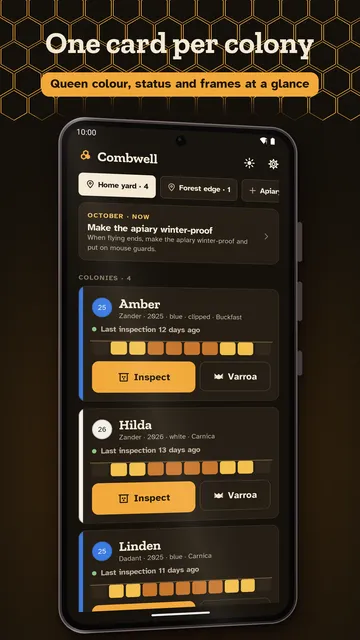
Combwell is an Android beekeeping app that gives every colony its own hive card and is built to be used with gloves on. It needs no account and works offline at the apiary.
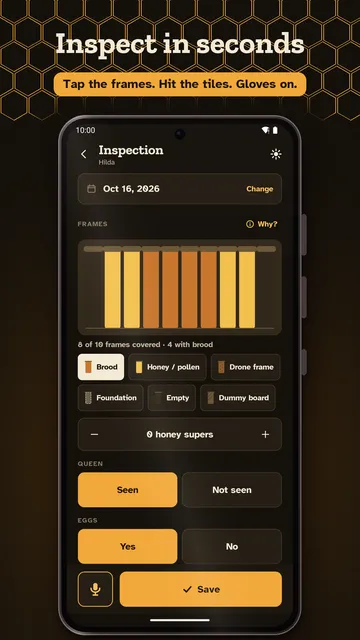
- Big tiles for queen seen, eggs, brood, queen cells, temper and stores
- Frame view from above: mark each frame as brood, honey, drone frame, foundation or empty
- Voice input: say one sentence and Combwell sets the tiles and keeps it as a note
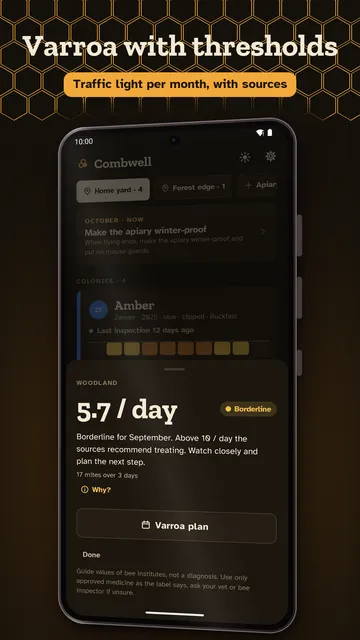
- Mite counts by drop board, sugar roll or alcohol wash, with a monthly traffic light based on the Honey Bee Health Coalition and the National Bee Unit
- Treatment log with product, amount, supplier, receipt and withdrawal period
- Swarm check reminder every 7 days in swarm season (adjustable) and a month-by-month plan
What the app cannot do
Combwell does not diagnose disease and does not replace your bee inspector, extension apiarist or vet. Thresholds are guide values from bee institutes, and the app never shows doses: follow the product label.
Price
Free for one apiary with two colonies; Combwell Pro is a monthly or yearly subscription. The free version shows ads; Pro is ad-free. We build this app ourselves; on Google Play it is listed under the developer name InfinityAkhi.
Get it on Google Play: Combwell
Screenshots
Frequently asked questions
Is the old 2 to 3 percent varroa rule still current?
The 9th edition of the Honey Bee Health Coalition guide (June 2026) uses 1% for the dormant and population increase phases and 2% for peak and decline. Local guidance can differ, so check with your extension service.
Sugar roll or alcohol wash?
The National Bee Unit describes the results as comparable and both as fairly reliable. The sugar roll does not kill the sampled bees; the alcohol wash does.
How often should I inspect in swarm season?
Every 7 days is the safe rhythm, and no more than 9, because a queen cell is capped on day 9 and the colony can swarm after that.
Does a sticky board replace a wash?
No. The coalition guide treats it as a quick post-treatment check only, and the National Bee Unit calls natural mite drop a not particularly accurate estimate.
Sources
More guides
- Recurring payments: find them, add them up, cancel what you don’t use
- Lean angle motorcycle guide: how it is measured and what the number means
- Constellation finder: how to find constellations in the night sky
- Oil change reminder: how to time it and never miss it
- Garden layout planner: how to lay out a raised bed step by step
- Trade journal: what to include and how to review it
- Our apps