Face symmetry test: how to measure your face and read the result
A face symmetry test draws a vertical midline through the bridge of the nose, the nose tip and the chin, then compares matching points such as eye corners, brows and mouth corners on both sides. The average distance between those pairs gives the score. It is only reliable with a straight head, even light and a neutral expression, and no real face is perfectly symmetrical.
Updated:
How do you measure facial symmetry?
Every measurement starts with a vertical midline. It runs through points that exist only once in the face: the bridge of the nose between the eyes, the nose tip, the middle of the upper lip and the tip of the chin. You then compare pairs of points that should sit the same distance from that line on the left and right, and measure how far they differ in height and distance.
By hand you can do this with a straight-on photo and any image editor: draw the line, read off how far each pair sits from it, note the differences. Apps do the same with automatically detected facial landmarks and convert to millimetres using an average face size. The principle does not change: the smaller the average difference between the pairs, the more symmetrical the face.
- Take a straight-on photo: camera at eye level, at least an arm’s length away, looking directly into the lens.
- Keep a neutral face: mouth closed, no smile, hair off the forehead and cheeks.
- Set the midline: connect the bridge of the nose, the nose tip and the tip of the chin.
- Compare pairs: inner and outer eye corners, highest point of the brows, sides of the nose, mouth corners, jaw angles.
- Average the differences: add up the single values and divide by the number of pairs.
| Region | Average difference |
|---|---|
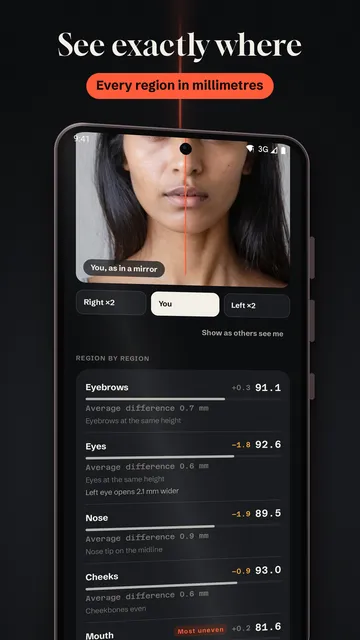
| Eyebrows | 0.7 mm |
| Eyes | 0.6 mm |
| Nose | 0.9 mm |
| Cheeks | 0.6 mm |
| Mouth | 1.5 mm |
| Jaw and chin | 0.8 mm |
| Average of all regions | 5.1 ÷ 6 = 0.85 mm |
Is it normal to have an asymmetrical face?
Yes. No real face is perfectly symmetrical, and small differences between the sides are part of a normal face: one brow sits a little higher, one eye looks slightly more open, the nose tip points a touch to one side. In everyday life hardly anyone notices, because we see faces as a whole.
A symmetry score therefore describes geometry, not looks. Research on face perception treats symmetry as one factor among several, next to averageness, skin, expression and familiarity. If you take a test out of curiosity, read the result exactly that way: as a number about distances, not about beauty.
- Expressions are naturally one-sided: many people smile or raise a brow more on one side.
- Habits such as chewing or sleeping on one side are often named as causes; a photo cannot settle that.
- If your symmetry changes suddenly, that is not a job for a test but for a doctor (see below).
Why does my face look different in photos than in the mirror?
In the mirror you see yourself flipped, while other people see you the way a normal photo shows you. Because every face is slightly asymmetrical, the unfamiliar side looks strange in photos. Many front cameras mirror the preview but save the picture unflipped, so the same face looks different twice.
Distance matters too: very close to the phone, the wide-angle front camera enlarges the nose and makes the ears look narrower. For a symmetry check this only counts when your head is off-centre, because then the lens distorts one side more than the other.
| Cause | Effect | Fix |
|---|---|---|
| Mirroring | Sides swapped, face looks unfamiliar | Always compare in the same view |
| Too close to the camera | Larger nose, rounded face | At least an arm’s length away |
| Head turned | One half looks narrower | Look straight into the lens |
| Light from one side | Shadows shift the contours | Light from the front, e.g. facing a window |
How accurate is a face symmetry test?
A single photo is a snapshot. A head tilted by a few degrees, a twitch at the corner of the mouth or light from one side moves the landmarks more than most real differences do. That is why simple tests often jump by several points when you take them twice in a row.
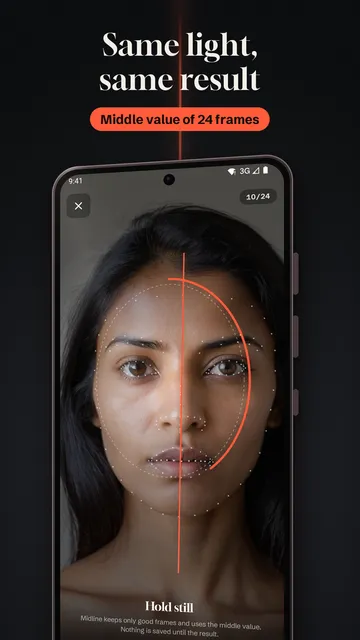
It gets more accurate when you analyse several frames and take the middle value (the median). The median resists outliers: one shaky frame barely moves it, whereas it drags the average along. Example with five measurements: 88.1, 90.4, 89.7, 86.2 and 89.9 points. The average is 88.9, the median 89.7, because the outlier 86.2 does not pull it down.
- Always compare under the same conditions: same place, same light, same time of day.
- Glasses off, hair back, neutral expression.
- A result with a spread (for example ±0.4) tells you more than a bare number.
- Differences of less than one point between two days are usually noise, not a real change.
Face suddenly asymmetrical: when to see a doctor?
If one side of the mouth suddenly droops, you cannot close one eye or half of the face suddenly looks slack, that is a warning sign. A stroke can start like this, especially together with slurred speech or a weak arm. Call emergency services straight away (999 in the UK, 911 in the US) and do not wait.
One-sided facial weakness can also have other causes, such as Bell’s palsy, and should be checked by a doctor promptly. Slow changes over months, swelling or jaw pain also belong with a doctor. A camera symmetry test is not made for this and cannot rule anything out.

How Midline measures face symmetry
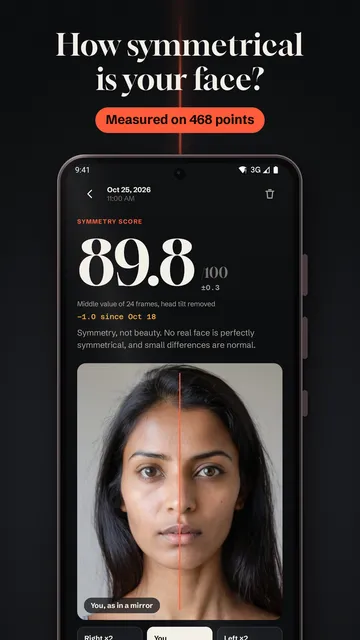
Midline is a face symmetry test for Android that does the steps above for you: the front camera maps 468 points on your face, head tilt is removed in 3D, and the app takes the middle value of 24 good frames. The score runs from 0 to 100: 100 minus 12 points per millimetre of average difference, so 89.8 in the worked example above.
- Live guidance while you measure: look straight ahead, come closer, light from one side, only one face in the picture. Measuring only runs while pose and light are right.
- Overall score with its spread (for example ±0.3), plus six region scores for eyebrows, eyes, nose, cheeks, mouth, and jaw and chin.
- Your aligned face with the midline drawn in, and a result card to share, with your photo or with just the drawn measuring grid.
- A weekly reminder to measure again in the same light at the same spot.
- With Pro: millimetre detail per region with the side (8 measurements), mirror faces built from two left or two right halves, full history with trend curve, before-and-after comparison and CSV export.
- Calculated on your phone, your photos never leave the device, no account needed. Live camera only, photos cannot be imported.
What the app cannot do
Midline measures symmetry, not beauty, and gives no attractiveness rating. The millimetres are converted using an average face size, so they are approximations, and results depend on light and pose. The app is not a medical device, does not diagnose anything and is meant for fun and curiosity; it is available for Android only.
Price
Measuring, the overall score, six region scores, the result card and your last 3 measurements are free; Midline Pro costs $6.99 a month or $39.99 a year in the US and can be cancelled any time in Google Play. We build this app ourselves; on Google Play it is listed under the developer name InfinityAkhi.
Get it on Google Play: Midline
Screenshots
Related calculators on ToolboxDay
Frequently asked questions
What is a normal symmetry score?
There is no fixed normal value, because every app calculates differently. What matters: no face reaches 100, and differences from a few tenths of a millimetre to just over a millimetre per region are invisible in everyday life.
Does facial symmetry say anything about attractiveness?
Only to a limited degree. Research treats symmetry as one of several factors in how faces are perceived, and a score about distances does not describe how someone comes across. That is why Midline deliberately gives no attractiveness rating.
Why do I get a different score every time?
Usually your head pose, the light or your expression changes slightly. Several frames with a median instead of one snapshot, plus the same place and light, make the result repeatable.
Can I test someone else’s photo with Midline?
No. Midline only measures live with the front camera; photos from your gallery cannot be imported.
Sources
More guides
- Glow up challenge: how to plan and document your 30 days
- What season am I? How to find your color season at home
- Skincare routine tracker: build an order you actually keep
- Recurring payments: find them, add them up, cancel what you don’t use
- Lean angle motorcycle guide: how it is measured and what the number means
- Constellation finder: how to find constellations in the night sky
- Our apps