Supplement tracker: how to take supplements consistently
A supplement tracker records which supplements you take and when, reminds you about open doses and counts down your supply. A list, a weekly pill box or an app all work. What matters most: follow the label or your doctor’s advice, don’t double up on the same nutrient from several products, and check with a pharmacist if you take medication.
Updated:
How to take supplements correctly
In both the US and the EU, dietary supplements are regulated as a category of food, not as medicines. The US National Center for Complementary and Integrative Health (NCCIH) points out that supplements can interact with medications or pose risks with certain health conditions or before surgery. Know why you take something and keep an eye on the amount.
The label states the suggested daily amount; stick to it unless your doctor says otherwise. More is not better.
- Take fat-soluble vitamins (A, D, E, K) with a meal that contains some fat.
- Add up identical nutrients: a multivitamin plus a vitamin D product gives you more than either label shows on its own.
- If you take medication, are pregnant or breastfeeding, or have surgery coming up, talk to your doctor or pharmacist first.
- Tie each dose to an existing habit such as breakfast, so you neither forget nor double up.
- Start new products one at a time, so you can tell what causes a side effect.
Best time to take vitamin D, and how much
Your skin makes vitamin D in sunlight. When that is missing, for example in winter, the German Federal Institute for Risk Assessment (BfR) states that an intake of 20 mcg of vitamin D per day reaches the target blood level. That is 800 international units (IU). Whether you need a supplement at all is best checked with your doctor.
Vitamin D is fat-soluble, so a meal is a good moment. Morning or evening matters less than a steady routine. High-dose products should only be taken after talking to a doctor, because vitamin D builds up in the body.
Conversion: 1 mcg of vitamin D = 40 IU, 1 IU = 0.025 mcg.
| Micrograms (mcg) | International units (IU) |
|---|---|
| 10 mcg | 400 IU |
| 20 mcg | 800 IU |
| 25 mcg | 1,000 IU |
| 50 mcg | 2,000 IU |
How long does a bottle last, and what does it cost per month?
Days of supply = pills in the bottle ÷ pills per day. A bottle of 120 capsules at 2 a day lasts 60 days. Plan the refill about a week ahead so you don’t run out.
Cost per month = price ÷ days of supply × 30. At $19.90 for 60 days that is about $0.33 a day and roughly $9.95 a month. Add up the monthly figures to see what your whole stack costs.
| Supplement | Bottle / dose | Lasts | Per month |
|---|---|---|---|
| Magnesium | 120 capsules, 2 a day, $19.90 | 60 days | about $9.95 |
| Vitamin D | 90 tablets, 1 a day, $6.30 | 90 days | about $2.10 |
| Omega-3 | 60 softgels, 2 a day, $14.00 | 30 days | about $14.00 |
Supplement tracker: list, pill box or app?
For one or two products, a weekly pill box is enough. The more supplements with different schedules you add (daily, weekdays only, every other day, weeks off), the more a list or app that records what you actually took pays off.
- Check off each dose when you take it, not later from memory.
- Write down the name and amount exactly as they appear on the label.
- Decide breaks and cycles in advance and note them.
- Bring your list to doctor and pharmacy visits; it helps them check for interactions.

How Pillary works as a supplement tracker
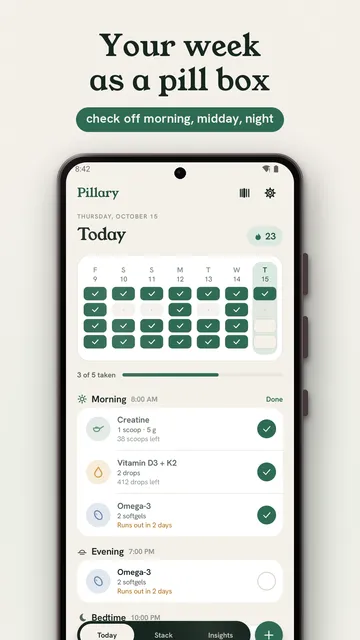
Pillary is a supplement tracker for Android: you add each supplement with your exact brand and amount, check off doses and only get reminded when something is still open. Pillary is a reminder and log; it does not give medical advice, does not check interactions, never suggests a dose and does not replace advice from a doctor.
- The start screen is a 7-day pill box with morning, midday, evening and bedtime compartments; missed days can be logged later.
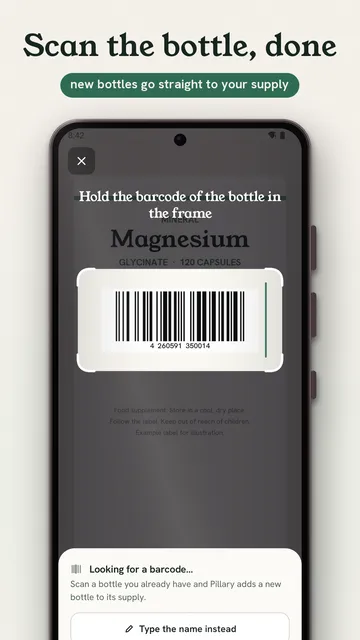
- Add a supplement by name, scan the barcode (name from Open Food Facts, only the barcode number is looked up) or photograph the label.
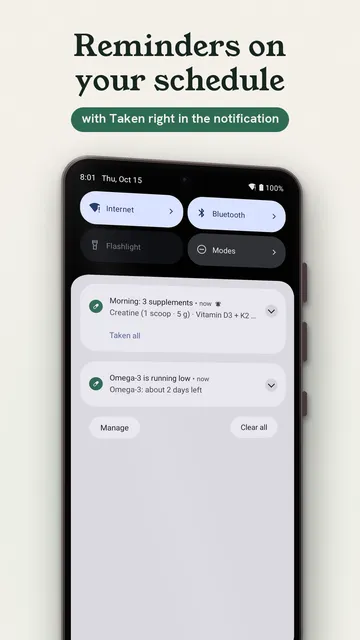
- Reminders every day, on certain weekdays or every few days, with “Taken” right in the notification; quiet when everything is checked off.
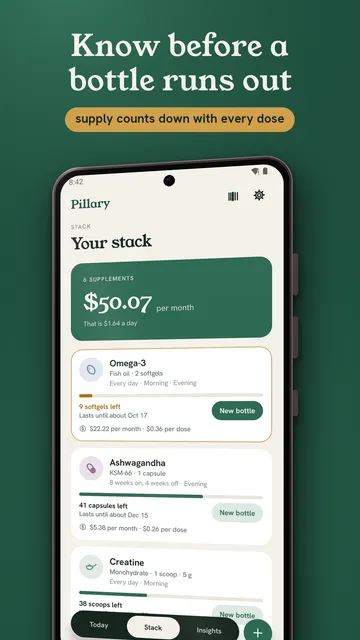
- Supply counts down with every dose and alerts you before a bottle runs out; scan a new bottle to add it.
- Cost per dose and per month for each supplement and for your whole stack.
- Streaks that don’t break on planned days off, and backups as a file.
What the app cannot do
Pillary does not tell you what or how much to take, and it does not detect interactions or overdoses. The free version covers up to 6 supplements, and the app is available for Android only.
Price
Up to 6 supplements with reminders, supply counter, barcode, label photo and streaks are free; Pillary Pro, with unlimited supplements, a 12-week calendar, cycles, spending, a second reminder, a widget and CSV export, costs $4.69 a month or $27.99 a year in the US. The free version shows ads; Pro is ad-free. We build this app ourselves; on Google Play it is listed under the developer name InfinityAkhi.
Get it on Google Play: Pillary
Screenshots
Related calculators on ToolboxDay
Frequently asked questions
Which supplements should not be taken together?
It depends on the nutrient and the amount; some minerals compete for absorption, and some supplements affect medications. For a reliable answer on your combination, ask a pharmacist or doctor and bring your list.
Should I take supplements with food?
Fat-soluble vitamins (A, D, E, K) are best taken with a meal containing some fat. For everything else, follow the label, which often says whether to take it with or without food.
How many IU is 20 mcg of vitamin D?
20 mcg equals 800 IU, because 1 mcg of vitamin D is 40 international units.
Does Pillary know my supplement?
Pillary does not need a product database: you type the name. The barcode scan fills in the name from Open Food Facts when the product is listed there.
Sources
More guides
- Daily protein tracker: how to count protein the easy way
- PR tracker for lifting: how to log and beat your records
- Recurring payments: find them, add them up, cancel what you don’t use
- Lean angle motorcycle guide: how it is measured and what the number means
- Constellation finder: how to find constellations in the night sky
- Oil change reminder: how to time it and never miss it
- Our apps