How to build a capsule wardrobe from the clothes you already own
A capsule wardrobe is a small set of clothes that all work together, so a few pieces make many outfits. Around 25 to 40 pieces per season is common, but the exact number matters less than colours and cuts that combine well and pieces you actually wear.
Updated:
What is a capsule wardrobe?
The term was popularised in the 1970s by London boutique owner Susie Faux: a collection of timeless essentials that you top up with a few seasonal pieces. Donna Karan made the idea famous in 1985 with her “7 Easy Pieces” collection of interchangeable workwear.
The point is not going without but getting more use. A representative Greenpeace survey from 2015 found that adults in Germany own 95 garments on average, excluding underwear and socks, and that one in five is almost never worn. In the US, the EPA estimated 17 million tons of textiles in municipal solid waste in 2018. A capsule wardrobe therefore starts in your own closet, not in a shop.
How many pieces should a capsule wardrobe have?
There is no fixed number. Many guides suggest 25 to 40 pieces per season; some count shoes and accessories, others do not. Decide what counts before you start and base it on your everyday life: an office week needs different pieces from working at home.
The number of outfits grows fast when pieces match. Tops, bottoms and shoes multiply: 5 tops × 3 pants or skirts × 2 pairs of shoes give 30 combinations. A dress counts as top and bottom at once and only combines with shoes.
| Closet | Maths | Outfits |
|---|---|---|
| Starting point | 5 × 3 × 2 | 30 |
| + 1 top | 6 × 3 × 2 | 36 (+6) |
| + 1 bottom | 5 × 4 × 2 | 40 (+10) |
| + 1 pair of shoes | 5 × 3 × 3 | 45 (+15) |
How do I start a capsule wardrobe from my closet?
You get the most out of starting with what you already wear. After that it is about gaps: the table above shows that a new piece in your smallest category adds the most combinations, as long as its colour works with everything else.
- Take out everything for one season and sort it: tops, bottoms, dresses, jackets, shoes.
- Mark honestly what you have worn in the last three months.
- Choose two or three neutral base colours plus one or two accent colours.
- The worn pieces in these colours form the core; pieces that go with almost nothing go into a box.
- Live with the selection for three months, then check what you missed and what you never wore.
How to calculate cost per wear
Cost per wear is the price divided by the number of days you have worn a piece. A $120 jacket worn 60 times costs $2 per wear; a $40 blouse worn twice costs $20. The maths often shows that the cheap impulse buy is the most expensive thing in the closet.
Before buying, ask the same question the other way round: how often would I realistically wear this, and how many of my clothes does it go with? A piece that only works with one other item rarely gets worn.
How to declutter your closet: what can go?
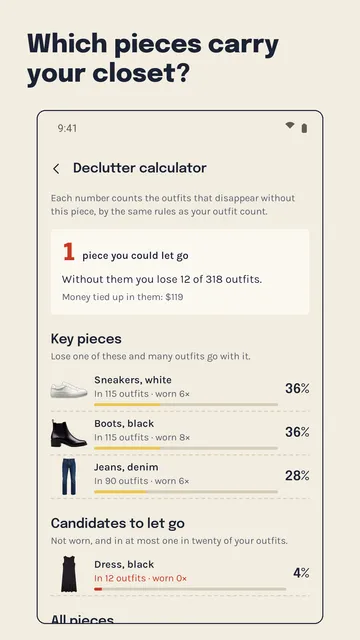
Two questions help: how often do I wear it, and how many outfits disappear without it? White sneakers that appear in every second outfit are a key piece. A dress you have not worn in a year and that matches almost nothing is a candidate to let go.
- Hanger trick: hang everything backwards and turn the hanger after wearing; after a season you see what never moved.
- Put pieces in a box first instead of giving them away straight away; whatever you do not miss in three months can go.
- Sell, swap or donate clothes in good condition rather than throwing them out.

How Wornly helps you build a capsule wardrobe
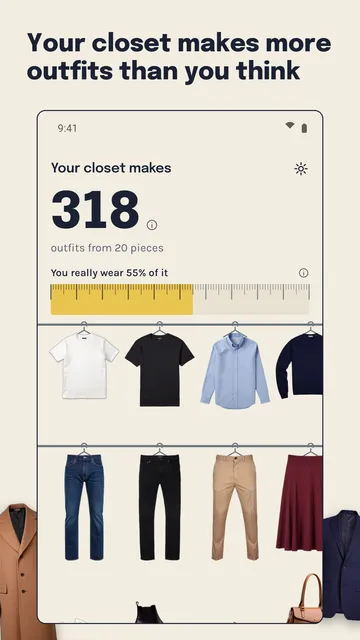
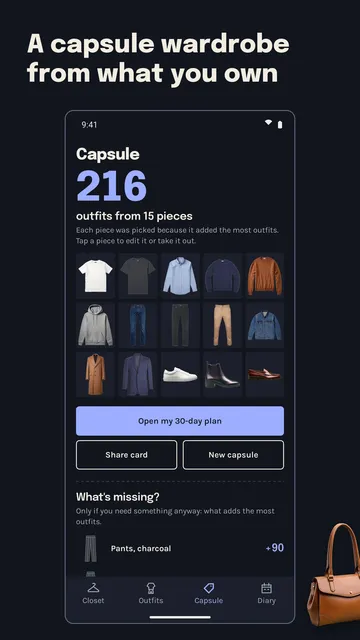
Wornly is a digital closet for Android that runs the maths above on your own clothes: it counts how many outfits your pieces make, builds a capsule wardrobe from them and shows which pieces carry your closet. You tap in your pieces and can add photos later; no account is needed.
- Closet test: one question per piece, ending with the share you really wear.
- A capsule by size and season from your own pieces, with reasons; plus a 30-day plan, packing lists and gaps.
- Outfit ideas from your pieces with a “Why?” explanation (season, dress code, pattern, colour) that you can overrule.
- Purchase check: how many new outfits a piece would add, and a wishlist ranked by price per new outfit.
- Declutter calculator with key pieces and candidates to let go, plus cost per wear.
- Mark pieces as in the wash, export everything as a ZIP.
What the app cannot do
Wornly works with rules for season, dress code, pattern and colour; it knows nothing about fit or your personal style, so you have the last word. You log what you wear yourself, the free version is limited to 15 pieces, and the app is Android only.
Price
Free for up to 15 pieces with the basics; Wornly Pro is a subscription at $6.99 a month or $44.99 a year in the US (Google Play shows your local price), cancel anytime in Google Play. The free version shows ads; Pro is ad-free. We build this app ourselves; on Google Play it is listed under the developer name InfinityAkhi.
Screenshots
Related calculators on ToolboxDay
Frequently asked questions
Do shoes and accessories count in a capsule wardrobe?
That is up to you. Some people count shoes but not jewellery. Just decide once so your number stays comparable.
Does a capsule wardrobe have to be all neutrals?
No. Neutral base colours make combining easier, and one or two accent colours are common as long as they work with the base.
How do I calculate cost per wear?
Divide the price by the number of days you have worn the piece. $120 worn 60 times is $2 per wear.
Do I have to photograph every piece for Wornly?
No. According to the store listing you tap in what is in your closet and can add photos whenever you like; cut-outs are made on the phone.
Sources
More guides
- What season am I? How to find your color season at home
- Glow up challenge: how to plan and document your 30 days
- Recurring payments: find them, add them up, cancel what you don’t use
- Lean angle motorcycle guide: how it is measured and what the number means
- Constellation finder: how to find constellations in the night sky
- Oil change reminder: how to time it and never miss it
- Our apps