Snore recorder: how to record and understand your nights
A snore recorder can be as simple as a phone on your nightstand running a recording app all night. It becomes useful when you compare several nights and note what was different, such as sleeping on your back, alcohol or a cold. A recording is not a medical test: pauses in breathing, gasping or heavy daytime sleepiness should be checked by a doctor.
Updated:
How do you record yourself snoring at night?
Almost any smartphone can record your snoring. What matters is placement, battery and a quiet setup, so that you actually have something useful to listen to in the morning. A plain voice memo works, but it leaves you with an hours-long file to search through yourself.
Apps that only save sound events skip that step: they cut the night into short clips and show when something happened.
- Put the phone on the nightstand, about an arm’s length from your head, microphone facing the bed. Not under the pillow.
- Plug in the charger: recording all night uses a noticeable amount of battery.
- Turn on Do Not Disturb so notifications don’t interrupt the recording or wake you.
- Let steady noise such as a fan or air purifier run for a moment first, so it can be treated as background.
- If you share the bed, note in the morning who was awake when, otherwise you can’t tell whose snoring you hear.
Why do I snore?
Snoring happens when the airflow makes the tissues at the back of your throat vibrate, usually as you breathe in. During sleep your tongue, palate and throat relax and narrow the airway. According to the American Academy of Sleep Medicine, about half of people snore at some point in their lives; it is more common in men and becomes more common with age.
Several factors make snoring more likely. These are exactly what you can compare across nights, because they change from one night to the next.
| Factor | Why | What you can try |
|---|---|---|
| Sleeping on your back | tongue and palate fall backwards | sleep on your side, positional pillow |
| Alcohol in the evening | throat muscles relax more | less or no alcohol before bed |
| Cold or allergies | blocked nose, mouth breathing | keep your nose clear, treat the cause |
| Being overweight | more tissue around the neck | lose weight if appropriate |
| Smoking | irritates the airways | stop smoking |
When should you see a doctor about snoring?
Occasional, steady snoring is usually harmless. Get it checked if it is loud and irregular, if pauses alternate with gasping or choking sounds, or if you are tired during the day even after enough sleep. These can be signs of sleep apnea, where breathing repeatedly stops during sleep.
The NHS also recommends seeing a GP when lifestyle changes don’t help or when snoring has a big impact on you or your partner, and suggests bringing someone who can describe your snoring. A phone recording can help you describe what it sounds like, but it does not detect or diagnose any condition and does not replace a doctor’s visit or a sleep study.
- Pauses in breathing that someone has noticed
- Gasping or choking during sleep
- Strong daytime sleepiness or dozing off
- Morning headaches or a dry, sore throat
- Snoring that has become much louder or more irregular
Is sleep talking normal?
Usually, yes. Sleep talking (somniloquy) is very common according to the AASM: it is reported in about half of young children and in around 5 percent of adults. What is said is often unclear or makes no sense, and it can happen in any stage of sleep.
On its own, sleep talking is harmless. Talk to your doctor if it suddenly becomes more frequent, starts at an older age, or comes with other symptoms such as strong movements or daytime sleepiness.
How to read your recordings: a two-week snoring diary
One night tells you little. Comparing about two weeks is far more useful: each morning, note what was different the evening before, then compare snoring time on nights with and without that factor.
Worked example: on 5 nights with a positional pillow you snored 18 minutes on average, on 9 nights without it 34 minutes. That is (34 − 18) ÷ 34 ≈ 47 percent less. A difference like this is a hint, not proof: a cold, stress or a different bed can play a part. The more nights you have, the more reliable the comparison.
- Per night: alcohol yes/no, sleeping position, cold, late meal, nasal strip.
- Record the same way each time: same spot, same sensitivity.
- Change one factor at a time, otherwise you can’t tell what made the difference.
How Nightmumble works as a snore recorder
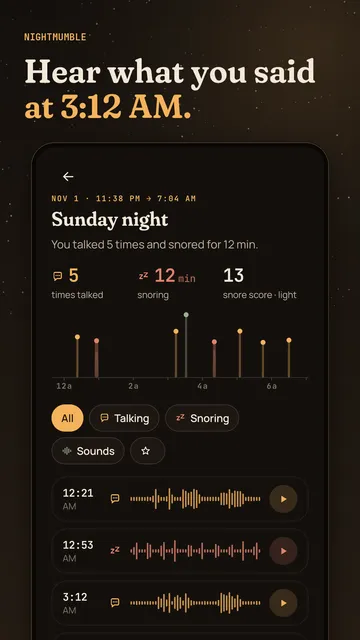
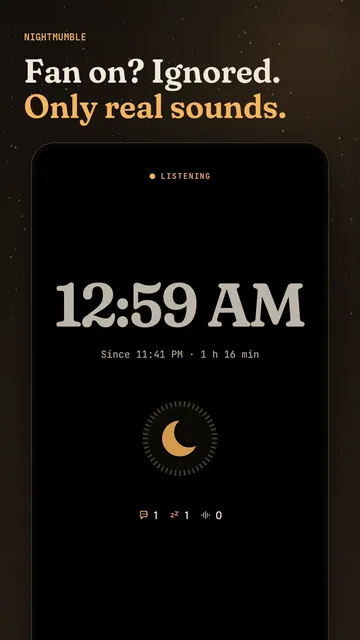
Nightmumble is a sleep talk and snore recorder for Android. It listens through the night but keeps only the moments with sound as short clips. In the morning you open the night and listen to exactly those moments. Recordings stay on your phone and are never uploaded; no account is needed.
- Saves only moments with sound as clips and learns steady background noise such as a fan, air purifier or rain so it doesn’t trigger on it.
- Sorts clips into Talking, Snoring and Other, with a night timeline, a snore score for each night and the loudest moment.
- Start delay and adjustable sensitivity.
- Clips from your last 2 nights and every clip you mark are free to play; share a clip as a video card or audio with a small watermark.
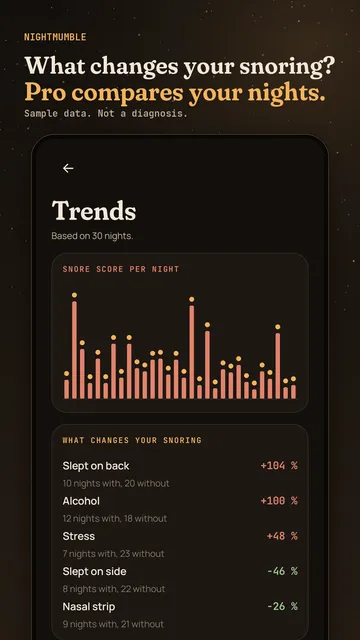
- Pro: full history, trends across weeks, tag influences like alcohol, back sleeping, late meals, a cold or nasal strips and compare them, Clear Voice to reduce noise, and export of all clips.
What the app cannot do
Nightmumble is not a medical device: it does not detect or diagnose sleep apnea or any other condition and does not measure breathing or oxygen levels. With two people in the room it cannot tell who is snoring, and it is available for Android only.
Price
The free version shows light ads; Pro is ad-free and costs $3.79 a month or $22.99 a year in the US (as of 7 Nov 2026, prices vary by country). We build this app ourselves; on Google Play it is listed under the developer name InfinityAkhi.
Get it on Google Play: Nightmumble
Screenshots
Related calculators on ToolboxDay
Frequently asked questions
Can I record my snoring without an app?
Yes, with your phone’s voice memo. You get one file covering the whole night that you have to listen through yourself. Apps with sound detection only keep the loud moments and save you the searching.
Where should the phone be while recording?
On the nightstand, about an arm’s length from your head with the microphone facing the bed, plugged in and on Do Not Disturb. Under a pillow the fabric muffles the sound.
Can a snore recorder app detect sleep apnea?
No. A recording can show when and how loudly you snored. Whether you have sleep apnea is something a doctor determines, usually with a home sleep apnea test or a sleep study.
Does Nightmumble upload my recordings?
No, recordings stay on your phone. According to its store listing, the app goes online for purchases, an anonymous usage count and, in the free version, for ads.
Sources
More guides
- Fan sounds for sleeping: why they work and how to use them
- 4-7-8 Breathing: How the Technique Works and What It Can Do
- Recurring payments: find them, add them up, cancel what you don’t use
- Lean angle motorcycle guide: how it is measured and what the number means
- Constellation finder: how to find constellations in the night sky
- Oil change reminder: how to time it and never miss it
- Our apps