Reptile tracker: what to record for your snake or lizard
A reptile tracker replaces the paper care log by the enclosure: you record feedings, sheds and weight for each animal and spot early when one drifts from its usual rhythm. Feeding intervals come from care sheets as guidance; what your animal needs depends on species, age and condition, and weight loss or a long refusal calls for a reptile vet.
Updated:
What should you record in a reptile log?
Everything that changes over weeks and would otherwise slip past you: feedings with prey type and size, refusals, sheds, weight, droppings and anything unusual. Only the series shows a trend; a single entry says little.
A clean log also helps at the vet and when you rehome an animal, because you can show data instead of memories. Some species also come with registration or paperwork duties under wildlife trade rules, so check what applies where you live.
- Feeding: date, prey and size, eaten or refused, regurgitated.
- Shed: start of the blue phase, shed date, complete or with stuck pieces.
- Weight: in grams, ideally at the same time of day and before feeding.
- Husbandry: temperature, humidity, bulb or UVB tube changes.
- Anything unusual: droppings, behaviour, breathing, skin or eyes.
How often should you feed a ball python?
Young animals are fed more often than adults; care sheets typically give roughly weekly intervals for young ball pythons and noticeably longer ones for adults. Body condition matters more than the calendar, which is why the scale belongs in your routine.
Ball pythons are known to refuse food for weeks, often in winter or breeding season. As long as the animal barely loses weight and otherwise seems normal, this is familiar behaviour for the species. If it loses weight noticeably, it needs a vet.
| Date | Weight | Change from peak |
|---|---|---|
| August 1 | 1,420 g | peak |
| September 1 | 1,405 g | −1% |
| October 1 | 1,380 g | −3% |
| November 1 | 1,330 g | −6% |
How do you know when a snake is about to shed?
Look for the blue phase: the eyes turn milky, the skin looks dull and bluish, and many snakes hide and refuse food. After a few days the eyes clear again, and the shed follows shortly after.
Healthy snakes usually shed in one piece. Stuck shed, especially eye caps or the tail tip, points to husbandry, often humidity. Retained eye caps that do not come off should be seen by a vet.
How often an animal sheds depends on species, age and growth; juveniles shed much more often. If you log the dates, after two or three sheds you know your own animal’s rhythm.
How does a ball python morph calculator work?
Morphs mostly follow Mendelian rules. With recessive genes such as albino, the trait only shows when the animal carries two copies; an animal with one copy is “het” and looks normal. With co-dominant (incomplete dominant) genes such as pastel, one copy is enough, and two copies give a distinct super form.
Pairing two hets turns into a probability for the babies: among the normal-looking offspring, on average two thirds carry a copy (66% possible het). Some genes are problematic: spider is linked to neurological issues, and the super forms of some genes are considered lethal or unproven.
| Pairing | visual | het | normal, no gene |
|---|---|---|---|
| het × het | 25% | 50% | 25% |
| visual × het | 50% | 50% | 0% |
| visual × normal | 0% | 100% | 0% |
| het × normal | 0% | 50% | 50% |
When should a reptile see a vet?
Reptiles often show illness late. That is why the plain numbers in a log are so valuable: they reveal a trend before it becomes obvious. They do not replace a diagnosis.
- Ongoing weight loss, or refusing food beyond what is usual for the species.
- Breathing noises, mucus in the mouth, open-mouth breathing.
- Repeated stuck shed, especially on the eyes.
- Regurgitation, diarrhoea, swellings, injuries or lameness.

How Scalewell helps you keep a care log
Scalewell is a reptile tracker for Android, for keepers and breeders: one-tap feeding, shed prediction, weight and a morph calculator, with no account. Records are stored on your phone and can be saved to a backup file for free.
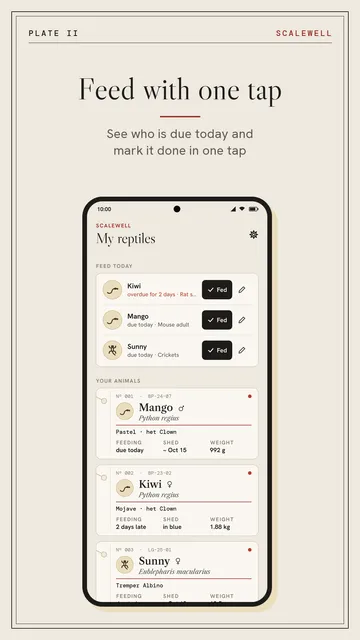
- “Feed today” shows every animal that is due; “Fed” also works right from the notification and the home screen widget.
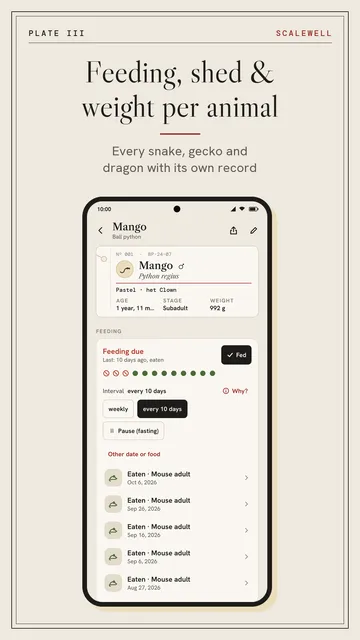
- Refusals and regurgitation are logged, reminders can be paused during fasting; feeding intervals per species and life stage come with a “Why?” and a source.
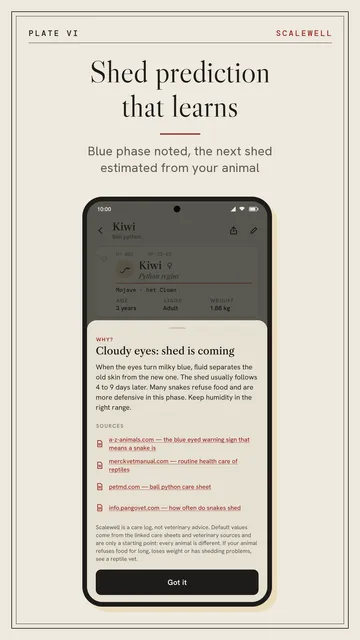
- Shed prediction that learns your animal’s rhythm after two sheds, with an “in blue” marker and a flag for stuck sheds.
- Weight in grams with a monthly trend and a warning on weight loss.
- Morph calculator for ball python, corn snake, leopard gecko and bearded dragon with 89 genes, allelic groups and possible het.
- Free: 2 animals; Pro adds unlimited animals, odds per egg with fractions, breeding and clutches, the full weight curve, and PDF and CSV.
What the app cannot do
Scalewell is a care log, not veterinary advice: it does not diagnose anything and only knows what you enter. Feeding intervals are guidance from care sheets, the morph calculator covers four species, and the app is available for Android only.
Price
Free for good with 2 animals, feeding, sheds, weight, backup and the names of all possible morphs; Scalewell Pro is a subscription at $4.69 a month or $37.99 a year in the US, cancel any time in Google Play. The free version shows ads; Pro is ad-free. We build this app ourselves; on Google Play it is listed under the developer name InfinityAkhi.
Get it on Google Play: Scalewell
Screenshots
Frequently asked questions
How long can a ball python go without eating?
Long fasts are well known in ball pythons, especially in winter and breeding season. Weight is the yardstick: if it stays stable and the snake otherwise seems normal, it is usually not a concern; with clear weight loss, see a reptile vet.
How often do bearded dragons shed?
Juveniles shed often and in patches while they grow, adults much less often. Bearded dragons do not shed in one piece like snakes.
What does 66% possible het mean?
When two het parents are paired, on average two thirds of the normal-looking babies carry one copy of the recessive gene. Which ones do only shows in a test pairing.
Which species does Scalewell support?
Feeding, shedding and weight work for any reptile; defaults are included for species such as ball python, corn snake, leopard gecko, bearded dragon, crested gecko, boa constrictor and Hermann’s tortoise.
Sources
More guides
- Pet vaccine tracker: keep your dog’s and cat’s shots on schedule
- Egg laying tracker: count eggs and understand your hens
- Recurring payments: find them, add them up, cancel what you don’t use
- Lean angle motorcycle guide: how it is measured and what the number means
- Constellation finder: how to find constellations in the night sky
- Oil change reminder: how to time it and never miss it
- Our apps