Pet vaccine tracker: keep your dog’s and cat’s shots on schedule
A pet vaccine tracker keeps every shot your dog or cat has had, with date, lot number and the next due date, alongside deworming, flea and tick protection, weight and vet visits. It tells you what is coming up and gives your vet exact information; the schedule itself is always set with your veterinarian.
Updated:
What should a pet vaccine record include?
Your vet’s certificate or pet passport proves past vaccinations, but it does not tell you what is due next, and it holds no weight or medication history. A tracker fills that gap, whether on paper, as a printable template or in an app.
- Vaccines: product, lot number, date, vet and next due date.
- Deworming and flea and tick prevention: product, date, next dose.
- Weight: once a month, more often for puppies, kittens and seniors.
- Medication: drug, dose, doses per day, length of the course.
- Vet visits: reason, findings in your own words, cost, next appointment.
- Basics: microchip number, date of birth, breed, insurance.
What is the core vaccine schedule for dogs?
International guidelines from WSAVA list distemper, canine adenovirus (hepatitis) and parvovirus as core vaccines for every dog, plus rabies wherever it occurs or the law requires it. Leptospirosis is recommended in many regions depending on local risk.
Puppies get a series of shots every 2 to 4 weeks until about 16 weeks of age, followed by a booster between 6 and 12 months. After that, the core vaccines are typically repeated no more often than every 3 years, while leptospirosis is given yearly; rabies follows the product label and local law.
| Vaccine | Interval | Note |
|---|---|---|
| Distemper, adenovirus, parvovirus | every 3 years | depends on product |
| Leptospirosis | every year | shorter protection |
| Rabies | 1 or 3 years | product label and local law |
| Kennel cough (Bordetella) | based on risk | e.g. before boarding |
How often should you deworm a dog?
It depends on risk. CAPC recommends year-round parasite control for dogs and cats, and in Europe ESCCAP advises deworming at least four times a year, or testing faeces, when the individual risk is unknown. Dogs at high risk, for example those that hunt or are fed raw, may need monthly treatment.
Puppies are dewormed early and often, starting at about two weeks of age, on a schedule from your vet. Whatever you use, write down the product and date so the interval stays right.
- Puppies: from about two weeks old at short intervals, following your vet’s plan.
- Adult dogs with unknown risk: at least 4 times a year, or regular faecal tests.
- High-risk lifestyle (hunting, raw feeding, close contact with small children): up to monthly, after talking to your vet.
What do pets need to travel within the EU?
Dogs, cats and ferrets travelling between EU countries need a microchip, an EU pet passport and a valid rabies vaccination. After the first rabies shot there is a 21-day wait before travel, and the chip must be implanted before the vaccination.
Some countries also require a tapeworm treatment before entry, and travel to or from countries outside the EU has its own rules. Check the current requirements with the European Commission or the destination’s authority before you leave.
- Have a microchip implanted and recorded in the pet passport.
- Get the rabies vaccination; allow 21 days after a first shot.
- Check entry rules of the destination, such as tapeworm treatment.
- Keep the passport, vaccine dates and vet contact at hand.
What vaccines do cats need?
Core vaccines for cats cover feline panleukopenia, feline herpesvirus and calicivirus (cat flu), plus rabies where required. Outdoor cats may need more depending on their risk, and the intervals again depend on the product and your vet.
Deworming also follows risk: indoor cats usually need it less often than outdoor cats that hunt. One shared record for dogs and cats saves duplicate work.

How Tailwell helps you track vaccines
Tailwell is a pet vaccine tracker for Android, for dogs and cats: vaccine record, due dates, parasite prevention, weight and vet notes in one record, with no account. Entries are stored on your phone, and a backup file for a new phone is free.
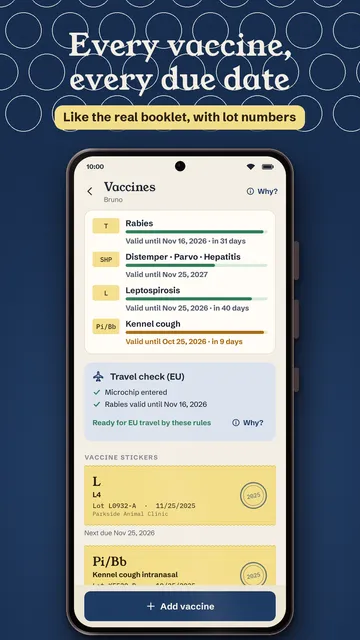
- A record built like the real booklet: each vaccine is a sticker with product, lot number, date and vet, with a traffic light showing how long it stays valid.
- Core vaccines suggested from the guidelines, with a separate due date for each component of a combination vaccine; the date your vet wrote down always wins.
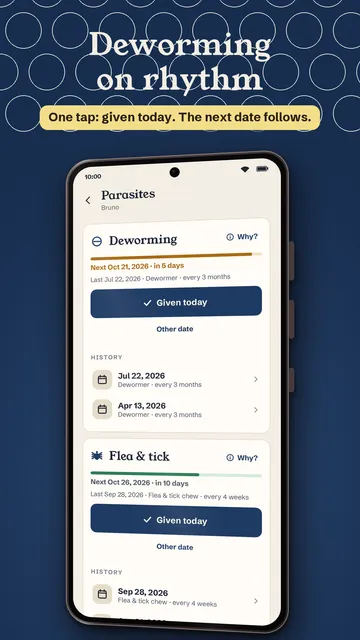
- Deworming and flea and tick prevention with “Given today” in one tap, and the rhythm moves on by itself, with the guideline explained.
- Weight in kg or lb with a body condition score from 1 to 9.
- Every interval with a “Why?” and its source, such as WSAVA, AAHA, CAPC, ESCCAP and the European Commission.
- With Pro: reminders before every due date, all your pets, medication plan, vet visits with costs, weight curve, PDF health record and EU travel check.
What the app cannot do
Tailwell is a health log and reminder tool, not veterinary advice: suggested dates follow published guidelines, and your vet decides what your pet needs. It does not replace an official pet passport or vaccination certificate, reminders need Pro, and it runs on Android only.
Price
One pet with vaccine record, due dates, parasite rhythm and backup is free; Tailwell Pro is a subscription at $3.79 a month or $23.99 a year in the US, cancel any time in Google Play. The free version shows ads; Pro is ad-free. We build this app ourselves; on Google Play it is listed under the developer name InfinityAkhi.
Get it on Google Play: Tailwell
Screenshots

Related calculators on ToolboxDay
Frequently asked questions
How often do dogs need vaccines?
After the puppy series and first booster, core vaccines are usually repeated every three years, leptospirosis every year, and rabies every one or three years depending on the product and local law. Your vet sets the plan.
Can a pet vaccine tracker replace the vaccination certificate?
No. For travel, boarding and authorities, the certificate or pet passport signed by your vet counts. A tracker adds due dates, weight and medication on top.
How long after a rabies shot can my dog travel in the EU?
After a first rabies vaccination there is a 21-day wait before the pet may travel. Boosters given on time keep the vaccination valid without a new wait.
Does Tailwell work for cats?
Yes. You choose dog or cat when you add a pet; for cats, Tailwell suggests panleukopenia and cat flu vaccines.
Sources
More guides
- Reptile tracker: what to record for your snake or lizard
- Egg laying tracker: count eggs and understand your hens
- Recurring payments: find them, add them up, cancel what you don’t use
- Lean angle motorcycle guide: how it is measured and what the number means
- Constellation finder: how to find constellations in the night sky
- Oil change reminder: how to time it and never miss it
- Our apps