Cold plunge for beginners: how long, how cold, how safe
For a beginner cold plunge, a common upper limit is no more minutes in the water than the water temperature in degrees Celsius – at 3 °C (37 °F), out after 3 minutes at the latest, and much shorter at first. Never plunge alone, get used to the cold over weeks with cold showers, and get out at once if you notice warning signs.
Updated:
Cold plunge: how long should you stay in?
The German Life Saving Association (DLRG) gives beginners a simple rule of thumb: at most as many minutes in the water as the water temperature in degrees Celsius. That is a ceiling, not a target. Newcomers stay in only briefly and build up step by step.
For a sense of how much cold experienced people do: in a study of winter swimmers (Søberg et al., Cell Reports Medicine 2021), participants averaged about 11 minutes of cold and 57 minutes of sauna per week, spread over several short sessions rather than one long one.
- Get out at once with heavy or uncontrolled shivering, pain in fingers or feet, a sudden headache, dizziness or feeling faint, whatever the clock says.
- A timer you can hear without looking stops “just a bit longer” from becoming too long.
| Water temperature | Maximum time in the water |
|---|---|
| 2 °C (36 °F) | 2 minutes |
| 4 °C (39 °F) | 4 minutes |
| 6 °C (43 °F) | 6 minutes |
| 8 °C (46 °F) | 8 minutes |
| 10 °C (50 °F) | 10 minutes |
How to start cold plunging as a beginner
According to the DLRG, the classic way in is weeks of cold showers. If you then take your first dip in open water, do it in autumn while the water is not yet ice-cold, rather than in the middle of winter.
If you have a heart or circulatory condition, high blood pressure or another medical condition, or are pregnant, talk to a doctor first. Cold water sharply raises heart rate and blood pressure in the first moments.
- For several weeks, end your shower with 30 to 60 seconds of cold water.
- Take your first dip in autumn, at a familiar, shallow spot with a safe way in and out.
- Go with at least two others: two in the water and one on land who can call for help (DLRG).
- Walk in slowly, breathe out long, keep your head above water; a hat or neoprene cap slows heat loss.
- Keep the first sessions short, then add a little time from one session to the next.
What is cold water shock?
The biggest danger is cold shock in the first minutes: sudden cold water triggers involuntary gasping and rapid breathing, and heart rate and blood pressure rise. The US National Weather Service describes this cold shock as occurring in the first 2 to 3 minutes and notes that water at 10 to 15 °C (50 to 60 °F) can be as dangerous in this respect as water at 2 °C (35 °F). Inhaling water during the gasp can lead to drowning, even for strong swimmers.
So never jump in or dunk your head; walk in slowly and focus only on calm, long exhales for the first 30 to 60 seconds. Stay longer and your hands and feet cool down, you lose strength, and over time hypothermia becomes a risk.
- Never plunge alone, and stay within reach of the edge or shore.
- No alcohol before cold water.
- No long breath holds and no hyperventilation in or near the water.
- With chest pain, trouble breathing, confusion or numbness, get out at once and get help.
What to do after a cold plunge
After you get out, your body keeps cooling for a while as cold blood from your arms and legs returns to your core (afterdrop). Drying off and getting dressed come first: a big towel, dry warm clothes, a hat, then move around.
A warm, non-alcoholic drink helps. The DLRG expert advises against putting a chilled body straight into the heat of a sauna, as that can strain the heart and circulation; warming up gradually is better.
- Lay out towel, clothes and shoes before you go in.
- Dry off, dress, then warm up by moving.
- Log water temperature, time and how it felt, so you can see how you adapt and don’t increase too fast.
How Rimewell helps with your cold plunge
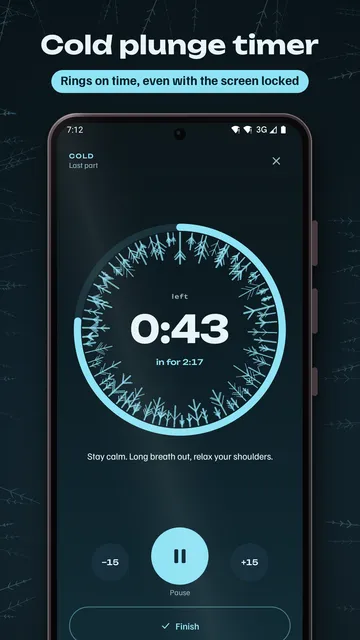
Rimewell is a cold plunge timer and log for ice baths, cold showers and sauna on Android. The timer rings at the exact second, even with the screen locked or the app closed. Rimewell is not a medical device, does not replace advice from a doctor and includes its own safety page with the warning signs.
- Timers for ice bath, cold shower and sauna with sound and vibration at every phase change, minute marks in the cold (every 30 or 60 seconds, or off) and a long final tone.
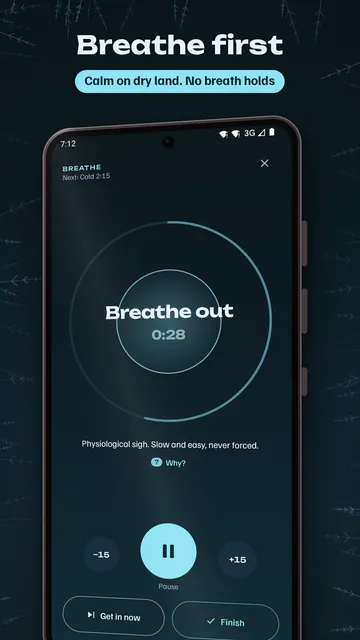
- A breathing circle on dry land before you get in (physiological sigh or calm 4-6 breathing), never long breath holds; during the first 30 seconds of cold, a cold shock coach helps you breathe out slowly.
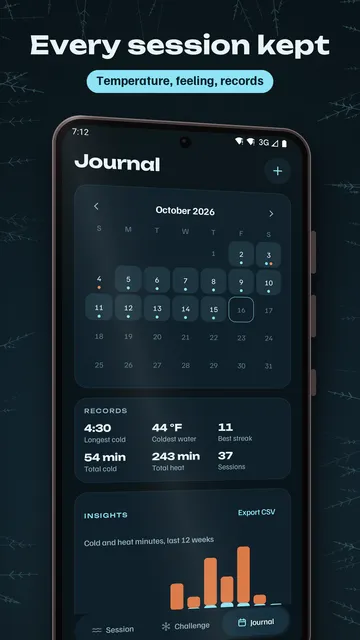
- A log with real duration, water or sauna temperature in °C or °F, how it felt from Brutal to Euphoric and a note; a month calendar and records.
- A weekly goal for cold and sauna minutes, a streak and a 30 day cold challenge from 0:30 to 3:00, at most one step per day.
- An adaptation plan that suggests your next target from your own sessions (a little less after a brutal one).
- A daily reminder that stays quiet on days you already had a session.
What the app cannot do
Rimewell does not measure water temperature or body signals and cannot detect an emergency: you enter the temperature yourself and need to watch for warning signs yourself. The app does not replace a buddy on the shore and is available for Android only.
Price
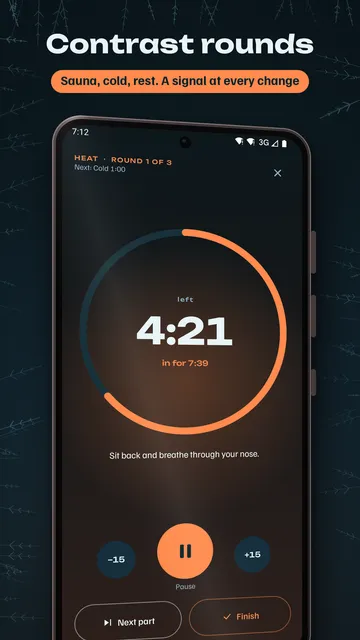
The ice bath, cold shower and sauna timer, the alarm with the screen locked, the safety page, two breathing patterns and the cold shock coach are free; Rimewell Pro, with the full challenge, your plan, full history, contrast rounds and more breathing rhythms, costs $3.79 a month or $23.99 a year in the US. The free version shows ads; Pro is ad-free. We build this app ourselves; on Google Play it is listed under the developer name InfinityAkhi.
Get it on Google Play: Rimewell
Screenshots
Related calculators on ToolboxDay
Frequently asked questions
What temperature should a cold plunge be?
There is no fixed number; water below about 15 °C (60 °F) can already cause a strong cold shock. For starting out, autumn water is a better choice than ice-cold winter water.
How often should you cold plunge?
For getting used to the cold, regularity matters more than length: several short sessions a week rather than one long one. The winter swimmers in the Søberg study averaged about 11 minutes of cold per week, spread over several sessions.
Are cold plunges good for you?
Research on health effects is limited, and cold water puts real strain on the heart and circulation. Healthy adults can try it with preparation and company; with a medical condition or during pregnancy, check with a doctor first.
Can I use Rimewell for cold showers?
Yes. Besides ice bath and sauna there is a separate cold shower mode, and those sessions go into your log too.
Sources
More guides
- 4-7-8 Breathing: How the Technique Works and What It Can Do
- Winter arc challenge: set your rules and keep them until December 31
- PR tracker for lifting: how to log and beat your records
- Recurring payments: find them, add them up, cancel what you don’t use
- Lean angle motorcycle guide: how it is measured and what the number means
- Constellation finder: how to find constellations in the night sky
- Our apps