Running a horse share: riding days, costs and a clear agreement
A horse share works when four things are settled in writing before the first ride: which fixed days each person rides, what the sharer contributes towards upkeep, how the horse and riders are insured, and how information is passed on at each handover. Most disputes are not about riding at all but about swapped days, money and things nobody wrote down.
Updated:
How many days a week should a horse sharer ride?
There is no fixed rule; one to three set days a week is common. What matters is that the days are agreed in advance rather than renegotiated every week. Fixed days give the horse a steady routine and both of you something to plan around.
The British Horse Society describes part loaning, or sharing, as looking after the horse on agreed days, usually while it stays at its current yard. Agree as well what happens when a day is missed: is it made up, swapped or simply lost? And who rides when the horse is lame or the farrier is due?
- Fixed days and times, split into riding, lunging, groundwork and hacking.
- A rule for swaps, extra days and cancellations (illness, holidays, weather).
- What the sharer may do: hack out alone, jump, compete, have lessons and with whom.
- Which yard jobs belong to a riding day, such as feeding, mucking out or bringing in.
How much should a horse share cost?
The amount is up to owner and sharer. A transparent starting point is a share of the regular running costs, weighted by riding days. The BHS points out that in a part loan the loanee often contributes an agreed amount towards the horse’s care, and the money should cover upkeep, not horse hire or lessons.
The formula: regular monthly costs × the sharer’s riding days ÷ 7. One-off bills such as vet treatment for illness or a new saddle usually stay with the owner unless you agree otherwise. For a sense of scale, the BHS cost guide cites a national survey putting the direct cost of keeping one horse at about £5,350 a year.
| Item | per month | share 2/7 |
|---|---|---|
| Livery with turnout | £380.00 | £108.57 |
| Farrier (£80 every 8 weeks) | £43.33 | £12.38 |
| Feed and supplements | £30.00 | £8.57 |
| Insurance (example £150 a year) | £12.50 | £3.57 |
| Total | £465.83 | £133.09 |
Does a horse sharer need insurance?
Check this before the first ride, because policies differ. Usually the owner insures the horse; the owner should tell the insurer that the horse is being shared and get confirmation that the sharer is covered as a rider. The BHS offers membership with insurance aimed at people loaning horses, which is one route for sharers.
Ask two separate questions: is the sharer covered if the horse injures someone else or damages property while they ride, and is anything paid if the sharer is injured? Get both answers in writing from the insurer.
- Owner: confirm the policy covers the named sharer as a rider.
- Sharer: check your own liability cover includes riding someone else’s horse.
- Both: personal accident cover is separate from liability cover.
What should a horse share agreement include?
The BHS strongly recommends a written contract and not starting until everything is agreed and signed, and it publishes a free sample loan agreement you can adapt. Keep yours short and specific, sign it both, and keep a copy at the yard.
- Names, the horse (name, age, microchip or UELN number) and the yard.
- Fixed riding days, permitted activities and the rule for swaps and cancellations.
- The monthly contribution, when it is due and what it covers.
- Insurance: which policies exist and who takes out what.
- Health: who to tell about problems and who decides on calling the vet.
- Trial period and notice period, for example two to four weeks.
How do owner and sharer hand over information?
Most misunderstandings are about the last ride: a warm leg, a loose shoe, a rug change. Write observations down straight after riding in one place everyone reads, such as a notebook in the tack room or a shared list.
Record farrier, vaccination and worming dates too, so nobody rides on the farrier’s day or forgets an appointment. The intervals come from your vet or farrier, not from the sharer.

How Trabeo helps you run a horse share
Trabeo is an Android app for owners and sharers that keeps these arrangements in one place: the weekly plan, a stable log, costs and a horse record. It also has a riding diary that records rides with gaits. Horses, plan, stable log, rides and costs stay on your phone, and no account is needed.
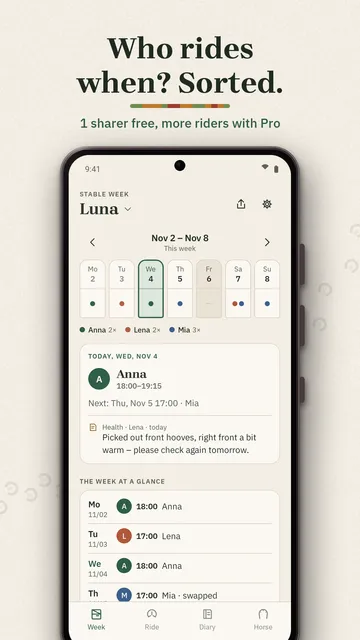
- Stable week: each day in the colour of the person riding; swaps, extra days and cancellations in a few taps, and the week can be shared as an image or text.
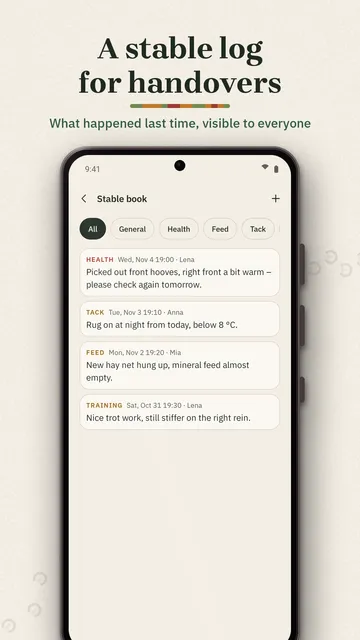
- Stable log for handovers with categories such as health, tack, feed and training, and the full history.
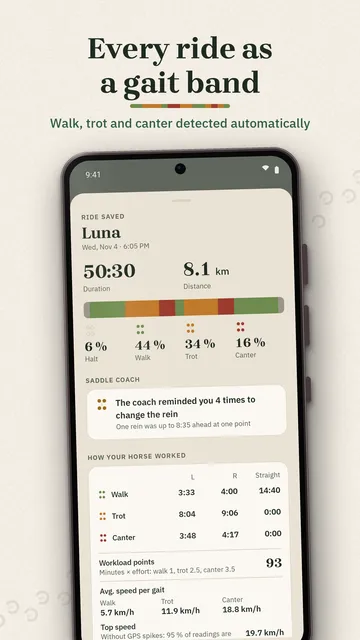
- Ride tracking: walk, trot and canter are detected from the motion sensor and GPS and shown as a gait band with shares, duration and distance; wrongly detected sections can be corrected.
- Horse record with due dates such as farrier, vaccination and worming, with reminders (3 free, unlimited with Pro).
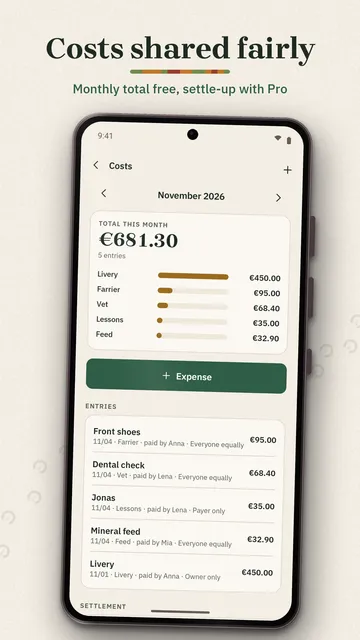
- Cost log with a monthly total for free; with Pro a settle-up showing who owes whom.
- With Pro: a saddle coach that reminds you by voice or vibration to change the rein in trot or canter, minutes per rein and gait, a calendar file (ICS), a horse health PDF and GPX and CSV export.
What the app cannot do
Trabeo is not a marketplace: it does not help you find a horse share, it helps you run one. Gait detection is an estimate from phone sensors and may need manual correction in an indoor arena without GPS; the app gives no veterinary advice and is available for Android only.
Price
The plan, stable log, ride tracking, costs and 1 horse are free; Trabeo Pro is a monthly or yearly subscription, in the US US$9.99 a month or US$59.99 a year, and you can cancel any time in Google Play. The free version shows ads; Pro is ad-free. We build this app ourselves; on Google Play it is listed under the developer name InfinityAkhi.
Screenshots
Related calculators on ToolboxDay
Frequently asked questions
Who pays the vet in a horse share?
Usually the owner, because the sharer’s contribution covers regular upkeep. If you want a different split, for example for injuries that happen during the sharer’s ride, write it into the agreement.
How do I work out a fair contribution?
Add up the regular monthly costs, multiply by the sharer’s riding days per week and divide by seven. Treat the result as a reasoned upper figure and agree the actual amount together.
Do both of us need Trabeo?
Not to stay in sync: the week can be shared as an image or text to any group chat. Anyone who wants to open the stable file and add entries needs Trabeo, but no subscription.
Does Trabeo detect gaits in an indoor arena?
Without GPS it tries to detect the gait from the rhythm of the motion sensor. If a section is wrong, you fix it with one tap after the ride.
Sources
More guides
- Pet vaccine tracker: keep your dog’s and cat’s shots on schedule
- Fishing journal: what to log after every catch
- Recurring payments: find them, add them up, cancel what you don’t use
- Lean angle motorcycle guide: how it is measured and what the number means
- Constellation finder: how to find constellations in the night sky
- Oil change reminder: how to time it and never miss it
- Our apps