Golf handicap calculator: index, course handicap and playing handicap
A golf handicap calculator follows the World Handicap System’s Rules of Handicapping: every round becomes a score differential, and your Handicap Index is the average of the lowest 8 of your most recent 20 differentials. From that index, the slope, course rating and par of a tee give you your course handicap for that course.
Updated:
How do you calculate a score differential?
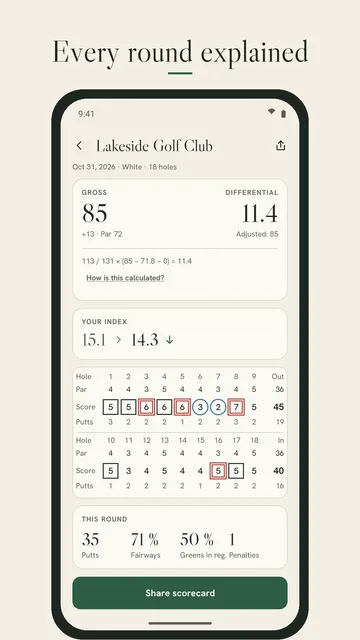
The score differential measures how good a round was relative to the difficulty of the course. Rule 5.1a: (113 ÷ Slope Rating) × (adjusted gross score − Course Rating − PCC adjustment). PCC adjusts for abnormal playing conditions, ranges from −1.0 to +3.0 and is usually 0.
Example: adjusted gross score 85, Course Rating 71.8, Slope 131, PCC 0. The maths: 113 ÷ 131 × (85 − 71.8) = 0.8626 × 13.2 = 11.39, which rounds to 11.4. Differentials are rounded to the nearest tenth, with .5 rounded up.
What is net double bogey?
Before a round counts, every hole is capped. Once you have a Handicap Index, the maximum hole score is net double bogey: par of the hole + 2 + any handicap strokes you receive on that hole (Rule 3.1b). The rules point out this equals the lowest score on a hole that earns zero Stableford points.
For the first scores, before an index exists, the cap is par + 5 (Rule 3.1a). Example: a par 4 where you receive one stroke and took 9. The score that counts is 4 + 2 + 1 = 7.
How many rounds do you need for a handicap index?
With 20 scores, the index is the average of the lowest 8 of the most recent 20 differentials, rounded to the nearest tenth (Rule 5.2b). With fewer scores a separate table applies (Rule 5.2a), and 3 scores are enough for a first index. The maximum Handicap Index is 54.0.
| Scores | Calculation | Adjustment |
|---|---|---|
| 3 | lowest 1 | −2.0 |
| 4 | lowest 1 | −1.0 |
| 5 | lowest 1 | 0 |
| 6 | average of lowest 2 | −1.0 |
| 7 or 8 | average of lowest 2 | 0 |
| 9 to 11 | average of lowest 3 | 0 |
| 12 to 14 | average of lowest 4 | 0 |
| 15 or 16 | average of lowest 5 | 0 |
| 17 or 18 | average of lowest 6 | 0 |
| 19 | average of lowest 7 | 0 |
| 20 | average of lowest 8 | 0 |
How do you calculate your course handicap?
Your course handicap is the number of strokes you receive on a given course from a given set of tees. Rule 6.1a: Handicap Index × (Slope Rating ÷ 113) + (Course Rating − par), rounded to the nearest whole number.
Example: index 14.3, Slope 131, Course Rating 71.8, par 72. The maths: 14.3 × 131 ÷ 113 = 16.58, plus 71.8 − 72 = −0.2, gives 16.38, so a course handicap of 16. For competitions, the format’s handicap allowance turns this into a playing handicap; the rules recommend 95% for individual stroke play and individual Stableford. Rule 6.2a applies the allowance to the unrounded course handicap to avoid double rounding: 16.38 × 0.95 = 15.56, so a playing handicap of 16. Rounding to 16 first and then taking 95% would give 15.2 and therefore 15.
Why does your index rise only slowly after bad rounds?
The system limits upward movement against your Low Handicap Index, the lowest index in the last 12 months. If a newly calculated index is more than 3.0 strokes above it, the part above 3.0 counts only at 50% (soft cap); after that, it cannot rise more than 5.0 strokes above the Low Handicap Index (hard cap). There is no limit on how far it can fall.
An exceptional score, a differential at least 7.0 strokes better than your index, lowers the index further: by 1.0 for 7.0 to 9.9 and by 2.0 for 10.0 or more (Rule 5.9). Since the 2024 revision a 9-hole differential is combined with your expected score over 9 holes to create an 18-hole differential; fewer than 9 holes played do not count.

How Pinvo works as a golf handicap calculator
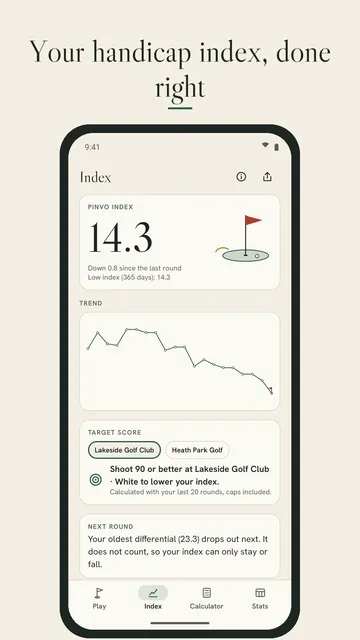
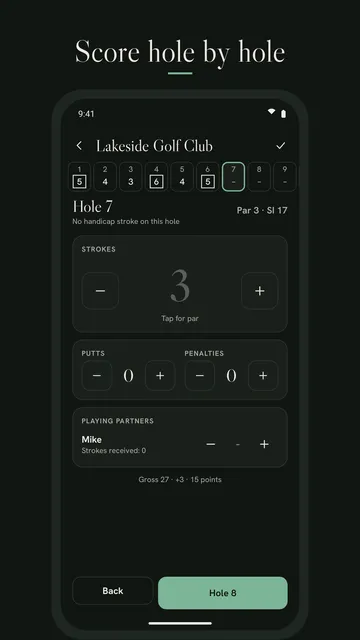
Pinvo is a golf handicap calculator and hole-by-hole scorecard for Android. It follows the published Rules of Handicapping, shows the formula behind every number and keeps your rounds on your phone, with no account.
- Course handicap and playing handicap for any tee, free and without limits: enter index, course rating, slope and par.
- Live scorecard that caps every hole at net double bogey automatically and counts Stableford points.
- Your handicap index from your first 3 to 5 rounds for free; 9-hole rounds count too.
- Up to 2 courses with several tees for free, plus backup and restore of all data in one file.
- With Pro: the full 20-round index with soft cap, hard cap and the exceptional score rule, index history, a target score per course, stats on putts, fairways and greens in regulation, up to 3 playing partners and CSV export.
What the app cannot do
Pinvo calculates an estimate following the published rules and is not an official Handicap Index: only your golf association issues one, and Pinvo has no connection to any association. It does not know your association’s Playing Conditions Calculation (PCC), and it is available for Android only.
Price
The calculator, scorecard and index from your first rounds are free; Pinvo Pro is a monthly or yearly subscription or a one-time “Pro for life” purchase (in the US US$2.99, US$19.99 or US$44.99), and subscriptions can be cancelled any time. We build this app ourselves; on Google Play it is listed under the developer name InfinityAkhi.
Screenshots
Related calculators on ToolboxDay
Frequently asked questions
Is Pinvo’s index my official handicap?
No. Pinvo follows the published Rules of Handicapping, but only your golf association issues an official Handicap Index. Use Pinvo to understand and check how your index is built.
How many rounds do I need for a first handicap index?
Rule 5.2a needs 3 scores. With 3 rounds your lowest differential counts minus 2.0, with 4 minus 1.0, and with 5 without adjustment.
Do 9-hole rounds count?
Yes. Since the 2024 WHS revision a 9-hole differential is combined with an expected score for the 9 holes not played to give an 18-hole differential. Rounds of fewer than 9 holes do not count.
What do course rating and slope mean?
Course rating is what a scratch golfer is expected to score from that tee in normal conditions. Slope shows how much harder the course plays for golfers who are not scratch; 113 is the standard value. Both are on the scorecard or available from the club.
Sources
More guides
- Vertical jump measure: how to test your jump height at home
- Hybrid training plan: how to prepare for a fitness race
- Recurring payments: find them, add them up, cancel what you don’t use
- Lean angle motorcycle guide: how it is measured and what the number means
- Constellation finder: how to find constellations in the night sky
- Oil change reminder: how to time it and never miss it
- Our apps