ECG interpretation step by step: one routine for every tracing
Reliable ECG interpretation follows the same order on every tracing: rate, rhythm, axis, intervals (PR, QRS, QT) and finally morphology of the ST segment and T wave. If you read each ECG in this order and measure instead of estimating, you miss fewer findings and recognise patterns faster over time.
Updated:
How do you read an ECG step by step?
Start with the paper, not with diseases. A standard ECG runs at 25 mm/s and 10 mm/mV: one small box (1 mm) is 40 ms, one large box (5 mm) is 200 ms, and 10 mm of height equals 1 mV. Once this conversion is automatic, you can measure any interval and amplitude yourself.
Then follow a fixed routine. Textbooks offer versions with six or seven steps; they mainly differ in whether axis and intervals are grouped. Which version you choose matters less than using the same one every time and never skipping a step, even when one finding jumps out.
- Rate: with a regular rhythm, 300 divided by the number of large boxes between two R waves. With an irregular rhythm, count the QRS complexes on a 10-second strip and multiply by 6.
- Rhythm: is there a P wave before every QRS and a QRS after every P wave? Are the intervals regular? An upright P wave in lead II points to sinus rhythm.
- Axis: look at lead I and aVF. Both mainly positive means a normal axis; I positive and aVF negative suggests left axis deviation, I negative and aVF positive suggests right axis deviation.
- Intervals: measure PR, QRS width and QT and compare them with normal values.
- Morphology: check Q waves, R-wave progression, ST segment and T wave in all twelve leads, always comparing neighbouring leads.
What are the normal ECG values to know?
The values below are common adult reference ranges from textbooks and guidelines. Cut-offs vary slightly by source, age and sex, and the QT interval is always judged after correction for heart rate (QTc).
| Measure | Reference value | In small boxes |
|---|---|---|
| Resting heart rate | 60–100 /min | – |
| PR interval | 120–200 ms | 3–5 |
| QRS width | under 120 ms | under 3 |
| QTc | roughly under 450 ms (men) or 460 ms (women) | – |
| P wave | up to about 120 ms wide | up to 3 |
How do you calculate heart rate from an ECG?
The large-box method is quickest: with 4 large boxes between two R waves, the rate is 300 divided by 4 = 75 per minute. Small boxes are more precise: 1500 divided by the number of small boxes, so 20 small boxes also give 75 per minute.
With atrial fibrillation or other irregular rhythms neither method is reliable. Count all QRS complexes on a 10-second strip instead: 13 complexes times 6 is about 78 per minute.
- 1 large box between R waves: 300 /min
- 2 large boxes: 150 /min
- 3 large boxes: 100 /min
- 4 large boxes: 75 /min
- 5 large boxes: 60 /min
- 6 large boxes: 50 /min
How can I practice ECG interpretation?
Active reading beats looking at pictures. Commit to a full interpretation before you check the answer, and measure the intervals with calipers or a ruler instead of guessing. Mix normal tracings with abnormal ones so you learn what normal variation looks like.
A practical plan is to learn one group of findings per week, such as AV blocks, then bundle branch blocks, then atrial arrhythmias, then ischaemia, while still running the complete routine on every case. Short daily sessions with spaced repetition stick better than long weekend sessions.
- Week 1: paper speed, boxes, waves and leads.
- Week 2: rate and rhythm on many regular and irregular strips.
- Week 3: axis and intervals until you no longer need to look anything up.
- From week 4: one group of findings at a time, always with the full routine.
What mistakes do beginners make in ECG interpretation?
The most common mistake is spot diagnosis: an obvious ST elevation draws all the attention, and the AV block or long QT next to it is missed. A fixed routine protects you from exactly that. The second classic is estimating instead of measuring, especially for PR and QRS, where 20 to 40 ms make the difference.
- Not checking the calibration pulse and paper speed (50 mm/s makes every interval look half as long).
- Missing swapped electrodes: a negative P wave and negative QRS in lead I are a warning sign.
- Judging ST changes in one lead instead of in contiguous leads.
- Ignoring an old ECG for comparison when one is available.
- Practising only on textbook images: real tracings have artefacts and baseline wander, so practise on as many different strips as you can.

How Kurvio helps with ECG interpretation
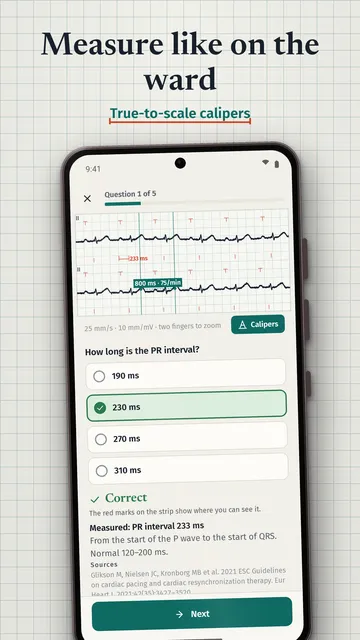
Kurvio is an Android learning app with to-scale ECG tracings (25 mm/s, 10 mm/mV) for nursing, EMS, medical school and medical assistants. You interpret a case, then a red pen marks the decisive spot on the tracing, and every criterion cites its source from guidelines and textbooks inside the app.
- ECG quiz with complete cases; all tracings come from the app’s own model, not from patient data.
- A measuring ruler to measure PR, QRS and QT yourself, like on paper.
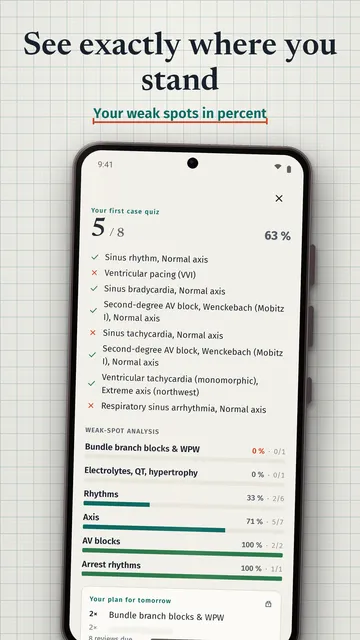
- Weak-spot analysis after the quiz that points you to matching lessons and cases.
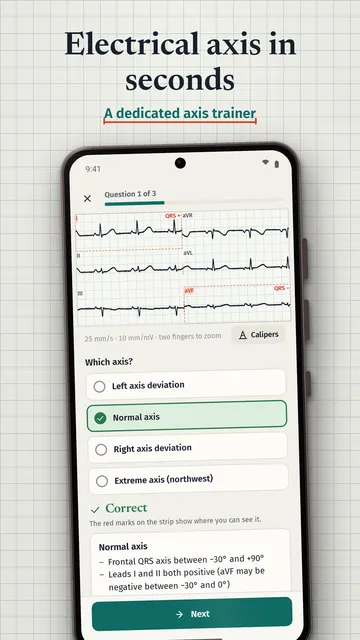
- Short practice drills: identify the rhythm, find the axis, match 12 leads, measure.
- A reading scheme with rate, rhythm, axis, intervals and morphology for every case.
- With Pro: a daily plan with spaced repetition, about 70 cases, around 30 lessons, the complete atlas and a timed exam mode with 20 questions.
What the app cannot do
Kurvio is a learning aid, not a diagnosis and not a medical device: it does not analyse your own ECGs and does not replace clinical judgment or training. All practice tracings are synthetic, and the app is available for Android only.
Price
The first case quiz with 8 cases, the case of the day, 5 drills per day, the basics lessons, 6 atlas entries, the reading scheme and the ruler are free; Kurvio Pro costs 9.99 USD/EUR per month or 59.99 USD/EUR per year and can be cancelled anytime in Google Play. We build this app ourselves; on Google Play it is listed under the developer name InfinityAkhi.
Screenshots
Frequently asked questions
How long does it take to learn ECG interpretation?
With regular practice, the basics of rate, rhythm, axis and intervals usually settle within a few weeks. Confidence with blocks and ischaemia takes much longer and, above all, many different tracings.
Can I learn ECG interpretation for free?
Yes, with open ECG libraries and reference sites online plus textbooks from a library. What matters is that you actively interpret and measure instead of just looking at images.
Can a learning app interpret a real patient ECG?
No. A learning app is for practice. Interpreting a patient’s ECG belongs with a clinician and the clinical context.
Who is Kurvio for?
For people in training, such as nursing and EMS students, medical students and medical assistants, who want to practise ECG interpretation in a structured way.
Sources
More guides
- 4-7-8 Breathing: How the Technique Works and What It Can Do
- Neck exercises for a stiff neck: a gentle 3-minute routine
- Recurring payments: find them, add them up, cancel what you don’t use
- Lean angle motorcycle guide: how it is measured and what the number means
- Constellation finder: how to find constellations in the night sky
- Oil change reminder: how to time it and never miss it
- Our apps