Cross stitch pattern maker guide: from photo to chart, size and floss
A cross stitch pattern maker turns a photo into a grid of squares and gives each square the closest floss colour; one square is one cross. Three choices decide the result: the width in stitches, which together with the fabric count sets the finished size, the number of colours, and a photo with clear contrast.
Updated:
Which photos make a good cross stitch pattern?
A good photo has a clear subject, even light and a strong difference between subject and background. Faces, pets and buildings work well when they fill most of the frame. Fine details such as single hairs, small text or distant people disappear in the grid, because one cross is the smallest unit.
- Crop tightly first; everything you do not need costs stitches.
- Drop busy backgrounds or leave them unstitched; it saves a lot of work.
- Avoid backlight and hard shadows, which turn into large dark areas.
- For portraits, watch the eyes: they need enough stitches or they look empty.
How big will my cross stitch be? Stitch count and Aida
The finished size depends on the stitch count and the fabric count. Aida is named after the number of squares per inch: 14-count Aida has 14 squares per inch. The maths is simply stitches ÷ count = inches (multiply by 2.54 for centimetres).
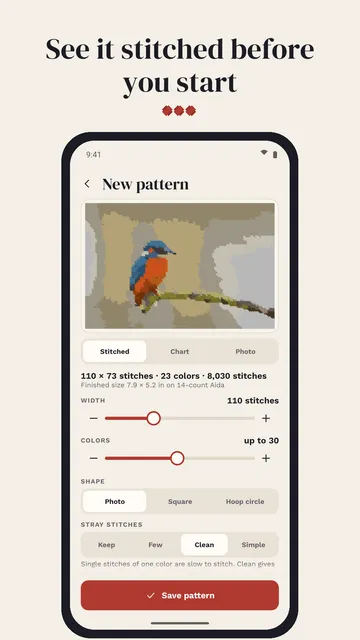
A pattern of 110 × 73 stitches comes out at about 7.9 × 5.2 in (20.0 × 13.2 cm) on 14-count Aida. Add a few inches of margin on every side so you can hoop the fabric and frame it later.
| Aida count | Width (in) | Width (cm) |
|---|---|---|
| 11 | about 10.0 | about 25.4 |
| 14 | about 7.9 | about 20.0 |
| 16 | about 6.9 | about 17.5 |
| 18 | about 6.1 | about 15.5 |
How many colours should a photo cross stitch pattern have?
More colours mean smoother blends but also more thread changes and more floss to buy. Simple motifs often need only 8 to 15 colours; photos with skin tones or fur usually use 20 to 30. Beyond that, the difference between neighbouring floss colours becomes hard to see.
A common problem with photo patterns is confetti stitches: a single cross of one colour in the middle of another area. Each one means threading, one cross, and finishing off. Good charts merge such strays into neighbouring colours without changing the picture.
How much floss do I need for a cross stitch?
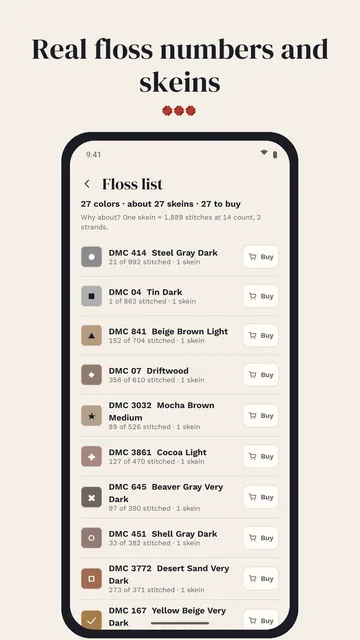
Stranded embroidery floss has six strands, and cross stitch on 14-count Aida usually uses two. How far one skein goes depends on fabric count, number of strands and how you stitch. So count the stitches per colour and divide by a per-skein value; Ixa, for example, assumes about 1,889 crosses per skein on 14-count Aida with two strands.
By that estimate, a colour with 992 stitches needs one skein. For colours just over a full skein, buy an extra skein from the same dye lot, since dye lots can differ slightly.
- Read the stitches per colour from the floss key.
- Divide by the per-skein value and round up.
- Plan one skein of reserve for large areas of a single colour.
- Tick off the floss you already have and put the rest on your shopping list.
Reading a chart and tracking your progress
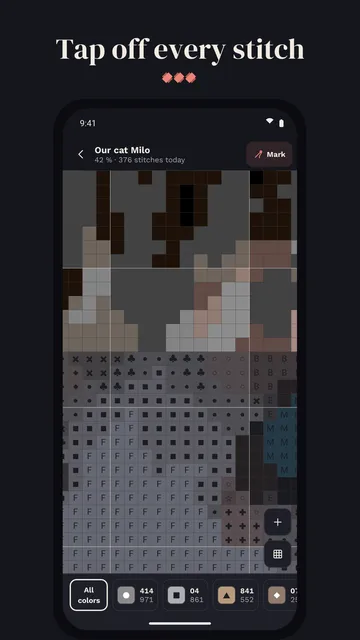
Counted charts are grids of squares with symbols, and each symbol stands for one floss colour. Every tenth line is usually bolder so you can count faster. Start in the centre of fabric and chart; you find the centre of the fabric by folding it in half twice.
- Work colour by colour within an area rather than row by row; it saves thread changes.
- Tick off or mark finished squares on the chart.
- Lay all top stitches in the same direction so the surface looks even.

How Ixa works as a cross stitch pattern maker
Ixa is an Android app that turns a photo into a counted chart with floss numbers, a floss list and a stitch tracker, right on your phone. According to its store listing, the pattern is made on the device with no account and no photo upload. Floss numbers follow the common DMC numbering; Ixa is not affiliated with the trademark owner.
- Width from 20 to 300 stitches, 2 to 60 colours, shape like the photo, square or round for a hoop.
- Clean up stray stitches in 4 steps, leave the background empty or keep soft blends.
- Preview as stitched, as chart or next to the photo, with the finished size on Aida.
- Floss picked from about 489 colours of the common DMC numbering, a floss list with skeins and the formula explained, mark floss as “have” or “buy”.
- Stitch tracker: tap a stitch, drag along a row, long press for a 10 × 10 block; highlight one colour and undo any step.
- With Pro: up to 300 × 300 stitches and 60 colours, unlimited patterns, a PDF chart with floss key, and progress with a finish date.
What the app cannot do
Ixa picks colours by calculation; how good a pattern looks depends heavily on the photo, and fine details get lost in the grid. The free version covers one pattern up to 50 × 50 stitches and 12 colours, the PDF chart needs Pro, and the app is Android only.
Price
The preview and one pattern up to 50 × 50 stitches are free; Ixa Pro is a subscription at $6.99 a month or $29.99 a year, or a one-time purchase at $49.99 in the US (Google Play shows your local price). We build this app ourselves; on Google Play it is listed under the developer name InfinityAkhi.
Screenshots
Related calculators on ToolboxDay
Frequently asked questions
Which Aida count is good for beginners?
14-count Aida is the most common: the squares are easy to see and two strands of floss cover them evenly. Finer fabrics such as 18-count make the picture smaller and more detailed but are harder to count.
How many stitches wide should a photo pattern be?
For recognisable faces or pets, roughly 80 to 150 stitches wide is a good range. Smaller patterns finish faster but lose detail.
Can I use the chart for needlepoint?
Yes, a counted chart also works for needlepoint on canvas; work out the finished size with the canvas mesh count instead.
Does Ixa upload my photos?
According to the store listing, no: the pattern is made on the phone and your photos stay on the device.
Sources
More guides
- Row counter for knitting: how to keep track of every row
- Recurring payments: find them, add them up, cancel what you don’t use
- Lean angle motorcycle guide: how it is measured and what the number means
- Constellation finder: how to find constellations in the night sky
- Oil change reminder: how to time it and never miss it
- Garden layout planner: how to lay out a raised bed step by step
- Our apps