Cat logic puzzle: rules and tips for placing every cat
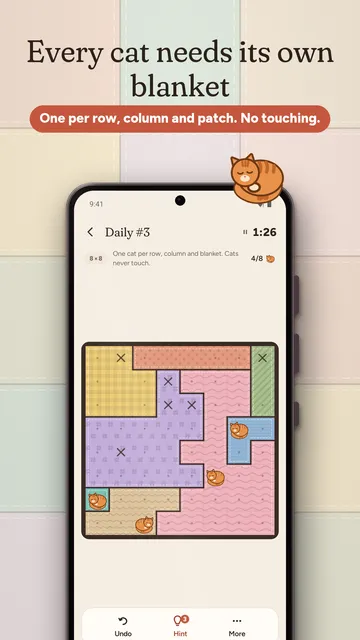
A cat logic puzzle asks you to place cats on a grid of coloured regions so that every row, every column and every region holds exactly one cat, and no two cats touch, not even diagonally. Good puzzles have exactly one solution that you can reach by logic alone, without guessing.
Updated:
How does a cat logic puzzle work? The rules
The board is a square of N × N cells divided into N connected coloured regions. An 8 × 8 grid therefore has 8 rows, 8 columns, 8 regions and exactly 8 cats in the solution. It shares only the core idea with number sudoku: every unit gets exactly one of something, but there are no numbers.
Puzzle fans know the genre as Star Battle with one star per unit; here the stars are sleeping cats, which is why it is often called cat sudoku. The four rules:
- Exactly one cat in every row.
- Exactly one cat in every column.
- Exactly one cat in every coloured region.
- No two cats may touch, horizontally, vertically or diagonally.
Cat sudoku tips: which solving techniques help?
Almost every puzzle falls to a handful of techniques. The key habit: work mostly with crosses. Mark every cell that cannot hold a cat, and only place a cat when it is forced.
- Start with the smallest regions: a region of 2 or 3 cells often gives a lot away at once.
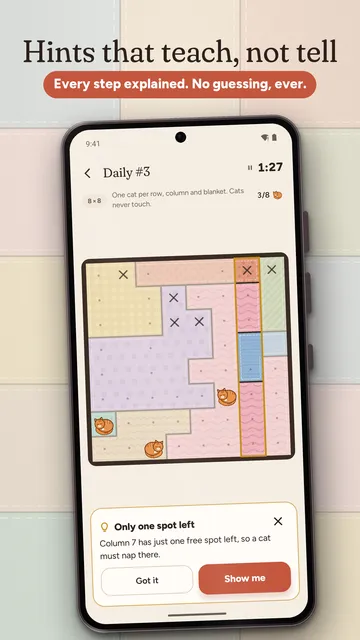
- After every cat, re-check all units for “only one spot left”.
- The last technique also works for three regions in three rows or columns (the pigeonhole principle).
| Technique | When it applies | What follows |
|---|---|---|
| Only one spot left | A row, column or region has a single free cell | The cat goes there |
| Clear the neighbours | A cat is placed | Cross all 8 surrounding cells, plus its row, column and region |
| Region in one line | All free cells of a region lie in the same row (or column) | The rest of that row (column) stays empty |
| Touches them all | A cell borders every free cell of a region | A cat there would leave the region no room, so cross it |
| Two regions, two rows | Two regions together fit entirely inside two rows | Those rows are taken; every other cell in them stays empty |
Worked example: how one region locks a whole row
Say the pink region has three free cells left after your first crosses, and all three are in row 4. You do not know yet exactly where the pink cat sits, but it is certainly in row 4. Since each row holds only one cat, every other cell of row 4 can no longer hold a cat.
Those crosses usually unlock more: perhaps the blue region now only has cells in column 7, which in turn locks column 7. The logic chains through the grid until somewhere only one spot is left again.
Why should a logic puzzle have exactly one solution?
Only with a unique solution can every step be justified. If a puzzle had two solutions, you would eventually reach a point where you had to guess. Careful puzzle generators therefore check every grid with a solver that counts solutions and throw out anything with more than one.
A second check asks whether a person can find the solution without trial and error. That also sets the difficulty: easy puzzles need only “only one spot left” and “clear the neighbours”, hard ones need region groups across several rows.
How hard is a 10×10 cat puzzle, and how do you approach it?
Grid size roughly sets the difficulty: a 6 × 6 is done in a few minutes, a 10 × 10 often takes much longer because regions are larger and more tangled.
- Look at edges and corners first: small regions along the border have few options.
- Look for pairs of rows or columns that together contain exactly two regions.
- Do not guess: when stuck, look for a cell that borders every free cell of one region.
- At the end, count every row, column and region once more.
How Napquilt plays as a cat logic puzzle
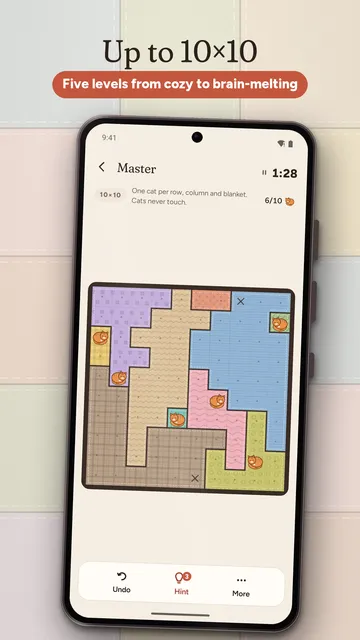
Napquilt is a cat logic puzzle for Android with sleeping cats on a patchwork quilt. Every puzzle comes from its own generator that checks for exactly one solution, and every one can be solved without guessing.
- Hints that teach: a hint shows where to look and explains the step in one sentence; “Show me” fills it in only if you want. Mistakes are pointed out, everything else stays.
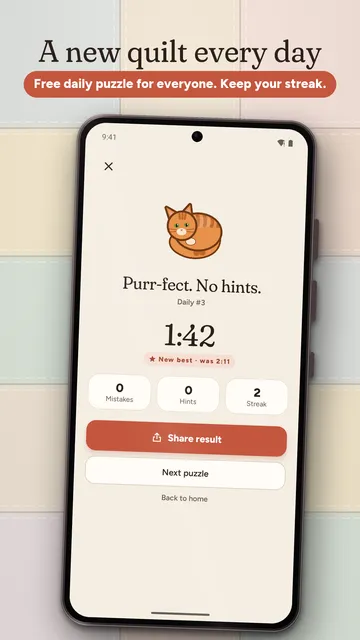
- The same daily puzzle for everyone, free; the week gets harder, from 6 × 6 on Monday to 10 × 10 on Sunday. Keep your streak and share your time without the solution.
- Five levels: Easy 6 × 6, Medium 7 × 7, Hard 8 × 8, Expert 9 × 9, Master 10 × 10.
- Stitched fabric patterns tell regions apart even when colours are hard to see; light and dark mode, undo and drag to cross out many cells.
- Progress stays on your phone and a backup file moves it to a new one; solving works without an internet connection.
What the app cannot do
Napquilt only has the one-cat-per-unit variant; grids with two stars per row like large Star Battle puzzles are not included. Free practice puzzles are limited to three a day in Easy and Medium, and the app is Android only.
Price
Free: the daily puzzle, 3 practice puzzles a day in Easy and Medium, one try of each harder level and 3 hints a day; Napquilt Pro costs $3.79 a month or $23.99 a year in the US, and the yearly plan currently starts with a 7-day free trial. We build this app ourselves; on Google Play it is listed under the developer name InfinityAkhi.
Get it on Google Play: Napquilt
Screenshots
Related calculators on ToolboxDay
Frequently asked questions
Is a cat logic puzzle the same as sudoku?
No. Both ask for exactly one per row and column, but the cat puzzle uses coloured regions instead of numbers and adds the rule that cats may not touch.
Do you ever have to guess?
Not in a well-made puzzle. If there is only one solution and the generator has checked that it can be reached by logic, there is always a justified next step.
Can cats touch diagonally?
No, not even at the corners. Every cat blocks all eight surrounding cells.
Is the daily puzzle the same for everyone?
Yes, in Napquilt everyone solves the same daily quilt. The share card shows the quilt and your time, never the solution.
Sources
More guides
- Dumpling squishy: what to know before you squish, buy or collect
- Desktop pet for phone: a tiny pet that lives on your screen
- Recurring payments: find them, add them up, cancel what you don’t use
- Lean angle motorcycle guide: how it is measured and what the number means
- Constellation finder: how to find constellations in the night sky
- Oil change reminder: how to time it and never miss it
- Our apps