Car engine sounds explained: firing order, rpm and exhaust
Car engine sounds come mainly from the combustion pulses that travel into the exhaust at the firing frequency: rpm and cylinder count set the pitch, while firing order and crankshaft set the rhythm. Whether an engine burbles, screams or drones depends on how evenly those pulses arrive and how the headers, muffler and intake shape them.
Updated:
How are engine sounds made?
A four-stroke engine fires each cylinder once every two crankshaft revolutions. Every firing sends a pressure pulse into the exhaust. The number of pulses per second gives the basic note, the firing frequency: rpm ÷ 60 × cylinders ÷ 2.
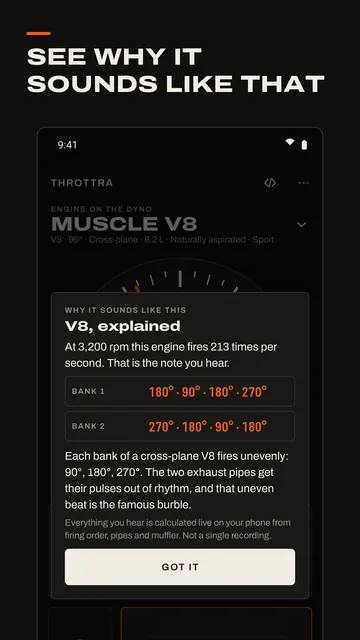
So a V8 at 3,200 rpm fires 3,200 ÷ 60 × 4 ≈ 213 times a second, which you hear as a tone of about 213 hertz. More cylinders or more rpm means a higher note. That is why a V12 sounds higher and smoother than a four-cylinder at the same rpm.
| Engine | Firings per revolution | Firing frequency |
|---|---|---|
| 1 cylinder | 0.5 | 25 Hz |
| 4 cylinders | 2 | 100 Hz |
| 6 cylinders | 3 | 150 Hz |
| 8 cylinders | 4 | 200 Hz |
| 12 cylinders | 6 | 300 Hz |
| 16 cylinders | 8 | 400 Hz |
Why does a V8 burble?
Most American V8s use a crankshaft with throws set 90 degrees apart (crossplane). That balances the engine well, but the two banks do not fire alternately: one bank gets its firings at intervals of 90°, 180°, 270°, 180° and so on. Each exhaust side therefore hears uneven pulses, and that creates the classic burble.
A flat-plane V8, as found in many sports cars, fires the banks strictly in turn. Each bank gets even pulses, so the sound is brighter and more of a scream, rather like two four-cylinders.
- Crossplane V8: uneven per bank, deep burble.
- Flat-plane V8: even per bank, brighter, screaming note.
- Boxer with unequal-length headers: pulses arrive offset in time, hence the well-known rumble of some boxer engines.
- Rotary (Wankel): one firing per rotor per eccentric-shaft turn, so a two-rotor at 6,000 rpm sits at 200 Hz like a four-cylinder, but often sounds raw and buzzy because of its open exhaust ports.
Which car engine noises mean trouble?
Not every unusual sound means damage, but some are clear warning signs. Note when the noise happens: cold or warm, at idle or under load, tied to rpm or to road speed. These details help a mechanic more than any imitation of the sound.
The table shows typical matches. It is no substitute for a diagnosis: with knocking under load, a deep metallic hammering or warning lights, stop loading the engine and have it checked.
| Noise | when | possible cause |
|---|---|---|
| Squeal | cold start, when steering | slipping serpentine belt |
| Short rattle | right after a cold start | timing chain or hydraulic lifters |
| Pinging, knocking | accelerating under load | engine knock, wrong fuel |
| Deep hammering | rises with rpm | bearing damage, have it checked now |
| Hissing | engine warm | vacuum or coolant leak |
| Droning, roaring | on the throttle | exhaust leak |
Why do electric cars make fake engine sounds?
Electric cars are almost silent at low speed and hard for pedestrians to hear. In the EU, newly registered electric and hybrid cars therefore need an acoustic vehicle alerting system (AVAS) that plays a driving sound up to about 20 km/h; the US has a similar rule for low speeds. Above that, tyre and wind noise drown out the drivetrain anyway.
Some makers also offer sound packages that create an engine note inside the cabin. That is a matter of taste: it makes throttle and speed audible but has nothing to do with the actual motor.
What changes exhaust sound the most?
After cylinder count and firing order, the exhaust system decides. Long, equal-length headers line the pulses up, collectors merge them, and mufflers mainly absorb high frequencies. A straight pipe lets more overtones through and sounds louder and sharper. Turbochargers soften the exhaust note because the turbine absorbs part of each pulse; in return you get whistle and blow-off sounds.
- For road cars: exhaust modifications may need to be approved and can affect whether the car is road-legal.

How Throttra lets you hear car engine sounds
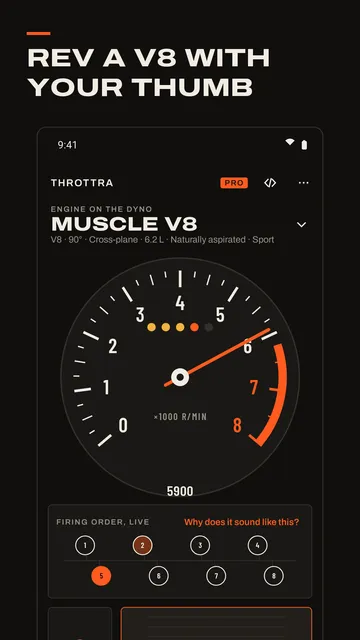
Throttra is a car engine sound simulator for Android that calculates every note live on your phone from the firing order, the pipes and the muffler, with no recordings or loops. You hold a gas pad, rev the engine and hear the effects described above directly.
- One big gas pad to rev; shifts, limiter, pops and bangs react to the rpm.
- Ready-made engines such as muscle V8, flat-plane V8, boxer, rotary, big twin and V12.
- “Why does it sound like this?” shows the firing order live and explains how many times per second the engine is firing.
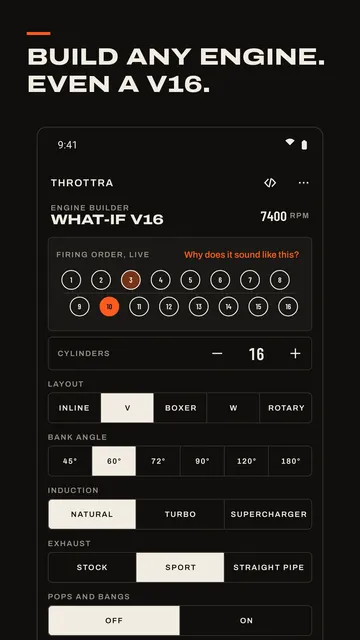
- Engine builder: 1 to 16 cylinders, inline, V, boxer, W or rotary, turbo or supercharger, exhaust from stock to straight pipe; every engine gets a shareable code.
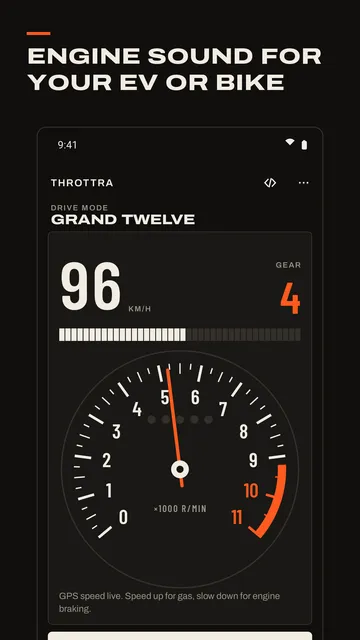
- GPS drive mode turns your real speed into engine sound with an automatic gearbox, plus a simulate mode; 9:16 clips with sound and rev counter.
What the app cannot do
Throttra is a sound simulation for fun, not a diagnostic tool for real engines. The free version plays 4 engines without limit and all others as a 20-second preview, with drive mode for 3 minutes a day; never touch the phone while driving or riding. The app is for Android only.
Price
Free with ads; Throttra Pro (ad-free, all 13 engines, unlimited engine builder, drive mode without a time limit) costs $5.99 a month, $34.99 a year or $89.99 once in the US. We build this app ourselves; on Google Play it is listed under the developer name InfinityAkhi.
Get it on Google Play: Throttra
Screenshots
Related calculators on ToolboxDay
Frequently asked questions
How do I calculate an engine’s firing frequency?
For a four-stroke: rpm divided by 60, times the number of cylinders, divided by 2. A six-cylinder at 4,000 rpm comes to about 200 Hz.
Why does a V8 sound different from two four-cylinders?
Because of the crankshaft. With the common crossplane design the banks fire unevenly, which creates the burble. A flat-plane V8, on the other hand, really does sound similar to two four-cylinders.
Is a knocking engine noise dangerous?
Knocking under load or a deep hammering that rises with rpm can point to serious damage. Stop loading the engine and have it checked by a mechanic.
Can I use Throttra in the car or on a bike?
GPS drive mode turns your real speed into engine sound. Set everything up before you set off, never touch the phone while moving and keep the volume low enough to hear traffic.
Sources
More guides
- 0 to 60 GPS timer on your phone: how to get times you can trust
- Lean angle motorcycle guide: how it is measured and what the number means
- Recurring payments: find them, add them up, cancel what you don’t use
- Constellation finder: how to find constellations in the night sky
- Oil change reminder: how to time it and never miss it
- Garden layout planner: how to lay out a raised bed step by step
- Our apps