Aim trainer and reaction time: what to practise and how to measure it
An aim trainer combines a reaction time test with accuracy: you hit targets as quickly as you can, and misses cost time. For simple visual reactions, young adults average around 190 milliseconds in the lab, but phones and screens add their own delay, so only compare results from the same device.
Updated:
What is a good reaction time?
For simple reactions, a known stimulus and a fixed response, research puts the average for college-age people at about 190 ms to a light and about 160 ms to a sound. Online and phone tests usually show higher numbers because the display and input device add delay.
So compare results only on the same device and the same test. An average over several attempts tells you more than a single best time, which may be luck.
| Measured time | What it means |
|---|---|
| under 100 ms | Hardly possible: usually a guess, a false start in sport |
| 150–200 ms | Very fast |
| 200–250 ms | Typical good range |
| 250–350 ms | Average including device delay |
| over 350 ms | Tired, distracted or a slow device chain |
How do aim trainers improve your aim?
An aim trainer drills two things at once: getting to the target fast and actually hitting it. If misses carry no penalty, wild tapping wins, which is exactly the habit you don’t want in a game. A time penalty for each miss keeps speed and accuracy in balance.
Short, focused sessions work better than long grinding. Your hand and eyes learn the movement, but fatigue quickly makes you sloppy and teaches the wrong pattern.
- Warm up with three to five attempts that don’t count.
- Then play a fixed set, for example five rounds, and note the average and hit rate.
- Practise at a similar time of day; sleep, caffeine and fatigue change results more than training does.
- Watch consistency, not just your best: a small spread means you react reliably under pressure.
- Compare after two or three weeks rather than after every attempt.
Why does a reaction under 100 ms count as a false start?
In track and field, World Athletics treats a start as false if the athlete moves within 0.1 seconds of the gun. The limit is based on tests showing that the brain cannot hear and process the start signal faster; anyone quicker was guessing.
Good reaction tests use the same rule and show the stimulus after a random wait, so you cannot predict the moment. Otherwise the test measures your sense of rhythm, not your reaction.
How accurate is a reaction time test on a phone?
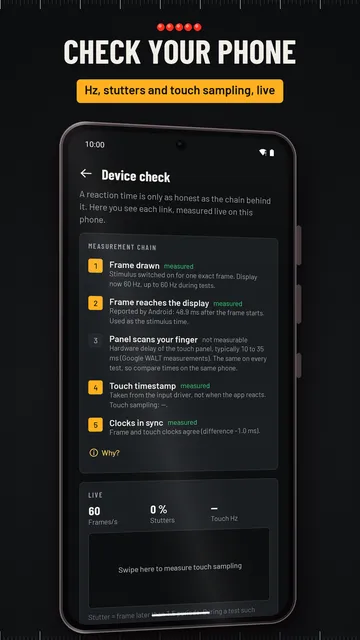
Time passes between the app ordering a colour change and that change actually appearing: a display only shows new content at fixed frame intervals. At 60 Hz a new frame arrives every 16.7 ms, at 120 Hz every 8.3 ms. On top of that, touchscreen sampling adds anywhere from a few to more than 30 ms depending on the phone.
A fair test therefore uses the moment the frame was really shown as its start and the hardware timestamp of the touch as its end. Tests that simply compare the system clock at command and tap easily show 20 to 50 ms too much.
- Switch your phone to its highest refresh rate (for example 120 Hz).
- Turn off battery saver, which often caps the frame rate.
- Always compare on the same device and the same test.
Which types of reaction test are there?
Besides the simple colour switch there are racing-style start lights, target tests for aim, sequence tasks and peripheral vision tests, where you look at the centre and react to something at the edge. Each measures something different, so mixing them gives a fuller picture of your reflexes.

How Zerotick helps you train
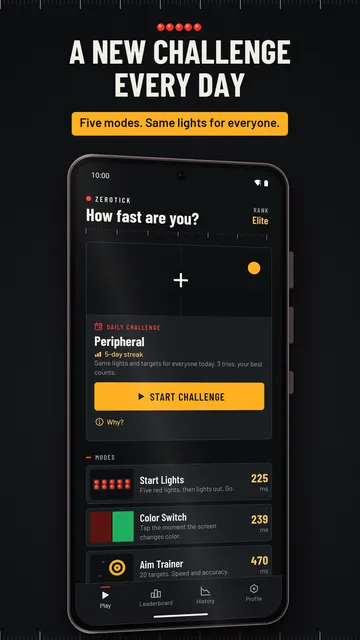
Zerotick is an aim trainer and reaction time test for Android with five modes. It takes the stimulus time from the moment the frame was really drawn (on Android 13 and newer, the display time reported by the system) and stamps your tap with the hardware timestamp of the touch event.
- Start Lights with five red lamps; a tap under 100 ms counts as a false start.
- Color Switch as a pure reflex test; with Pro also Aim Trainer (20 targets, each miss costs 150 ms), Sequence 1 to 9 and Peripheral.
- “Measurement chain” device check showing your refresh rate, dropped frames and touch sampling.
- A daily challenge that is the same for everyone, with 3 attempts a day and a streak.
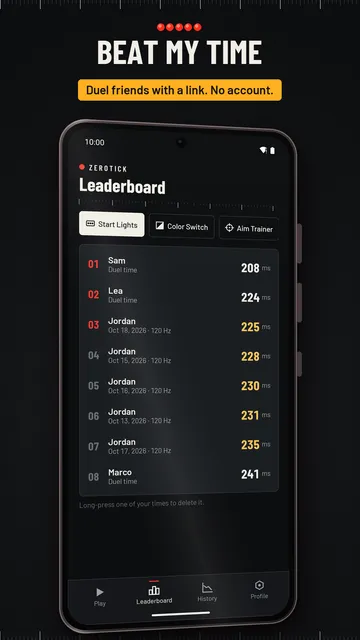
- “Beat my time” duel link: both players get the same sequence, no account needed.
- Ranks from Rookie to Pole, 12 badges and a local leaderboard with your duel opponents; color blind mode.
What the app cannot do
Zerotick can only measure what the phone delivers: the touch panel’s own delay cannot be removed, so results are only comparable on the same device. The leaderboard is local to your phone.
Price
Free with ads: Start Lights, Color Switch, the leaderboard, the daily challenge and one duel a day; Zerotick Pro removes the ads, unlocks the other modes and costs $2.79 a month or $18.99 a year in the US (€2.99 / €19.99 in Germany). We build this app ourselves; on Google Play it is listed under the developer name InfinityAkhi.
Get it on Google Play: Zerotick
Screenshots
Related calculators on ToolboxDay
Frequently asked questions
What is a good reaction time on a phone?
In the lab, young adults average around 190 ms to a light. On a phone, 200 to 250 ms is good, because the display and touchscreen add time.
Why is my result different on every phone?
Refresh rate and touch sampling vary from device to device, so only compare results from the same phone.
Does an aim trainer on a phone help with PC or console games?
It trains attention, timing and the habit of accuracy over speed. The exact hand movement differs from a mouse or controller, so treat it as a supplement.
Do I need an account for duels?
No. You send a link, both of you play the same sequence and the times are compared.
Sources
More guides
- 0 to 60 GPS timer on your phone: how to get times you can trust
- Vertical jump measure: how to test your jump height at home
- Recurring payments: find them, add them up, cancel what you don’t use
- Lean angle motorcycle guide: how it is measured and what the number means
- Constellation finder: how to find constellations in the night sky
- Oil change reminder: how to time it and never miss it
- Our apps