Mimic voice game: how to play, score and copy sounds better
In a mimic voice game one player plays a sound, such as an animal, a machine or a short tune, and everyone tries to copy it as closely as possible with their own voice. The closest copy wins the round; scoring is fairest when pitch line, rhythm, tone and length are judged separately.
Updated:
How do you play a mimic voice game?
The idea is simple and needs nothing but a sound to play. One person runs the game and the others copy in turn. It is funniest when everyone hears the same original but nobody hears the other attempts first.
- Pick a sound and play it once for everyone.
- Take turns copying it: one attempt each.
- Score it: vote by feel or award points by fixed criteria.
- Keep score; after, say, five rounds the highest total wins.
- At the end, have the funniest attempt performed again.
How do you judge a good copy?
Your ear tracks several things at once. Most important is the pitch line: does the sound rise or fall, and where? Then comes rhythm, the pattern of loud, quiet and pauses, followed by tone colour (timbre) and overall length.
Voting by feel often rewards the loudest or funniest player. For fair rounds, score each criterion from 0 to 25 points and add them up.
| Criterion | What to listen for | Points |
|---|---|---|
| Pitch line | Does it rise and fall in the same places? | 0–25 |
| Rhythm | Do syllables, pauses and accents match? | 0–25 |
| Tone | Bright or dull, rough or smooth like the original? | 0–25 |
| Length | About as long, not cut short? | 0–25 |
What sounds are good for a mimic game?
Mixed difficulty keeps a round exciting: a few easy sounds to start, then some where everybody fails and laughs. Animals and everyday noises work for all ages; machines and beatbox challenge older players.
- Easy: cow, dog, doorbell, cuckoo clock, duck.
- Medium: rooster, donkey, motorbike starting, dripping tap, coffee machine.
- Hard: whale, dial-up modem, diving seagull, sci-fi laser.
- For musical players: three notes of a tune, a beatbox bar, a ringtone.
Tips to copy sounds better with your voice
Listen for the shape first, then the sound. Many attempts fail because they get the tone right but take the pitch the wrong way. Hum the contour quietly before you go loud.
Onomatopoeia helps you remember: turning a sound into syllables, like “cock-a-doodle-doo”, makes the rhythm easier to hit. For tone, play with your mouth shape and nose: a round mouth sounds dull, a wide one bright.
- Take a deep breath first so the length doesn’t run out.
- Quiet and precise beats loud and roughly right.
- Copy the pauses too: silence is part of the rhythm.
Variations for kids and big groups
For kids, score more gently: getting the rough shape right already earns plenty of points. Big groups love the chain, a telephone game with sounds: the first player makes up a sound, the next copies it, and so on. At the end, compare how far the last sound has drifted from the first.

How Copycaw runs your mimic voice game
Copycaw is a party game for Android where one phone goes around the room: a crow plays a sound, you copy it, and the app scores on the phone how close you got.
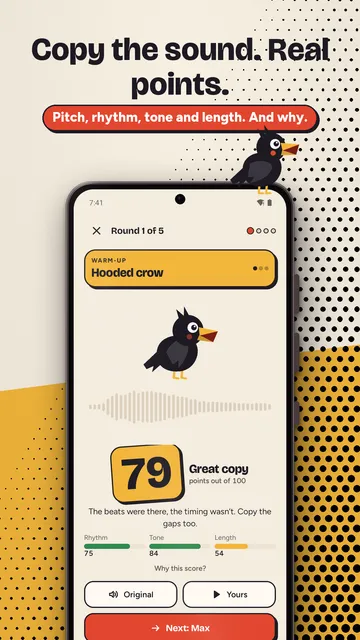
- Scoring in four parts, pitch line, rhythm, tone and length, plus one sentence on why; the same recording always gets the same points and silence gets zero.
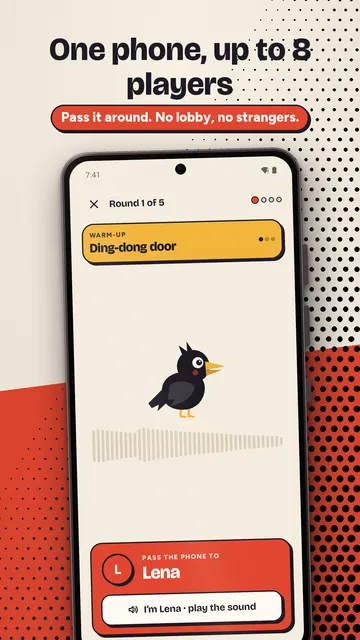
- One phone for 2 to 8 players, a leaderboard after every round and a podium at the end.
- 138 sounds in 8 packs, including real, freely licensed animal and human recordings; the free Warm-up pack has 15 sounds.
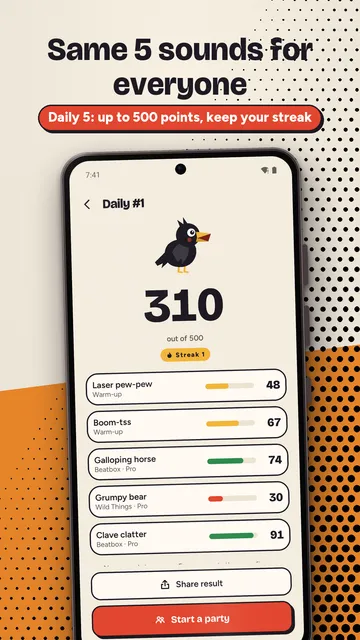
- Daily 5: five sounds every day, the same for everyone, up to 500 points.
- Copycat Chain, the telephone game with sounds.
- Gentle, normal or strict scoring, plus a result card and a 9:16 video clip to share.
What the app cannot do
Copycaw compares your recording with the original by fixed measures and cannot judge whether an attempt was funny. Noisy rooms affect the score, and the free version allows one party a day with up to 4 players and 5 rounds.
Price
Free to play with one party a day, Daily 5, one chain a day and your first clip; Copycaw Pro costs $4.69 a month or $27.99 a year in the US (€4.99 / €29.99 in Germany) and can be cancelled anytime in Google Play. The free version shows ads; Pro is ad-free. We build this app ourselves; on Google Play it is listed under the developer name InfinityAkhi.
Get it on Google Play: Copycaw
Screenshots
Related calculators on ToolboxDay
Frequently asked questions
How many players do you need?
Two is enough, four or more is more fun. Copycaw supports up to 8 players on one phone.
Can I play a mimic game alone?
Yes, with daily challenges. Copycaw has Daily 5 with five sounds every day.
Is it suitable for kids?
Yes, with gentle scoring and sounds that fit their age. Copycaw has a “gentle” scoring level for this.
Does Copycaw need an account?
No. You only enter names for the round if you like.
Sources
More guides
- Spy word game: how to play and how to catch the imposter
- Vocal range finder: how to find your range and voice type
- Recurring payments: find them, add them up, cancel what you don’t use
- Lean angle motorcycle guide: how it is measured and what the number means
- Constellation finder: how to find constellations in the night sky
- Oil change reminder: how to time it and never miss it
- Our apps