IBS tracker: how to keep and read a food and symptom diary
An IBS tracker records over a few weeks what you ate, which symptoms came when and how strong they were, and what your bowel movements looked like. From that you can spot patterns to discuss with your doctor or a dietitian. A diary does not diagnose anything, but it makes your observations comparable.
Updated:
What should you track in an IBS food diary?
A useful diary has four columns: food and drink, symptoms, bowel movements and daily factors. Log as soon as you can and include the time, because with gut symptoms the gap after a meal matters. Portion size matters too: a small serving often behaves differently from a large one.
Guidelines and health services recommend a food and symptom diary to observe possible triggers before changing your diet. Don’t cut foods out for good on your own; talk it through first.
- Food: time, foods, rough amount (small, normal, large), drinks.
- Symptoms: type (bloating, pain, cramps, urgency, nausea), strength from 1 to 10, start and duration.
- Bowel movement: time, Bristol type, urgency, anything unusual such as blood.
- Daily factors: stress, sleep, exercise, period, medication.
What is the Bristol stool chart?
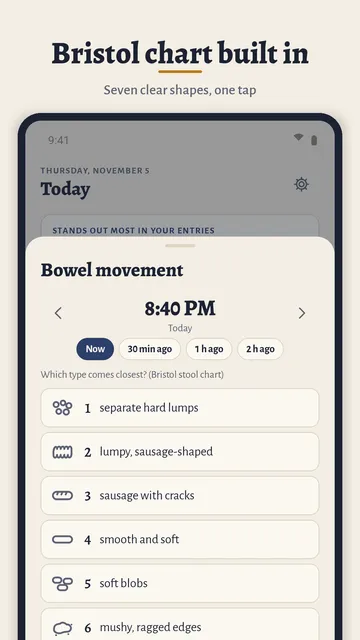
The Bristol chart sorts stool into seven types by appearance. It was described in 1997 as a simple guide to gut transit time: hard types suggest slower transit, loose types faster transit. Because everyone uses the same seven pictures, your notes are easy to understand at the clinic.
| Type | Appearance | Rough meaning |
|---|---|---|
| 1 | separate hard lumps | slower transit |
| 2 | sausage-shaped but lumpy | slower transit |
| 3 | sausage-shaped with cracks | typical range |
| 4 | smooth and soft | typical range |
| 5 | soft blobs with clear edges | faster transit |
| 6 | mushy, ragged edges | faster transit |
| 7 | watery, no solid pieces | fast transit |
How long should you keep an IBS diary?
Plan for at least two, better four weeks. Symptoms vary from day to day, and one bad evening tells you little. Only once a food has come up several times can you compare how you felt afterwards with meals without it.
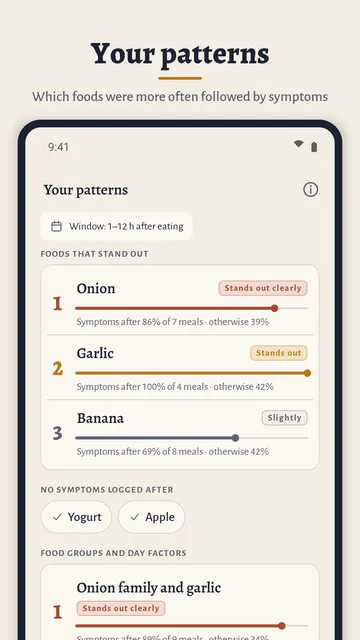
You can do the maths yourself: count the meals that contained a food and how often symptoms followed within a fixed time window. Do the same for all other meals. Example: 6 of 7 meals with onion (86%) versus 9 of 23 meals without (39%). That gap stands out, but with small numbers chance plays a part; a pattern is not proof.
| Meals | Count | Followed by symptoms | Share |
|---|---|---|---|
| with onion | 7 | 6 | 86% |
| without onion | 23 | 9 | 39% |
When should you see a doctor about bowel symptoms?
IBS is diagnosed by a doctor after other causes have been ruled out. That is why certain warning signs always belong at the clinic, not just in your diary.
- Blood in your stool or black stool.
- Unintended weight loss.
- Symptoms that wake you at night, or a fever.
- New, persistent changes in bowel habits, especially in older age.
- A family history of bowel cancer or inflammatory bowel disease.

How Fenlo works as your IBS tracker
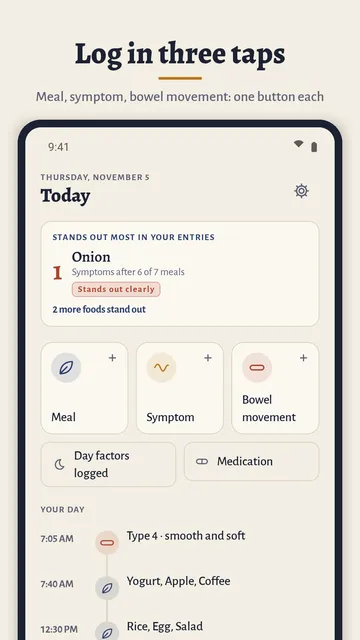
Fenlo is a diary for food, symptoms and bowel movements that calculates frequencies from your own entries: after which foods did symptoms follow more often than usual within your chosen time window? The calculation runs on your phone, and “Why?” shows the meals behind every number.
- Log in a few taps: food with portion size, symptom type and strength, bowel movement on the Bristol chart, plus daily factors and medication; “Same as last time” for frequent meals.
- Foods that stand out, with percentages with and without the food; small numbers are pulled toward your own average.
- Unlimited logging, your top food that stands out and a 7-day journal are free.
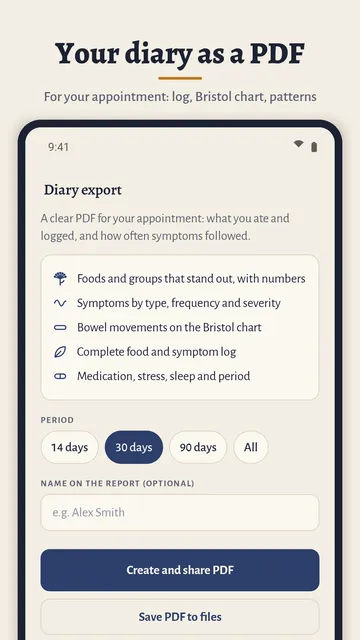
- With Pro: the full list, the “eaten together” combination check, large vs. small portions, groups and daily factors, comparing two periods, a PDF for your appointment and the full history.
- No account; your health entries stay on the device.
What the app cannot do
Fenlo is not a medical device, does not diagnose and contains no FODMAP content tables; it only shows frequencies in your own entries. It is Android only and is currently not offered on Google Play in the EU, EEA, Switzerland or the UK.
Price
Logging, your top food that stands out and a 7-day journal are free; Pro costs $7.99 a month or $49.99 a year in the US. The free version shows ads; Pro is ad-free. We build this app ourselves; on Google Play it is listed under the developer name InfinityAkhi.
Screenshots
Frequently asked questions
Is there a simple template for an IBS tracker?
A table with columns for time, food and amount, symptoms with strength, Bristol type and daily factors is enough. What matters is logging the same way every day.
How soon after eating do IBS symptoms start?
It varies a lot, from shortly after a meal to many hours later. That is why it helps to pick a fixed window, for example 1 to 12 hours, and assess every meal the same way.
Does a pattern in my diary prove a food intolerance?
No. A pattern is a lead for the conversation with your doctor, nothing more. Whether and how to cut foods out is best decided with a professional.
Is an IBS food diary useful on a low FODMAP diet?
Yes, especially then. A low FODMAP diet should be guided by a dietitian, and the diary shows how you react to foods in each phase.
Sources
More guides
- GLP-1 injection tracker: doses, sites and side effects in one log
- Supplement tracker: how to take supplements consistently
- Daily protein tracker: how to count protein the easy way
- Recurring payments: find them, add them up, cancel what you don’t use
- Lean angle motorcycle guide: how it is measured and what the number means
- Constellation finder: how to find constellations in the night sky
- Our apps