Baby nap tracker guide: wake windows, naps and sleep by age
A baby nap tracker helps you see your baby’s own pattern: when naps start, how long they last and how long your baby stays awake in between. Experts recommend 12 to 16 hours of total sleep per day from 4 to 12 months, while wake windows grow from under an hour in newborns to several hours by the first birthday.
Updated:
How much should a baby sleep?
There is no official hourly recommendation for newborns, because their needs vary so much; in the first weeks babies sleep in short stretches spread across day and night. From 4 months, the American Academy of Sleep Medicine gives ranges that the American Academy of Pediatrics supports. They cover the total of night sleep and naps.
| Age | Sleep per 24 h | Source |
|---|---|---|
| 0–3 months | no official range, varies widely | – |
| 4–12 months | 12–16 h | AASM, supported by the AAP |
| 1–2 years | 11–14 h | AASM, supported by the AAP |
| 3–5 years | 10–13 h | AASM, supported by the AAP |
What are wake windows by age?
A wake window is the stretch a baby can comfortably stay awake between two sleeps before becoming overtired. Keeping a baby up well beyond it often makes falling asleep harder, not easier.
Wake windows are rules of thumb from parents and practitioners, not a scientific standard. Use the ranges below as a starting point, then trust your baby’s tired signs and a few days of logging, which show you your baby’s own usual awake time.
| Age | Wake window | Naps per day |
|---|---|---|
| 0–4 weeks | 35–60 min | 4–5 |
| 2–3 months | 60–90 min | 4–5 |
| 4 months | 75–105 min | 3–4 |
| 5–6 months | 2–2.75 h | 2–3 |
| 7–8 months | 2.5–3.25 h | 2–3 |
| 9–12 months | 3–4 h | 2 |
| 15–18 months | 4.5–5.5 h | 1 |
What are the early signs that a baby is tired?
Early tired signs are quieter than crying. If you spot them, you can put your baby down before overtiredness sets in. Every baby shows them a bit differently, so it is worth watching closely for a few days and noting the time.
- Staring into space, turning away from faces and toys
- Rubbing eyes, pulling ears, yawning
- Moving less, or suddenly kicking and flailing more
- Fussing that playing does not settle
- Late sign: hard crying and arching, which usually means the window has already passed
How do you track baby naps?
You only need two times per sleep: when your baby fell asleep and when they woke up. From these you can read nap length, the awake time before each nap and, over a week, the typical rhythm. Paper works, but at 3 am a single tap is easier than writing.
- Log every sleep for at least 5 to 7 days, naps and night.
- Write down the awake time before each nap, not just the nap length.
- Look for the awake time that most often led to an easy nap; that is your baby’s own window.
- Recheck every few weeks, because windows lengthen as your baby grows.
How can babies sleep safely?
Safe sleep matters more than any schedule. Health bodies in the US and the UK give very similar advice to lower the risk of sudden infant death syndrome (SIDS).
- Always place your baby on their back to sleep, for naps too.
- Use a firm, flat sleep surface in your baby’s own crib or cot, ideally in your room for the first months.
- Keep pillows, loose blankets, bumpers and soft toys out of the sleep space.
- Avoid overheating and keep the baby’s environment smoke-free.
- If you are worried about your baby’s sleep, breathing or weight, talk to your pediatrician or health visitor.

How Dozary works as a baby nap tracker
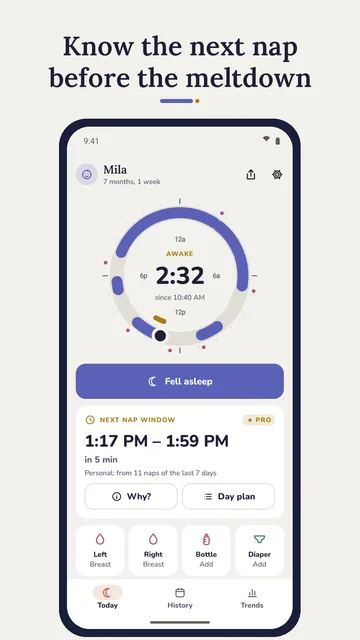
Dozary is a baby nap tracker for Android: tap “Fell asleep” and “Woke up”, and the app works out the next wake window from your baby’s awake times. It starts with common values for the age and, after 3 naps of the same kind, blends in the median of your baby’s own awake times from the last 7 days; “Why?” shows every number behind it.
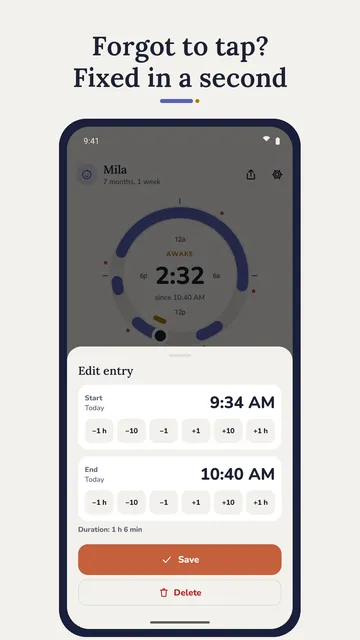
- One big button starts and stops sleep, the screen turns dark at night; if you tapped late, set the time back 5 to 30 minutes or adjust it with plus and minus.
- A quiet notification with the running sleep time and a “Woke up” button, plus a home-screen widget.
- 24-hour sleep clock, breastfeeding timer for left and right, bottle, solids and diapers.
- Today view, history, a week poster to share and a short handover summary for a partner or sitter.
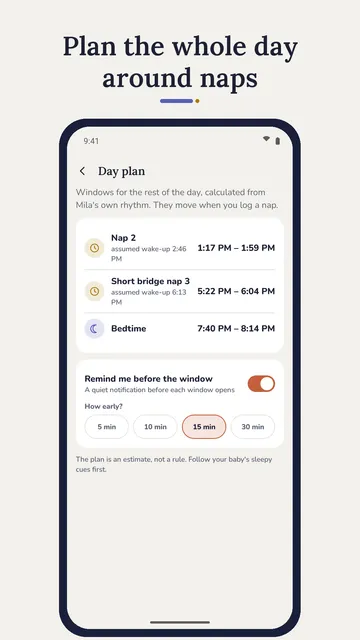
- With Pro: the personal sleep window every day, a day plan with bedtime, a reminder before each window, trends over 7 to 90 days, a PDF report for your pediatrician and a second baby.
What the app cannot do
Dozary is not a medical device and gives no medical advice; its windows are estimates from rules of thumb and your entries, not a schedule your baby has to follow. The app does not measure anything itself, it only works with what you log, and it runs on Android only.
Price
Logging, the sleep clock, 7 days of history, handover, widget and the personal sleep window for the first 3 days are free; Dozary Pro costs 9.99 USD/EUR per month, 59.99 USD/EUR per year or is available as a one-time purchase. We build this app ourselves; on Google Play it is listed under the developer name InfinityAkhi.
Screenshots
Frequently asked questions
Are wake windows backed by science?
No, the usual wake window charts are rules of thumb. The evidence-based recommendations cover total sleep from 4 months and safe sleep. Watching your own baby tells you the most.
How many naps does a 6-month-old take?
Many 6-month-olds take two to three naps a day. The range is wide; what matters is whether your baby seems content during the day and rested at night.
My baby sleeps much less than the chart says. Is that a problem?
Differences are common and usually normal. If your baby feeds well, gains weight and is alert and content when awake, there is usually no cause for concern. If you are unsure, ask your pediatrician.
Do I need an account for Dozary?
No. Your entries stay on your phone and in your own Android backup, and you can save a backup file to move to a new phone.
Sources
More guides
- Snore recorder: how to record and understand your nights
- Fan sounds for sleeping: why they work and how to use them
- 4-7-8 Breathing: How the Technique Works and What It Can Do
- Recurring payments: find them, add them up, cancel what you don’t use
- Lean angle motorcycle guide: how it is measured and what the number means
- Constellation finder: how to find constellations in the night sky
- Our apps