Metal detecting: permission, the law and keeping a find log
Metal detecting is legal in many places, but almost never without permission: you need the landowner’s consent for private land, federal public land in the US is protected by the Archaeological Resources Protection Act, and in England and Wales potential Treasure must be reported within 14 days. Rules differ by country, state and site, so check them before every new location.
Updated:
Do you need permission to go metal detecting?
Yes, in practice always. On private land you need the owner’s permission, and digging on someone else’s land without it can be trespass or criminal damage. On public land the rules come from whoever manages it: a federal agency, the state, the county or the city.
Get permission in writing and keep it with you on the hunt. Write down who gave permission, for which fields, for how long and on what conditions, for example only after harvest, holes filled, finds shown to the owner.
- Landowner or tenant name and contact details.
- The exact area, ideally with the field boundary marked.
- Dates, conditions and how finds are shared or shown.
- Any permit from a public land manager, carried with you.
What are the metal detecting laws in the US?
At federal level, the Archaeological Resources Protection Act (ARPA) protects archaeological resources on public lands and Indian lands. According to the National Park Service, it sets out prohibited activities, criminal and civil penalties for unpermitted work, and the permit requirements a federal land manager must apply before allowing archaeological investigation.
Below that level, metal detecting laws differ by state and by site: state parks, beaches, city parks and county land each have their own rules, and many require a permit or ban detecting outright. Before you go, look up the rules of the agency that manages the land, not a general list online.
What does the Treasure Act mean for detectorists in the UK?
In England and Wales the Treasure Act 1996 applies. The Portable Antiquities Scheme explains that finders are legally required to report potential Treasure within 14 days of discovery, or within 14 days of realising it may be Treasure, and that finds which meet the legal definition can be acquired by museums.
Scotland, Northern Ireland, finds at sea and on the foreshore follow different procedures. The legal definition of Treasure is set out in the Act itself, so check it there rather than relying on rules of thumb.
- Record the exact findspot with GPS before you move on.
- Note depth, target ID and circumstances, and take a photo.
- Do not clean or alter the find; bag and label it separately.
- Report it to the right body for where you found it, within the deadline that applies.
How do you search a field systematically?
Walking at random means some strips get searched three times and others never. Walk parallel lanes instead, spaced slightly narrower than your swing so the lanes overlap a little.
A worked example shows why tracking coverage matters: with a 4 ft (1.2 m) swing over 1.25 miles (2 km) you cover at most about 26,000 sq ft, roughly 0.6 acres. A 10-acre field therefore needs at least 17 such passes, before overlap and detours. Knowing what you have already covered stops you wasting time on the same ground.
- Start at a field edge and mark the end and return of each lane.
- Log trash as well as keepers with the target ID: after a few hunts you see which numbers are mostly trash on your ground.
- Always fill your holes and put the soil on a mat while you dig.

How Trovik helps with metal detecting
Trovik is a find log for detectorists on Android. It draws your hunt as a band as wide as your swing, saves finds with GPS spot and photo, and keeps landowner permissions in one place. No account is needed; finds, photos and tracks stay on your phone.
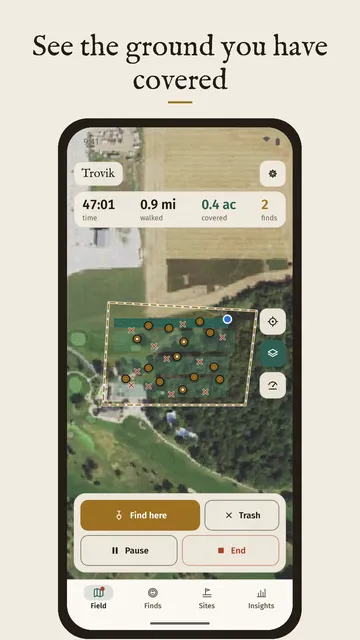
- Live coverage in your swing width with time, distance, area covered and finds; pause or end from the notification, and a warning if GPS drops out.
- “Find here” saves the GPS spot and time, plus type, depth, target ID and a photo; trash is logged with its target ID and never counts against your free finds.
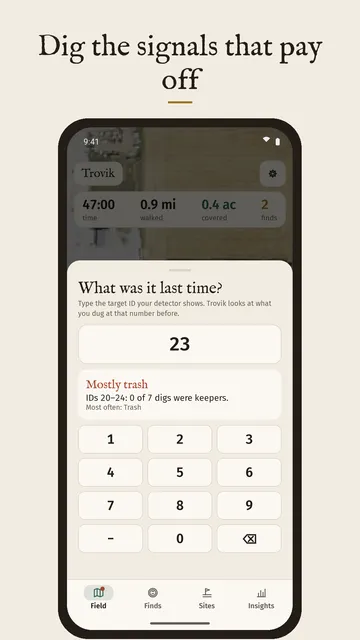
- Target ID check learned from your own digs: worth digging, mixed or mostly trash.
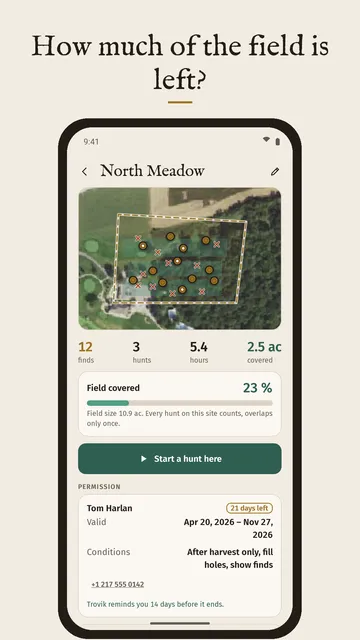
- Sites with landowner, contact, dates and conditions; draw the field boundary and see the share searched across all hunts (share and expiry reminders with Pro).
- Photos are saved without location data; share cards show the find, never the map or the spot.
- With Pro: unlimited finds and sites, earlier hunts on the map, offline maps, a PDF find list with photos for the landowner, and CSV and GPX export.
What the app cannot do
Trovik does not tell you where detecting is allowed and does not replace a permit or the landowner’s permission; reporting finds to the authorities is up to you. Coverage is only as accurate as your phone’s GPS, and the app is available for Android only.
Price
Hunts with live coverage, 25 finds plus unlimited trash and 1 site are free; Trovik Pro is monthly or yearly or a one-time purchase (in the US US$5.99, US$34.99 or US$79.99), and subscriptions can be cancelled any time in Google Play. The free version shows ads; Pro is ad-free. We build this app ourselves; on Google Play it is listed under the developer name InfinityAkhi.
Screenshots
Related calculators on ToolboxDay
Frequently asked questions
Is metal detecting legal on public land in the US?
It depends on who manages the land. Archaeological resources on federal public lands and Indian lands are protected by ARPA, and states, counties and cities set their own rules for parks and beaches. Check with the managing agency before you go.
What do I have to report in England and Wales?
Potential Treasure must be reported within 14 days of discovery or of realising it may be Treasure. The Portable Antiquities Scheme explains the process and who to contact.
Does Trovik show where I am allowed to detect?
No. Trovik is a logbook: it remembers finds, hunts and permissions, but it does not know protected sites or local rules.
Does Trovik work without signal?
Your track and finds are always recorded offline. Maps need a connection unless you save a site’s map for offline use, which is a Pro feature.
Sources
More guides
- Euro coin collection: how to start, what to collect and which coins are rare
- Hunting journal: what to log and how it makes you a better hunter
- Fishing journal: what to log after every catch
- Recurring payments: find them, add them up, cancel what you don’t use
- Lean angle motorcycle guide: how it is measured and what the number means
- Constellation finder: how to find constellations in the night sky
- Our apps